U.S. President Donald Trump departed for Tokyo on Monday, where he is set to meet Japan’s Emperor Naruhito and newly elected Prime Minister Sanae Takaichi as part of an Asia tour aimed at boosting trade, investment, and defence cooperation.
On his longest foreign trip since taking office in January, Trump has already announced a series of agreements with Southeast Asian nations and oversaw the signing of a ceasefire deal between Thailand and Cambodia during his first stop in Malaysia.
His week-long tour will conclude with a summit in South Korea on Thursday with Chinese President Xi Jinping, where the two leaders are expected to seek ways to prevent further escalation in their trade dispute.
Having already secured a $550 billion investment pledge from Japan in exchange for relief from tariffs, Trump is expected to discuss additional economic commitments, as Takaichi looks to strengthen ties through new purchases of U.S. vehicles, soybeans, and energy products.
“Just leaving Malaysia, a great and very vibrant country. Signed major Trade and Rare Earth Deals, and yesterday, most importantly, signed the Peace Treaty between Thailand and Cambodia. NO WAR! Millions of lives saved,” Trump wrote on Truth Social before his departure. “Such an honour to have gotten this done. Now, off to Japan!!!”
Takaichi, who last week became Japan’s first female prime minister, told Trump in their first phone call that reinforcing the Japan-U.S. alliance was her “top priority.”
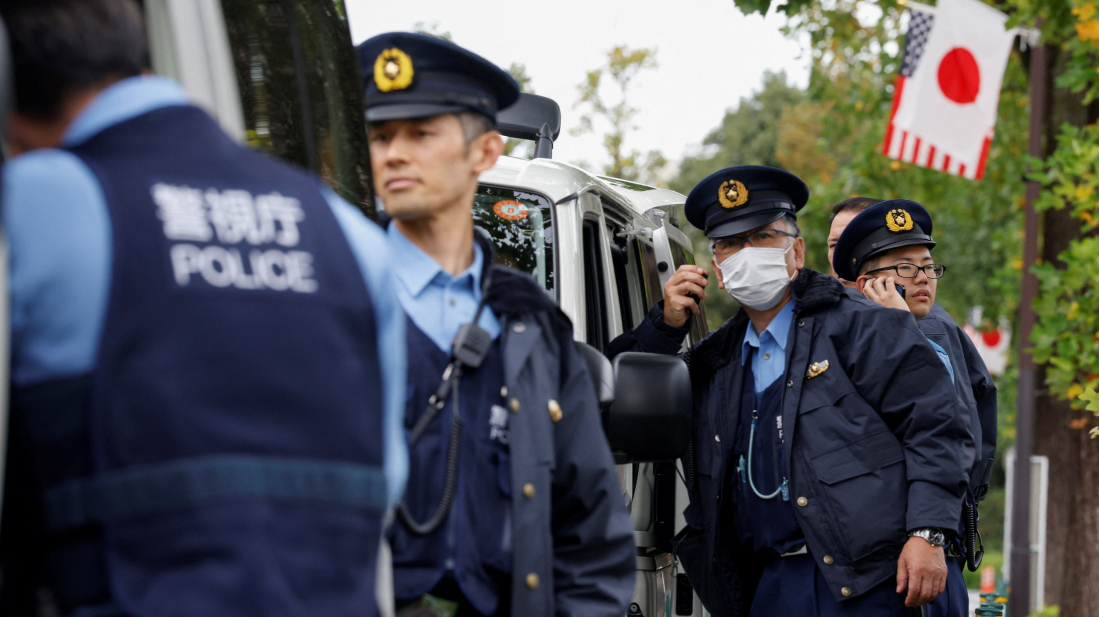
Thousands of police have been deployed across Tokyo for Trump’s visit, following the arrest of a knife-wielding man outside the U.S. Embassy on Friday and the announcement of anti-Trump protests in central Shinjuku.
Commerce Secretary Howard Lutnick and his Japanese counterpart Ryosei Akazawa, who negotiated the July tariff agreement, are scheduled for a working lunch on Monday. Treasury Secretary Scott Bessent and Secretary of State Marco Rubio, both accompanying Trump, will also meet Japanese officials for the first time.
Imperial welcome and high-stakes diplomacy
Trump’s visit begins with a ceremonial meeting with Emperor Naruhito at the Imperial Palace — a symbolic engagement recalling his first encounter with the monarch in 2019. Substantive talks will follow on Tuesday with Prime Minister Takaichi at the Akasaka Palace, the same venue where Trump met former leader Shinzo Abe six years ago.
Takaichi, a close ally of the late Abe, has already earned Trump’s praise. “She’s great… we’re going to be seeing her very soon. She’s very friendly,” he told reporters on Saturday. “She was a very close ally and friend of Prime Minister Abe, and you know he was one of my favourites.”
Beyond economic pledges, Takaichi is expected to reassure Trump that Japan remains committed to enhancing its defence capabilities, having pledged to accelerate the country’s largest military build-up since World War Two.
Japan hosts the largest contingent of U.S. forces overseas, and Trump has previously criticised Tokyo for not contributing enough to its own defence amid growing tensions with China.
“Some kind of statement reaffirming that the two nations stand shoulder-to-shoulder in deterring any attempt to change the regional status quo by force would be valuable,” said Kevin Maher, a Japan expert at NMV Consulting in Washington and former U.S. diplomat.
While Takaichi has vowed to raise defence spending to 2% of GDP, her ability to meet any further U.S. demands may be limited, as her ruling coalition lacks a parliamentary majority.
After Japan, Trump will travel to Gyeongju, South Korea, for talks with President Lee Jae Myung on Wednesday, though officials say a long-discussed trade deal is unlikely to be finalised.
Trump’s final stop will be Thursday’s meeting with President Xi in South Korea. The two sides have recently exchanged tariff hikes and threats over key minerals and technologies. Expectations for a breakthrough remain low, with officials focusing instead on managing disputes and laying the groundwork for Trump’s planned visit to China early next year.











What is your opinion on this topic?
Leave the first comment