Israeli airstrikes kill 11 in Gaza, Palestinian officials report
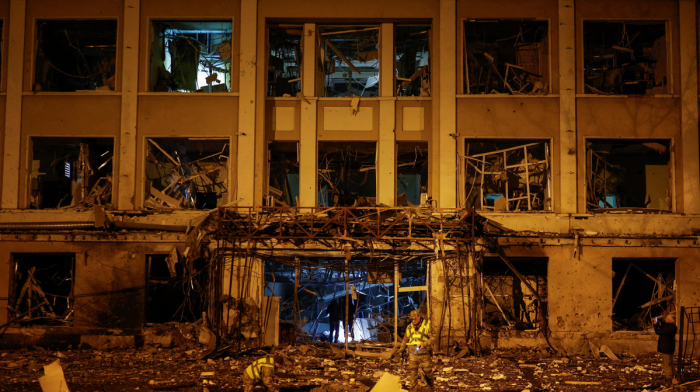
At least eleven Palestinians were killed in Israeli airstrikes in the northern and southern Gaza Strip on Sunday (15 February), Palestinian civil defe...
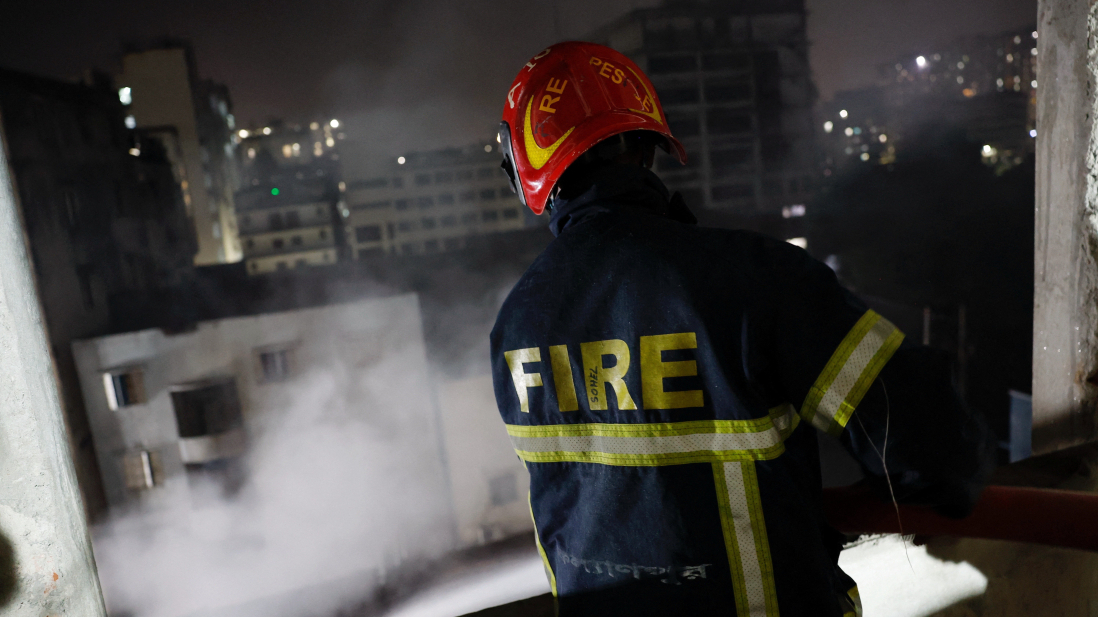
Toxic gas and a locked door that barred access to a roof were responsible for most of the deaths in a devastating fire in a Bangladesh garment factory and an adjoining chemical warehouse, a fire official said on Wednesday.
The tragedy, which killed 16 and critically injured several more, spotlights Bangladesh’s poor record on industrial safety, despite improvements following incidents in 2012 and 2013 that drew global attention to unsafe working conditions.
Thick smoke rose as firefighters cooled the charred remains of a four-storey building in Dhaka, a day after a blaze on its third floor spread through a warehouse filled with plastic and chemicals.
"The victims could not escape because the roof door was locked," said fire service official Talha Bin Jashim. "Most of them died from inhaling toxic gas, rather than burns."
He added, "There’s still smoke because of the stored chemicals, and the toxic fumes are making it difficult to bring the fire under control."
Dozens of relatives waited outside the blackened building, some clutching photographs of those missing. Identification of the bodies, many badly burned, is being carried out at Dhaka Medical College Hospital.
The government has launched an investigation to determine the cause of the fire and identify those responsible for safety lapses.
Many workers in garment factories nearby fell ill from inhaling the smoke that shrouded the site in the capital's Mirpur area.
Authorities later ordered all surrounding factories to shut down temporarily, as a safety measure.
Many small factories and warehouses in Bangladesh operate with little oversight, though conditions in the garment industry have improved since the 2012 Tazreen Fashions fire and the 2013 Rana Plaza collapse that killed more than 1,200 workers.
The world’s second-largest exporter of apparel, Bangladesh supplies major retailers such as Walmart, Gap, and H&M, employing 4 million people and generating about $40 billion a year, or more than a tenth of GDP.
Fires are common in densely populated Dhaka, often caused by faulty wiring, gas leaks or unsafe storage of chemicals.
In 2021, a similar fire at a food processing factory killed 54, while in 2019, a fire in the capital’s old quarter killed at least 70.

U.S. Ambassador to NATO Matthew Whitaker said China has the power to bring an end to Russia’s war in Ukraine, arguing that Beijing is enabling Moscow’s military campaign.
American figure skating star Ilia Malinin endured a dramatic collapse in the men’s free skate on Friday night, falling twice and tumbling out of medal contention at the Milan Cortina Winter Olympics as Kazakhstan’s Mikhail Shaidorov surged to a surprise gold medal.
“Respected and feared globally,” U.S. President Donald Trump told troops at Fort Bragg on Friday (13 February), framing America’s renewed strength against to mounting pressure on Iran amid stalled nuclear talks.
Dubai-based global ports operator DP World said on Friday that its long-serving chairman and chief executive, Sultan Ahmed Bin Sulayem, has stepped down following mounting pressure linked to alleged ties to disgraced financier Jeffrey Epstein.
Speaking at Munich Security Conference, Ukrainian foreign minister Andrii Sybiha calls for decisive steps ahead of expected Geneva talks
U.S. Secretary of State Marco Rubio will begin a two-day visit to Slovakia and Hungary on Sunday (15 February), aimed at strengthening ties with the two Central European nations, whose leaders have maintained close relations with President Donald Trump.
The Munich Security Conference concludes on Sunday (15 February) with discussions centred on Europe’s role in an increasingly unstable global landscape, including security coordination, economic competitiveness and the protection of democratic values.
Start your day informed with AnewZ Morning Brief: here are the top news stories for the 15th of February, covering the latest developments you need to know.
Australia will spend A$3.9bn to build a new shipyard for AUKUS nuclear-powered submarines, Prime Minister Anthony Albanese has announced, marking a major step in the trilateral defence pact with the U.S. and Britain.
Britain, France, Germany, Sweden and the Netherlands said on Saturday (14 February) they are convinced that late Kremlin critic Alexei Navalny was poisoned with a lethal toxin in a Russian penal colony two years ago.
You can download the AnewZ application from Play Store and the App Store.
What is your opinion on this topic?
Leave the first comment