The European Commission will include the International Monetary Fund's (IMF) assessment of Ukraine's financing needs over the next two years in deciding how big the European Union's Reparations Loan to Kyiv should be, EU Economic Commissioner Valdis Dombrovskis said.
The European Union is discussing ways to use frozen Russian assets to underpin a "reparation loan" to Ukraine to bolster its wartime finances as U.S. President Donald Trump is curbing direct U.S.-funded military aid to Kyiv.
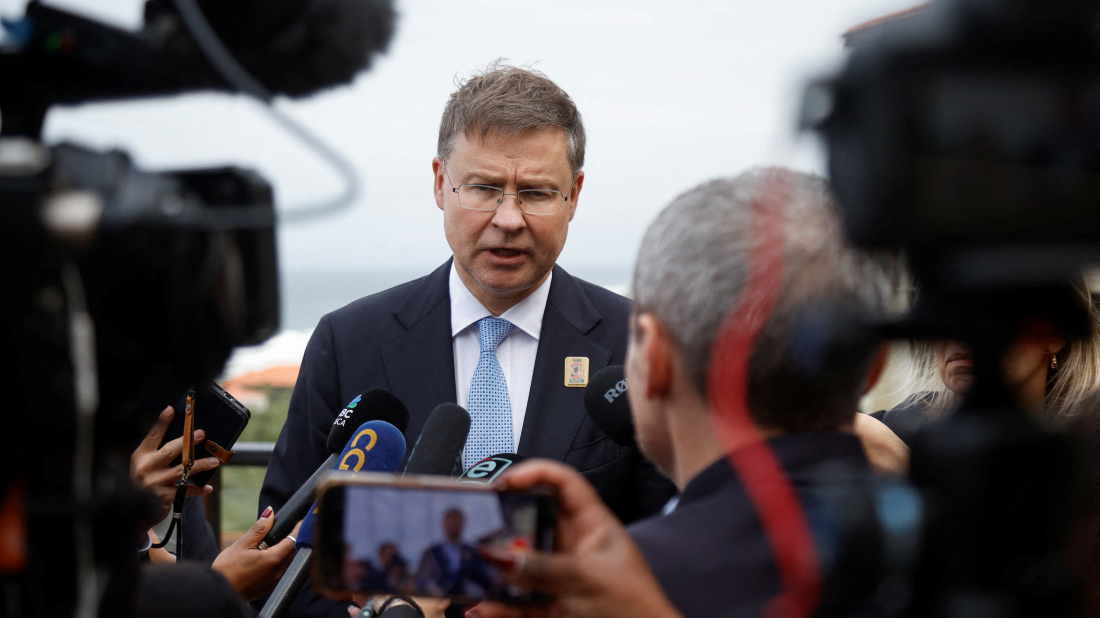
"What the Commission is proposing is a reparations loan, so basically providing a loan to Ukraine by using cash balances of immobilised Russian assets without... touching Russia's claim on those assets," Dombrovskis told reporters on entering talks between EU finance ministers in Copenhagen.
Waiting for IMF assessment on financing needs
"We are right now working on all the modalities, on timings, on volumes. For volumes, it will be important for us also to see the IMF assessment on the finance needs for Ukraine over the next two years, and the IMF is currently finalising this work," he said.
Spanish Finance Minister Carlos Cuerpo said he expected a Commission proposal on the loan in October.
"From the Spanish perspective, we will be supportive," Cuerpo told reporters.
There is around $300 billion in Russian central bank assets immobilised in G7 countries, the bulk of which is in Europe and in particular in Belgium, where the Euroclear securities repository holds €194 billion ($228.24 billion) of the assets.
Of the €194 billion in securities, some €170 billion have now become cash as the securities matured since their freezing when Moscow invaded Ukraine in February 2022. It is not clear how much of that money could be used for the Reparations Loan idea.
Loan risks to be shared among EU governments
Dombrovskis said the model that the Commission was working on would be replicable in all G7 countries that hold some of the frozen Russian assets and that he discussed the idea with G7 finance ministers during a recent call.
The Commission has not disclosed any details of the reparations loan idea apart from the assumption that Ukraine would only repay the loan once it receives reparations from Russia for war damage and that risks associated with the loan would be shared by EU governments.
EU officials involved in the discussions of the idea said it would involve replacing the Russian assets held in Europe with zero-coupon bonds issued by the European Commission. The bonds would have guarantees from either all EU countries or just those willing to participate.
The government guarantees are the politically risky feature because they could be called upon if Russia makes claims once EU sanctions against Moscow are reversed.
Belgian Finance Minister Vincent Van Peteghem said he was sceptical about the idea.
He called the proposal "rather vague" and stressed risks need to be shared among all EU member states.















What is your opinion on this topic?
Leave the first comment