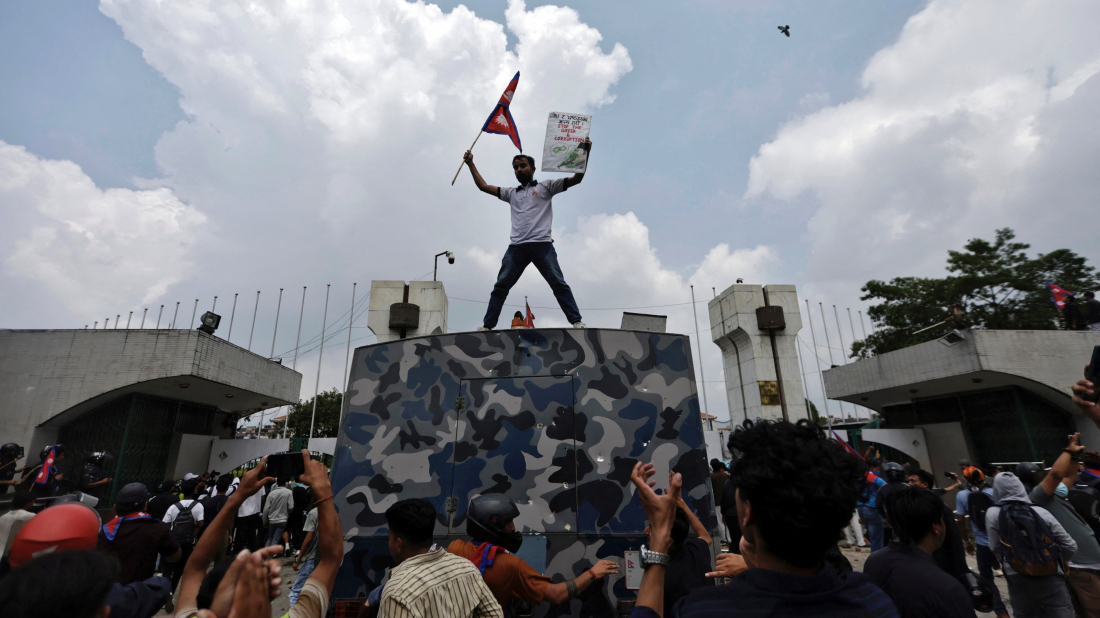
At least 19 people were reported dead and dozens more injured in Nepal’s capital on Monday according to the state media after police fired tear gas and rubber bullets at demonstrators attempting to storm parliament over a social media blackout and corruption.
According to a local official, some protesters forced their way into the parliament compound by breaking through barricades, setting fire to an ambulance, throwing objects at riot police, and ferrying the wounded to hospitals on motorbikes.
“The police have been firing indiscriminately,” one protester told ANI news agency. “They fired bullets which missed me but struck a friend standing behind me, injuring his hand.”
Nepal Television reported more than 100 injuries, though there has been no official confirmation, and Reuters was unable to independently verify the figures. Parliamentary spokesperson Ekram Giri confirmed that some protesters entered the premises but not the main building and were eventually dispersed by police.
Organisers described the demonstrations, which spread to other cities, as a “Gen Z movement”, saying they reflected young people’s frustration with the government and discontent with its policies. “This is the protest of Nepal’s new generation,” another demonstrator told ANI.
The unrest was fuelled by a government decision last week to block access to several social media platforms, including Facebook, citing their failure to register with authorities amidst a crackdown on misuse. Officials argued that fake accounts were being used to spread hate speech, misinformation, fraud, and other online crimes. About 90% of Nepal’s 30 million citizens are internet users.
Police were authorised to use water cannons, batons, and rubber bullets, while the army was deployed in protest areas to reinforce law enforcement, district office spokesperson Muktiram Rijal told Reuters. He said the curfew, extended until 10 p.m. local time (16:15 GMT), covered the Singha Durbar area, home to the prime minister’s office and other government institutions.
Similar demonstrations were reported in Biratnagar, Bharatpur, and Pokhara. Thousands of young people, many in school or university uniforms, marched through Kathmandu carrying the national flag and placards reading “Shut down corruption and not social media”, “Unban social media”, and “Youths against corruption”.
Critics argue corruption is endemic in Nepal, and Prime Minister K.P. Sharma Oli’s government has been accused by opponents of failing to deliver on its pledges.
Nepal’s move to restrict social media access comes as governments worldwide, including those in the United States, European Union, Brazil, India, China, and Australia, tighten regulation of social media and Big Tech amid rising concerns over misinformation, data privacy, online harm, and national security. While critics warn such measures may suppress free expression, regulators insist stronger oversight is necessary to safeguard users and maintain public order.












What is your opinion on this topic?
Leave the first comment