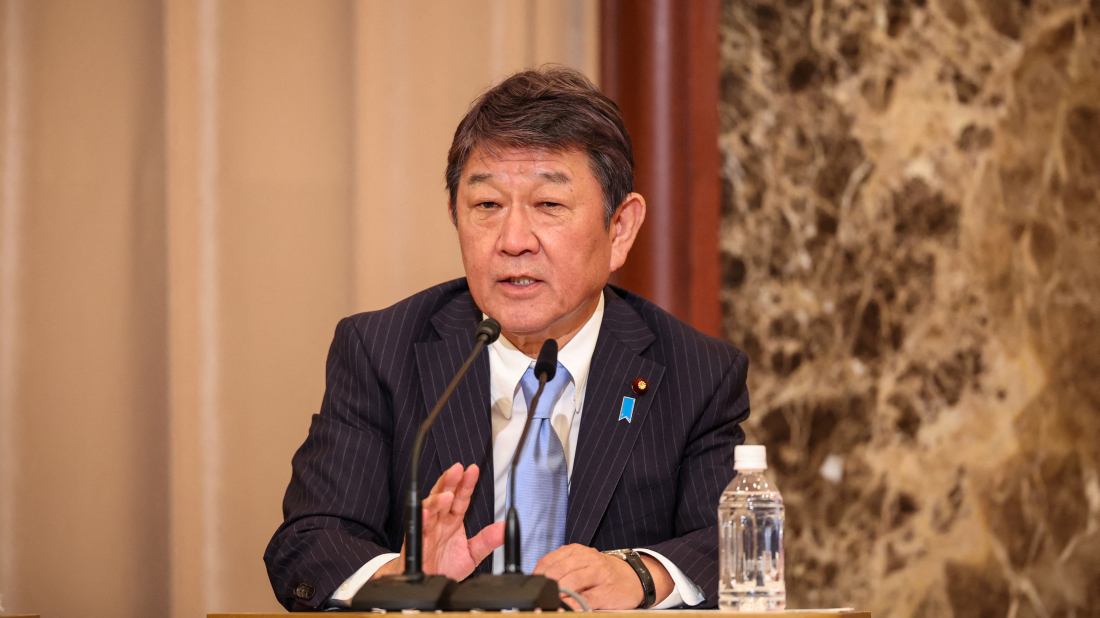
Former Foreign Minister Toshimitsu Motegi became the first ruling party lawmaker to throw his hat into the ring to succeed outgoing Japanese Prime Minister Shigeru Ishiba on Monday, as financial markets whipsawed on the political uncertainty.
Ishiba called time on his brief tenure on Sunday, saying he was taking responsibility for bruising elections that saw his ruling coalition lose its majority in both houses of parliament amid voter anger over rising living costs.
He instructed his Liberal Democratic Party (LDP) - which has governed Japan for most of its post-war history - to hold an emergency leadership election. The party plans to hold the vote on 4 October, broadcaster TBS reported, citing an unnamed senior party official.
Japan's yen sank and stocks surged on Monday after Ishiba's resignation stoked speculation that his potential successors - such as fiscal dove Sanae Takaichi - may ramp up spending in the world's most indebted advanced economy.
"The LDP is facing its worst crisis since its founding," Motegi, 69, told reporters on Monday as he announced his plan to stand for leadership.
"We must unite quickly to tackle our serious challenges at home and abroad and move the country forward."
Chief Cabinet Secretary Yoshimasa Hayashi also intends to run in the election, a source close to the government's top spokesperson told Reuters.
The frontrunners, however, are LDP veteran Takaichi and Shinjiro Koizumi, a political scion and son of former Prime Minister Junichiro Koizumi, who gained prominence as Ishiba's farm minister tasked with trying to rein in soaring rice prices.
Both would mark milestones for Japan: Takaichi, 64, becoming its first female leader and Koizumi, 44, its youngest in the modern era.
Neither has formally announced their candidacy but they finished second and third respectively in the last leadership contest in September 2024.
"All indications are that it will come down to them facing off against each other," said Jeffrey Hall, a lecturer in Japanese studies at Kanda University of International Studies.
Conservative Contender
Of most consequence for investors and Japan's diplomatic relations would be Takaichi, who has held a number of posts including as economic security and internal affairs ministers.
She stands out for her opposition to the Bank of Japan's interest rate hikes and her calls to ramp up spending to boost the fragile economy.
Investors are betting the political hiatus alone will delay the BOJ's monetary policy tightening plans.
Money markets are now pricing in a roughly 20% chance of the BOJ hiking rates by the end of October, down from 46% a week ago.
The expected leadership bid of the nationalistic Takaichi will also be closely watched by Japan's powerful neighbour China.
Known for conservative positions such as revising the pacifist constitution, Takaichi is a regular visitor to the Yasukuni shrine to honour Japan's war dead, viewed by Beijing and others as a symbol of past militarism.
Takaichi earlier this year also visited Taiwan, the democratic island claimed by China, where she suggested Taiwan, Japan and other partners could form a "quasi-security alliance".
"China might take a more hostile stance towards Japan, because she depicts herself as very much a hawk regarding China," said Hall of Kanda University.




















What is your opinion on this topic?
Leave the first comment