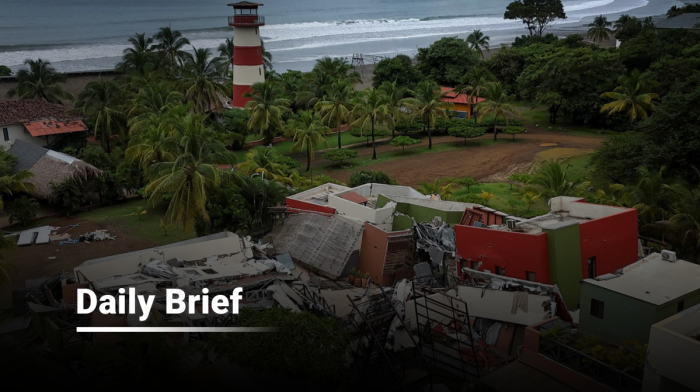
Indonesia quake kills 54 as search continues on Independence Day
Residents of villages in eastern Indonesia hit by a deadly earthquake that killed at least 54 people were awaiting...
President Donald Trump announced on Monday that countries without separate trade agreements with the United States could soon face tariffs ranging from 15% to 20%, a sharp increase from the general 10% rate imposed in April.
Speaking alongside UK Prime Minister Keir Starmer at his Turnberry golf resort in Scotland, Trump said the U.S. administration would soon notify around 200 countries of the new 'world tariff' rate. “It’ll probably be one of those two numbers,” he told reporters.
The move is part of Trump’s broader push to eliminate U.S. trade deficits by placing tariffs on nearly all trading partners. He has already imposed tariffs as high as 50% on some countries, including Brazil, which will take effect on Friday.
The sweeping tariff threat has triggered urgent negotiations from several nations- including India, Pakistan, Canada, and Thailand- all hoping to secure more favourable terms.
On Sunday, Trump announced a major trade agreement with the European Union featuring a 15% tariff on most EU exports, $600 billion in European investment in the U.S., and $750 billion in energy purchases over the next three years.
This followed a $550-billion deal with Japan and smaller pacts with Britain, Indonesia, and Vietnam. Negotiations continue with other nations, but with the Friday deadline approaching, chances for additional agreements are narrowing.
Trump emphasised his preference for a simplified tariff system over protracted trade talks. “We’re setting a tariff for essentially the rest of the world,” he said. “That’s what they’ll pay if they want access to the U.S. market. We can’t sit down and make 200 separate deals.”
Canadian Prime Minister Mark Carney said on Monday that talks with Washington were in an intense phase, acknowledging that Canada was still aiming to avoid the 35% tariff recently applied to some of its exports. He admitted that Canada which sends 75% of its exports to the U.S. would likely have to accept a certain level of tariffs.

At least 11 people were killed in Israeli strikes on southern Lebanon on Saturday, among the deadliest since a June ceasefire. Meanwhile, Qatar denied holding Iranian pilots. It said it had found the remains of one pilot after an airspace violation and had contacted Iran to coordinate a handover.
A wildfire in Croatia driven by strong winds descended on the tourist town of Omis overnight, engulfing houses, forcing about 1,000 people to evacuate to safety and injuring dozens, fire brigade and health officials said on Friday.
U.S. President Donald Trump's threats to make the Strait of Hormuz part of U.S. territory have been mocked by Iran's Deputy Foreign Minister, Kazem Gharibabadi, who said the sea passage "cannot be seized by tweet."
Russia and Ukraine traded large-scale overnight attacks targeting energy, industrial and military facilities on Saturday, with a three-month-old baby killed and 11 people injured in a Russian drone strike on a residential building in Ukraine’s Dnipropetrovsk region.
For fishermen along Pakistan’s southwestern coast, the consequences of the U.S.-Iran conflict are being felt far from the battlefield.
Residents of villages in eastern Indonesia hit by a deadly earthquake that killed at least 54 people were awaiting aid on Monday as rescuers prepared to comb through collapsed buildings in search of people trapped beneath the rubble.
South Korea's presidential Blue House said on Monday it was reviewing U.S. President Donald Trump's comments on scaling back joint military drills. It added that it hoped a favorable relationship between Washington and Pyongyang could lead to meaningful talks.
Start your day informed with AnewZ Morning Brief. Here are the top news stories for the 17th of August, covering the latest developments.
More than 183,000 customers across Hawaii were without power as Tropical Storm Lala weakened after bringing hurricane-force winds, heavy rain, and flooding to the islands.
Canadian measures aimed at preventing terrorist financing can obstruct legitimate humanitarian work by Muslim charities, particularly when aid is destined for countries considered high-risk, according to a new study.
You can download the AnewZ application from Play Store and the App Store.
What is your opinion on this topic?
Leave the first comment