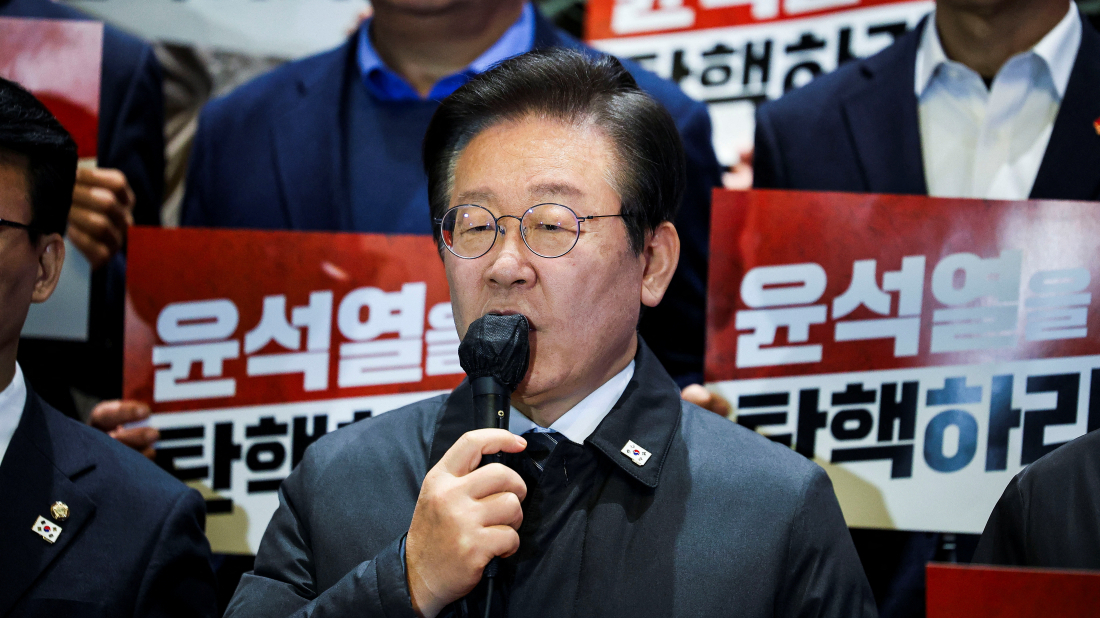
South Korean opposition leader Lee Jae-myung called for President Yoon Suk Yeol’s impeachment, citing his short-lived martial law imposition as a constitutional crisis.
South Korean opposition leader Lee Jae-myung said on Friday the best way to restore order in the country is to impeach President Yoon Suk Yeol, a day ahead of a planned parliamentary vote over Yoon's short-lived imposition of martial law.
Yoon's move to impose military rule on Dec. 3 was rescinded barely six hours later but it plunged the country into a constitutional crisis and widespread calls for him to step down for breaking the law.
Yoon on Thursday vowed to "fight to the end," blaming the opposition party for paralysing the government and claiming a North Korean hack into the election commission made his party's crushing defeat in an April parliamentary election questionable.
Democratic Party leader Lee called Yoon's remarks "a declaration of war" against the people. "It proved that impeachment is the fastest and the most effect way to end the confusion," he said.
Yoon survived the first attempt to impeach him last Saturday when most of his ruling People Power Party (PPP) boycotted the vote. Since then at least seven PPP members have publicly supported a vote to impeach him.
Opposition parties, which control the single-chamber parliament, have introduced another impeachment bill and plan to hold a vote at 5 p.m. (0800 GMT) on Saturday. They need at least eight PPP members to pass the bill with the two-third majority required.
Lee called on opposition members to "join and vote yes for impeachment," saying "history will remember and record your decision." A vote to impeach Yoon would send the case to the Constitutional Court, which has up to six months to decide whether to remove him from office or reinstate him.
There was more criticism of Yoon's defiant address on Thursday, including his claim that a hack by North Korea last year may have compromised the computer system of the National Election Commission, without citing evidence.
Yoon cited as one reason for declaring martial law a refusal by the commission to cooperate fully in a systems inspection which meant the integrity of the parliamentary election held in April could not be assured.
On Friday, the Secretary General of the commission, Kim Yong-bin, denied the possibility of election fraud, saying voting is entirely done by paper ballots and the courts have dismissed all 216 claims of irregularities raised as groundless.
Yoon is separately under criminal investigation for alleged insurrection over the martial law declaration.
















What is your opinion on this topic?
Leave the first comment