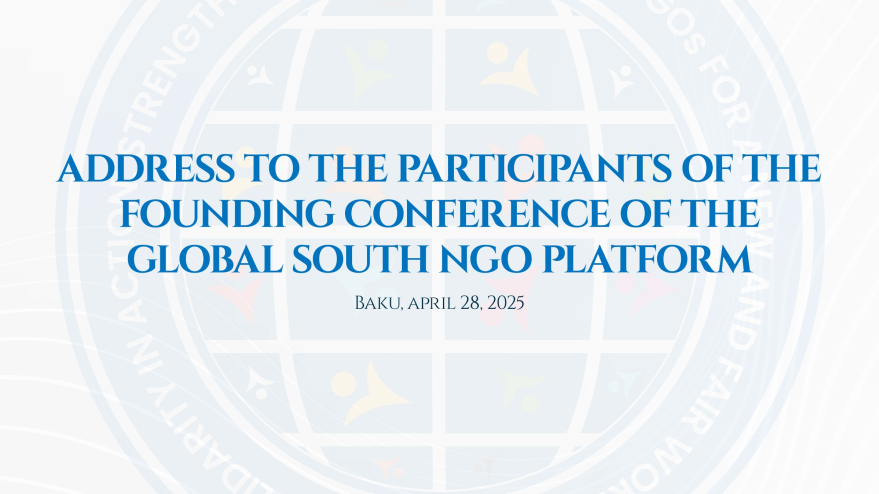
President of Azerbaijan Ilham Aliyev addressed the participants of the founding conference of the Global South NGO Platform.
Dear Conference participants,
Today marks a milestone for the Global South. Representatives from over 100 prominent non-governmental organizations, civil society have gathered to establish the first-ever Global South NGO Platform.
We are delighted that last November, during the international conference on South-South cooperation of NGOs from Non-Aligned Movement countries held on the sidelines of COP29 in Baku, Azerbaijan National NGO Forum’s initiative to establish the Global South NGO Platform received overwhelming support. More than 1000 NGO representatives and activists from nearly 140 countries came together to sign the respective joint declaration.
The transformation of the COP29 NGO Coalition, which brought together nearly 500 NGOs from over 100 countries, into an initiative group, driven with the purpose of institutionalising the Global South NGO Platform, is indicative of the need for joint, coordinated action.
As a country pursuing diversified foreign policy, Azerbaijan chaired the Non-Aligned Movement of 120 countries from 2019 to 2023, resolutely defending the interests of developing countries and advancing key global initiatives. We provided humanitarian and financial assistance to over 80 member states in different economic situation, including during the COVID-19 pandemic. We have also taken substantial steps toward the institutionalization of the Non-Aligned Movement.
Having become a powerful voice of the Global South, Azerbaijan views the launch of this platform in Baku as recognition of its activity during the chairmanship of the Non-Aligned Movement and its COP29 Presidency. I believe that the Global South NGO Platform will make a significant contribution to amplifying the voices of our peoples, conveying their positions to the international community, and defending and ensuring their rights.
Azerbaijan’s efforts to foster active dialogue between the Global South and the Global North - by cultivating an atmosphere of mutual trust and understanding, and consistently playing a balancing role in the pursuit of long-elusive consensus - culminated in the “Baku Breakthrough” achieved during COP29.
COP29, hosted by Azerbaijan, marked a historic success, and our country rightly takes pride in the legacy of COP29, which welcomed some 80 thousand participants from 197 countries.
Through its active diplomacy, Azerbaijan continues working with determination to narrow the gap between the positions of the Global North and the Global South and to foster more inclusive and effective dialogue. However, the mistrust that has persisted for years between the two remains a major impediment to achieving lasting success. We have taken on the role of a bridge between the Global South and the Global North to help address this imbalance and are committed to making renewed contributions to the cause of confidence-building.
As a country that has successfully undergone economic and political transformation – and restored fully its territorial integrity and sovereignty through its own means in the face of military aggression – Azerbaijan deeply understands the challenges faced by the least developed countries, developing countries and the Global South as a whole, and remains fully committed to promoting cooperation, solidarity, and lasting success.
Azerbaijan’s policies have always been grounded in mutual respect and the principles of shared development. Regrettably, many of the major challenges faced by countries in the Global South are results of continued neocolonial policies pursued by certain Western countries. We strongly reject all forms and manifestations of colonialism and consider such practices causing immense tragedies, subjugation, and suffering among peoples completely unacceptable.
Azerbaijan is a country that adheres to the principle of non-interference into domestic affairs, respects the political systems as well as the cultural, ethnic, and religious diversity of peoples, and always actively promotes interfaith, inter-civilizational and intercultural dialogue. I believe that through our concerted efforts, we can build a brighter future and a new, just world order for our peoples.
I wish success to the Global South NGO Platform, and congratulate every participant on this notable event!
You can always count on Azerbaijan!












What is your opinion on this topic?
Leave the first comment