Georgia’s Constitutional Court is hearing a case to ban five opposition parties, amid disputes over election protests, judicial impartiality and political freedoms. As the legal battle intensifies, opposition groups are preparing fresh street protests.
The hearings, which resumed on 26 October, have exposed sharp divisions over what constitutes an attempt to overthrow the constitutional order and whether the defence has been given a fair opportunity to challenge the allegations.
The lawsuit, signed by 88 lawmakers from the ruling Georgian Dream party, seeks to ban the United National Movement, Coalition for Change, Strong Georgia–Lelo, the Federalists and Gakharia for Georgia.
Georgian Dream accuses the parties of threatening Georgia’s constitutional order, independence and territorial integrity. The opposition rejects the allegations, calling the case an attempt to eliminate political rivals.
The court has yet to issue a ruling and is still hearing arguments from both sides.
Court accepts some opposition evidence
On 26 October, the court partially approved a request from Gakharia for Georgia to submit additional evidence, including video recordings, news reports and statements by Georgian Dream officials.
However, the judges rejected the rest of the proposed evidence and declined to summon several witnesses, including Georgian Dream founder Bidzina Ivanishvili and Tbilisi Mayor Kakha Kaladze.
The decision followed a series of unsuccessful defence motions. The court rejected a request to postpone the hearings until 13 November, along with proposals to obtain an advisory opinion from the European Court of Human Rights and hear from experts appointed by the Council of Europe’s Venice Commission.
While the decision allows the defence to challenge parts of the ruling party’s account, most attempts to expand the scope of the proceedings have been unsuccessful.
Opposition disputes claims over election protests
On 28 October, Giga Lemonjava of Coalition for Change argued that refusing to recognise election results does not automatically amount to an attempt to overthrow the constitutional order.
He said political parties were under no legal obligation to recognise election results, arguing that such a refusal could not justify a ban without evidence of violence or an attempt to circumvent the Constitution.
His argument strikes at the heart of Georgian Dream’s case, which draws on the opposition’s response to the disputed 2024 parliamentary elections, subsequent protests and demands for a new vote.
The ruling party maintains that the targeted groups have undermined the constitutional system through their political activities and cooperation. Its case also relies on findings from a parliamentary investigative commission examining alleged abuses under former president Mikheil Saakashvili.
The defence insists the lawsuit blurs the line between legitimate political dissent and attempts to overthrow the state.
Judges must now decide whether the evidence meets the constitutional threshold required to ban each party.
European criticism sparks courtroom clash
Tensions rose further on 28 October when Lemonjava cited a European Parliament resolution adopted on 8 October, which condemned the attempt to ban the opposition parties and called for the lawsuit to be withdrawn.
Constitutional Court Chairman Revaz Nadaraia questioned whether the resolution was relevant, arguing that the defence should focus on the constitutional complaint rather than use the hearings to deliver political messages.
Nika Gvaramia of Coalition for Change disputed that position, insisting that the broader political context was relevant to the proceedings.
The exchange exposed a wider disagreement over whether international criticism and concerns about democratic standards should form part of the court’s consideration of the case.
Gvaramia turns Georgian Dream’s argument against it
On 29 October, Gvaramia turned the ruling party’s legal argument back on itself, suggesting Georgian Dream could also face grounds for prohibition if the same constitutional standards were applied consistently.
He argued that an interpretation of the Constitution used to restrict political competition and challenges to the government could equally be applied to Georgian Dream.
Gvaramia maintained that demanding elections, justice and the release of political prisoners did not amount to the conduct alleged in the lawsuit.
His remarks challenged the consistency of Georgian Dream’s legal reasoning rather than establishing any constitutional wrongdoing by the ruling party.
Kafka comparisons fuel concerns over court proceedings
Opposition figures and civil society critics have likened the case to Franz Kafka’s novel The Trial, describing the proceedings as absurd and grotesque. In the novel, an individual becomes trapped in an opaque judicial process.
The comparison reflects fears that political statements, disputed election results and protest activity could become grounds for banning political organisations.
Scrutiny has also intensified over the court’s handling of defence requests and questions surrounding judicial impartiality.
Constitutional Court judge Manana Kobakhidze resigned after her request to recuse herself was denied. Her previous position as a founding member and first chairperson of Georgian Dream had prompted concerns about her impartiality, given that the case was brought by lawmakers from the same party.
The court has continued with seven judges. Although the rejection of defence motions does not, by itself, demonstrate bias, the handling of evidence and concerns over impartiality remain under scrutiny.
Georgian Dream denies the lawsuit is politically motivated and insists it is pursuing a legitimate constitutional process.
Opposition plans fresh protests
Beyond the courtroom, opposition groups are seeking to sustain pressure on the government through demonstrations.
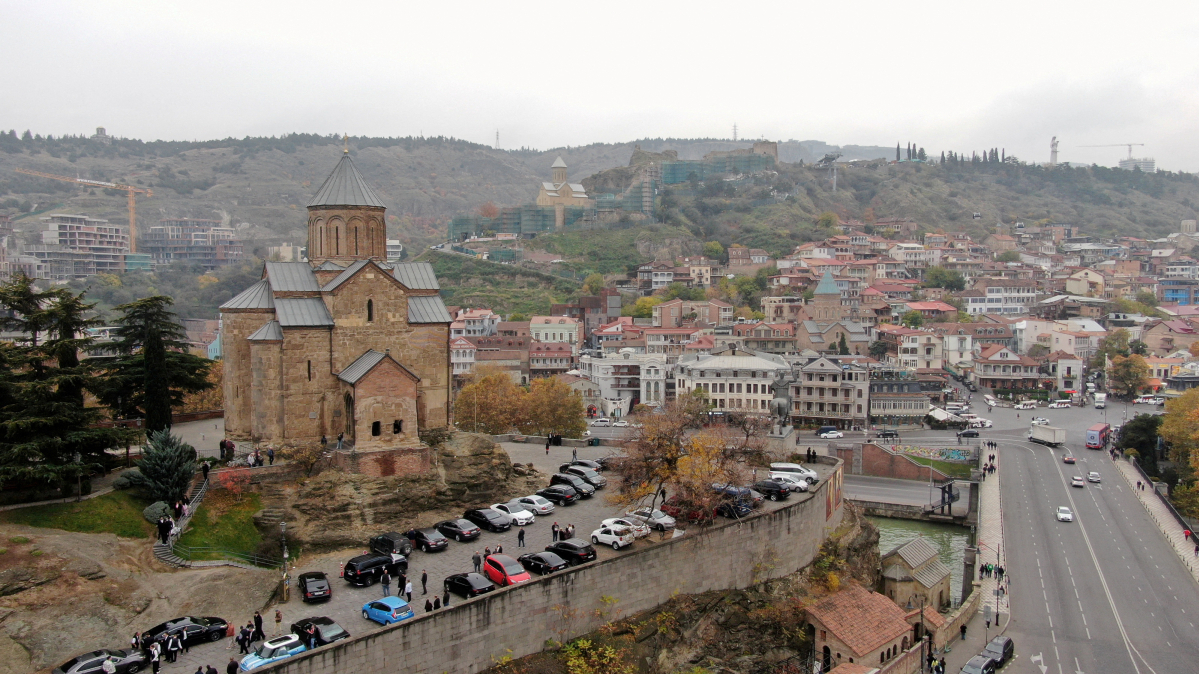
A march in Tbilisi on 25 October, held under the slogan “Georgia without Ivanishvili. Georgia deserves better”, united several opposition groups.
Organisers are now preparing another rally for 28 November, the second anniversary of the government's announcement that it was suspending EU accession talks, a decision that sparked a sustained wave of protests.
Although the demonstrations have failed to force a change in government policy, street protests remain a key part of the opposition’s response to Georgia’s political crisis.
The Federalists, meanwhile, have refused to participate in the court hearings, arguing that their involvement would lend legitimacy to the process.
What happens next?
As of 29 October, the court is continuing to hear arguments from both sides, with judges expected to begin questioning the parties before the proceedings move towards a conclusion.
The court has until June 2027 to issue a decision, which cannot be appealed in Georgia.
If the lawsuit succeeds, all five parties could be banned from operating, potentially reshaping Georgia’s political landscape ahead of the 2028 parliamentary election.
Four of the targeted political groups won seats in the disputed 2024 election but subsequently relinquished their mandates, while Gakharia for Georgia retains 11 MPs.
For Georgian Dream, the lawsuit is a constitutional measure aimed at protecting the state. For the opposition, it threatens to remove major political rivals from the electoral arena.
The outcome could have far-reaching consequences for political competition in Georgia.










What is your opinion on this topic?
Leave the first comment