Georgia’s Constitutional Court in Batumi will on Wednesday hear a lawsuit seeking to ban five Georgian opposition parties, four of which collectively gained 784,820 votes (37.79 per cent) in the country’s last national elections in 2024.
The lawsuit is being brought by the ruling Georgian Dream party and two allied groups which sit with the party in the Georgian Parliament. If it succeeds, all opposition parties that crossed the five per cent threshold in 2024 could disappear.
The newest lawsuit, submitted in September, argues that five opposition groups, Unity – National Movement (UNM), Coalition for Change, Strong Georgia – Lelo, For Georgia, and the Federalists, have since 2016 continuously denied the legitimacy of Georgia’s current authorities and ruling party.
The lawsuit argues that the parties’ activities are unconstitutional under Article 23 of the Constitution, because they have attempted, and still aim, to overthrow Georgia’s constitutional order or change it by force.
As evidence for this it references the named parties’ refusal to recognise the legitimacy of elected bodies and officials, and protest events which it links to the parties.
Following the 2024 parliamentary elections, UNM, Coalition for Change, Strong Georgia – Lelo and For Georgia all passed the five per cent threshold for entering Parliament. However, the four groups refused to recognise the outcome of the vote, citing electoral fraud, and refused to take their seats.
Some of the groups later reversed their position and took up their 12 seats in the Georgian Parliament in October 2025.
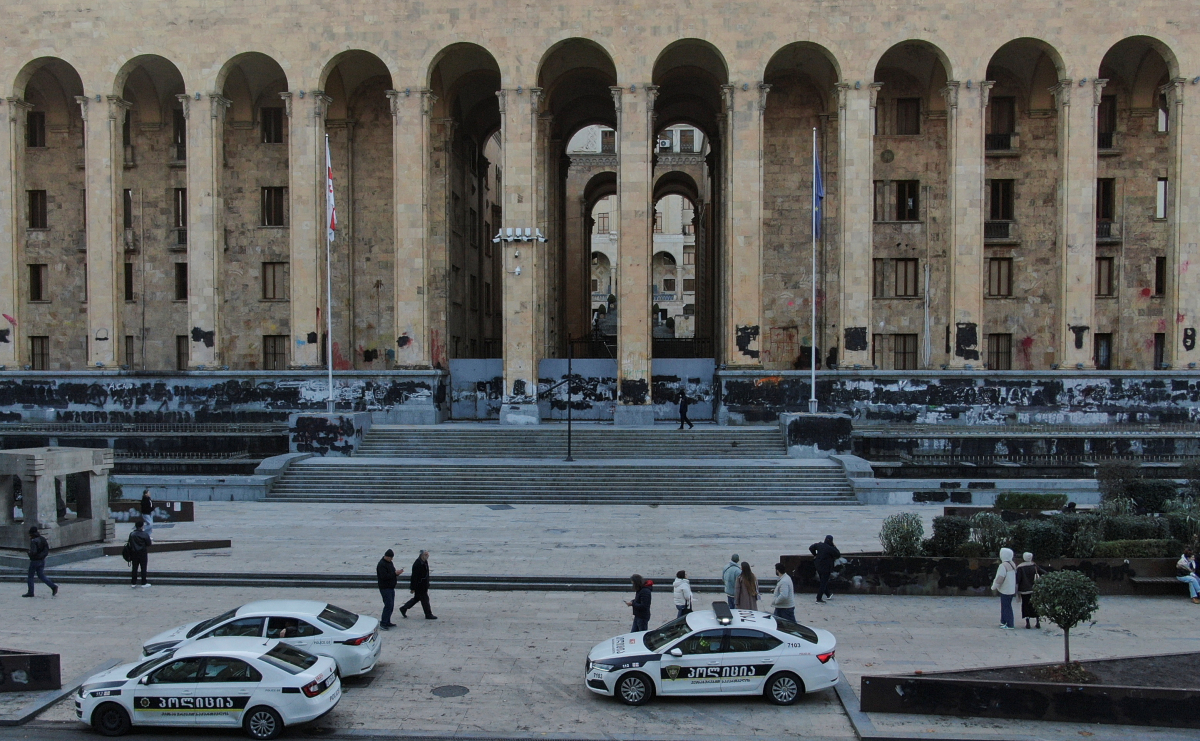
To further its argument, the lawsuit points to a June 2019 incident where it is alleged Unity – National Movement and other closely connected parties stormed the Georgian Parliament building. UNM has denied this.
The lawsuit goes on to claim that between 2019 and 2025 there were six attempts to overthrow or violently change Georgia’s constitutional order.
A second line of argument in the lawsuit targets UNM for its record while in power between 2004 and 2012, focusing on human rights violations documented in prisons, as well as the August 2008 war with Russia.
While much of the lawsuit filed with the Constitutional Court focuses on UNM, it argues the five parties cannot be considered as separate entities, but rather as a single union due to their common positions.
Which parties are facing a ban?
The five political groups targeted by the ban are among Georgia’s main opposition forces and all strongly support the country’s integration into Europe.
Unity – National Movement (UNM)
UNM is an informal coalition of pro-Western political parties in Georgia, dominated by the United National Movement, which governed Georgia between 2004 and 2012.
The party rose to power under its founder, the imprisoned former Georgian President Mikheil Saakashvili, following widespread protests over disputed parliamentary elections in 2003, known as the Rose Revolution.
During its time in power, the party focused on rooting out corruption and pursuing free market economic policies. It also realigned the country’s foreign policy towards the West.
The party lost the 2012 parliamentary elections to Georgian Dream following the 2008 war with Russia, and a scandal involving abuse of inmates in the Georgian prison system.
Coalition for Change
The informal coalition of multiple pro-Western liberal parties was formed ahead of the 2024 parliamentary election and picked up the second-highest share of the vote after Georgian Dream (11 per cent).
Most of its leaders were previously associated with the United National Movement, though the coalition’s parties broke away at different times.
All four leaders of the coalition from the 2024 elections have since been jailed or are in pre-trial detention.
For Georgia
Giorgi Gakharia founded the party in 2021 after resigning as Prime Minister and leaving Georgian Dream in opposition to the arrest of then United National Movement leader Nika Melia on charges of organising violence during protests in 2019 which culminated in an attempt to storm the Georgian Parliament.
The party passed the threshold to enter parliament in the 2024 elections. Although it initially refused to take up its seats, it later retracted the decision.
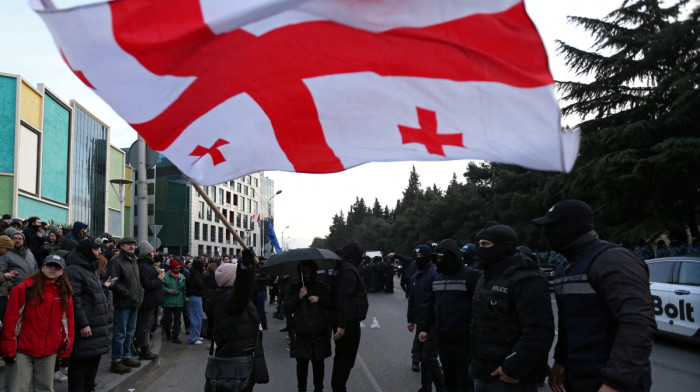
In November 2025, Gakharia was charged in absentia with ordering the violent dispersal of protesters outside Parliament during the 2019 protests, when he was Georgian Dream’s Interior Minister. The same 2019 events feature in the lawsuit against his party, which cites the alleged storming of Parliament as evidence of an attempt to overthrow the constitutional order by UNM and allied parties.
Strong Georgia – Lelo
Another coalition of liberal pro-Western parties, founded ahead of the 2024 elections, in which it received 8.8 per cent of the vote. The group was also the main opposition bloc to Georgian Dream in the 2025 local elections, picking up 6.74 per cent of the vote.
The Federalists
A pro-European party that advocates for the decentralisation of Georgia. It did not participate in the 2024 parliamentary elections.
Where did the idea of the ban originate?
During campaigning in the 2024 parliamentary elections, Georgian Dream’s billionaire founder and honorary chairman, Bidzina Ivanishvili, threatened to ban United National Movement.
“After securing the constitutional majority, we will outlaw and hold accountable the United National Movement and its satellite or successor parties, including for war crimes committed against our own people,” Ivanishvili told supporters in the Georgian city of Kutaisi in 2024.
In February 2025, Georgian Dream set up a parliamentary commission to investigate the activities of the United National Movement government between 2003 and 2012.
In August of the same year, the commission published a 463 word report which linked the United National Movement government to torture, human rights violations, murders, violence, corruption, and threatening Georgia’s territorial integrity, among other alleged wrongdoings.
Mamuka Mdinardze, Georgian Dream’s then leader in Parliament, said in March 2025 that the party would use the commission’s findings as the basis of its move to ban UNM and other political groups.
“It is already evident that the final conclusion of the parliament temporary investigative commission will provide us with a solid basis to appeal to the Constitutional Court of Georgia regarding the unconstitutional status of the United National Movement and its satellite parties,” he said, as reported by Georgian news agency Interpress News.
Prime Minister Irakli Kobakhidze in September linked the initiative to ban certain political parties with efforts to stop foreign interference in the country’s political system.
“We promised the voters that we would neutralize the foreign agent network in our country, and we are delivering on that promise in practice… This is not an opposition at all; in reality, it is a network of foreign agents,” he said.
What reaction has the proposed ban received?
Representatives from the parties targeted by the lawsuit are due to make their case in court during the three-day hearing from 21 October to 23 October.
Giorgi Sioridze, a member of Lelo – Strong Georgia, has described the move to ban the parties as itself an attack on Georgia’s constitutional order and called on the country’s Public Defender to set out a legal position on the lawsuit.
“We expect the Public Defender to engage in this process within the scope of her mandate and to submit a legal opinion assessing the constitutionality and possible consequences of restricting citizens’ political rights,” he said on October 19, according to the Georgian Public Broadcaster.
Lasha Parulava, a member of the United National Movement, said in April that the initiative signalled that the dismantling of democracy was “actively underway.”
Another UNM member, Levan Bezhashvili, previously said there could be no hope of impartial justice, alleging Georgian Dream’s control over the Constitutional Court’s composition.
The Council of Europe’s Venice Commission, which advises on constitutional matters, has criticised legislative amendments adopted by the Georgian Parliament in 2025, which broadened the Constitutional Court’s powers when banning political parties.
It said changes which allow for the prohibition of individuals associated with banned political groups from in the future participating in political parties and holding office raised “serious concerns under international human rights standards” in a report published in October.
What happens next?
Seven judges will hear the case during three consecutive days of proceedings at the Constitutional Court of Georgia in Batumi later this week.
Eight judges were expected to rule on the case, but Judge Manana Kobakhidze resigned suddenly last week.
Kobakhidze, a founding member of Georgian Dream and former MP for the party, had sought to be excused from the lawsuit due to her previous political activities and criticism of United National Movement. Her request was rejected by the other judges on 12 October, and she stepped down two days later
After the hearing concludes on Friday, the seven judges have until 24 June 2027 to issue a decision on the case.
Read more from Georgia:










What is your opinion on this topic?
Leave the first comment