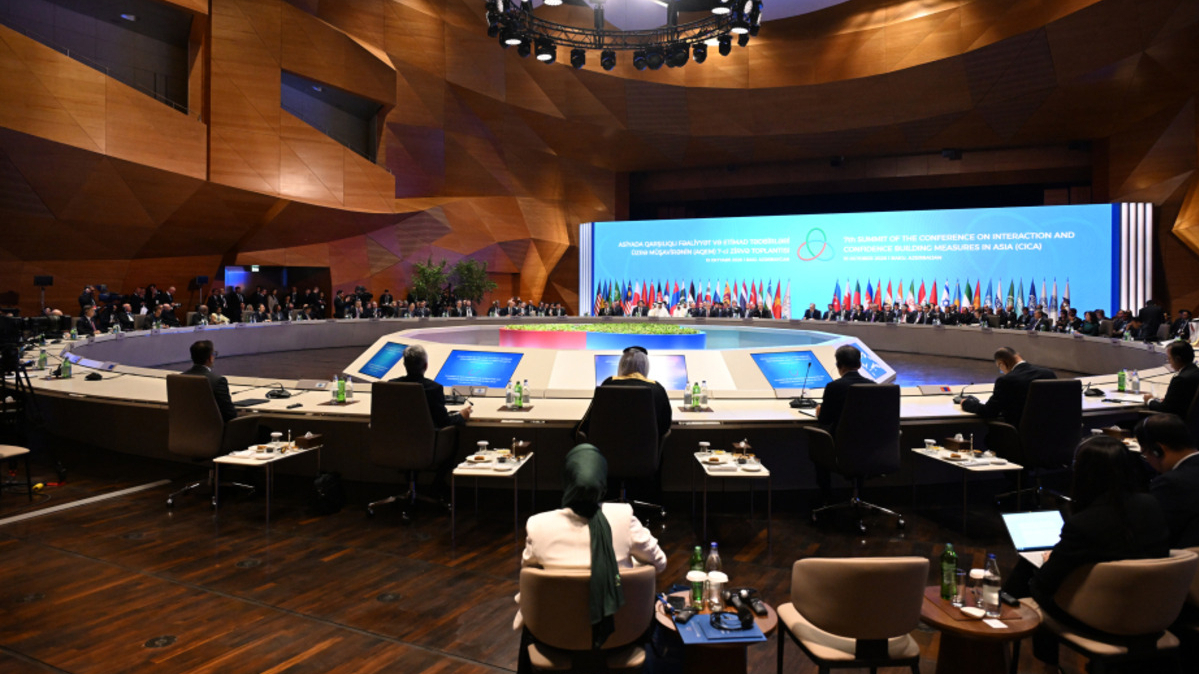
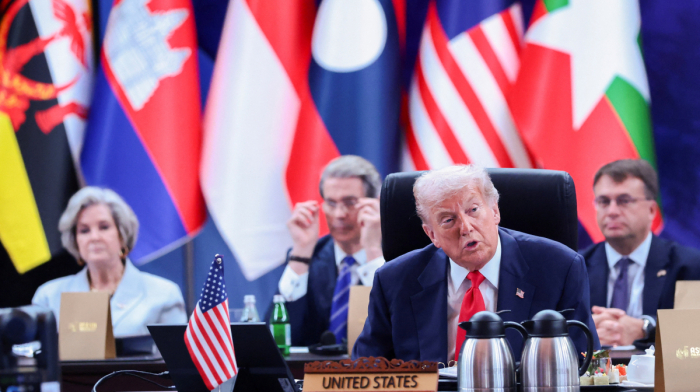
Azerbaijan's chairmanship of the Conference on Interaction and Confidence Building Measures in Asia (CICA) has been extended until 2028, as leaders gather in Baku for the organisation's seventh summit to discuss regional security and cooperation.
President Ilham Aliyev announced the two-year extension in his opening remarks on Thursday, thanking CICA member states for their support.
The decision follows discussions on the organisation's future, including talks in May between Azerbaijan's Deputy Foreign Minister Araz Azimov and CICA Secretary General Kairat Sarybay.
CICA's Senior Officials Committee formally approved the extension a day earlier on 14 October, covering the 2026–2028 period.
Members also signed the Baku Declaration at the summit and approved the appointment of Azerbaijan's Ambassador Sultan Hajiyev as the new Secretary General of the forum for the 2026-2030 term.
Contained within the declaration are specific provisions on advancing international order and addressing existing military-political, economic and environmental risks.
Aliyev defends Garabagh operations and criticises international institutions
Aliyev used his address to revisit the former Azerbaijan-Armenia conflict, defending Baku's military operations and criticising the international response.
He recalled Armenian Prime Minister Nikol Pashinyan's previous statement that “Garabagh is Armenia, full stop”, accusing Yerevan of continuing to challenge Azerbaijan's territorial integrity following the 2020 ceasefire.
The president pointed to Azerbaijan's restoration of full sovereignty over Garabagh in September 2023, saying the military operation had ended separatism in the region.
He also compared the ongoing trials of former Garabagh separatist leaders in Baku to the Nuremberg trials held after the Second World War.
Aliyev argued that international institutions could have prevented military action by taking a tougher stance against Armenia, including imposing sanctions. He maintained that Azerbaijan had been forced to restore its sovereignty and territorial integrity through military means.
He also took aim at the European Parliament and the Council of Europe over their positions on Azerbaijan, characterising the institutions as outdated and describing them as examples of anachronism and atavism in international politics.
Kazakhstan calls for stronger transport links across Asia
Kazakh President Kassym-Jomart Tokayev put forward a new CICA initiative to improve transport links across Asia, arguing that greater connectivity could boost economic growth and build trust between nations.
He said closer economic integration and better transport infrastructure could also help ease tensions and reduce the risk of conflict.
Tokayev pointed to a strategic partnership agreement signed last year between Kazakhstan, Uzbekistan and Azerbaijan to develop a green energy corridor across the Caspian Sea, connecting to Europe via the Black Sea.
The project aims to deliver renewable electricity from Central Asia to European markets, strengthening energy ties and supporting sustainable infrastructure development.
Laos joins CICA as 29th member
The summit also welcomed Laos as CICA's 29th member, marking a further expansion of the regional organisation.
The accession of the Lao People's Democratic Republic received backing from member states and was included on the summit's agenda.
The move reflects CICA's push to broaden its membership and deepen cooperation across Asia.
First proposed by Kazakhstan in 1992, CICA is a multilateral forum aimed at promoting peace, security and trust among Asian nations.
With Azerbaijan now set to lead the organisation until 2028, CICA is seeking to strengthen its institutions and turn regional dialogue into more practical cooperation.
Aliyev highlights Azerbaijan's regional role and CICA achievements
President Ilham Aliyev underlined Azerbaijan's growing role as a transport and economic hub linking Asia and Europe, highlighting its contributions to regional security through political, economic, energy and humanitarian cooperation.
He said Azerbaijan followed an independent foreign policy rooted in equality, non-interference in other countries' internal affairs and respect for national sovereignty and territorial integrity. Aliyev also reaffirmed Baku's opposition to double standards and selective approaches to resolving international conflicts.
Turning to the former conflict with Armenia, Aliyev said Azerbaijan had recaptured more than 300 cities and villages during the 44-day Patriotic War in 2020, before restoring full sovereignty and territorial integrity in September 2023.
The president also outlined the country's achievements during its CICA chairmanship, highlighting efforts to strengthen the organisation and deepen cooperation in transport, digitalisation, environmental protection, tourism, education and science.
He said initiatives backed unanimously by member states had reinforced CICA's institutional and legal framework, broadened its membership and strengthened its ability to promote dialogue, regional security and economic prosperity.
Aliyev closed by thanking member states for backing a two-year extension of Azerbaijan's chairmanship until 2028.










What is your opinion on this topic?
Leave the first comment