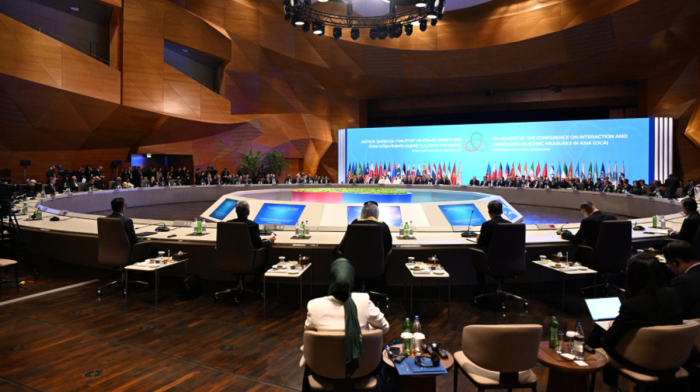
Azerbaijan is hosting the seventh summit of the Conference on Interaction and Confidence Building Measures in Asia (CICA) in Baku on Thursday, 15 October, following agreements that could extend the country's leadership of the Asian security forum until 2028.
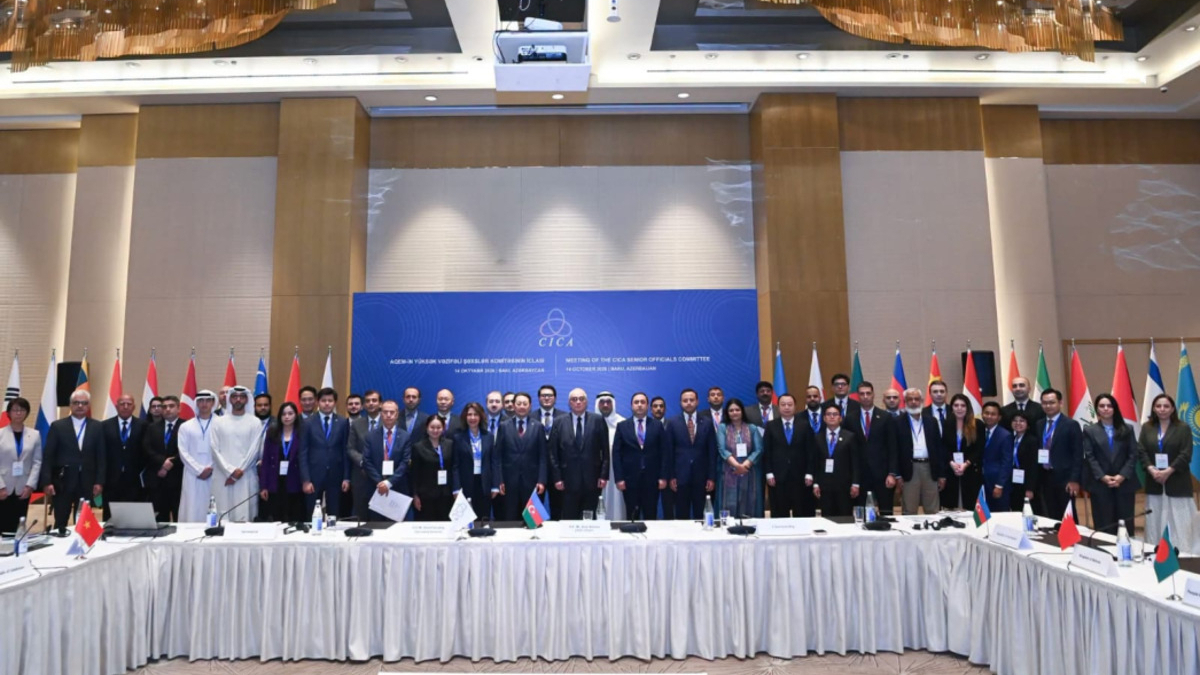
At a meeting on Wednesday, CICA's Senior Officials Committee agreed to extend Azerbaijan's chairmanship for 2026–2028 and approved a draft decision to appoint Azerbaijani diplomat Sultan Hajiyev as Secretary General for 2026–2030.
Officials also finalised a draft Baku Declaration and a statement on occupational safety and health for consideration by heads of state at the summit, according to the CICA Secretariat.
The preparations brought another development: Laos signed CICA's founding documents, taking a step towards becoming its 29th member, while Cambodia completed the ratification process required for a convention governing the Secretariat's privileges and immunities to enter into force.
With leaders and senior officials gathering in Baku, the summit places Azerbaijan at the centre of discussions involving countries with different political, economic and security interests.
What is CICA and what does it stand for?
CICA stands for the Conference on Interaction and Confidence Building Measures in Asia.
It is a multilateral forum established to promote peace, security and stability across Asia through dialogue, cooperation and measures designed to build trust between countries.
Unlike a military alliance, CICA does not provide collective defence guarantees. Its purpose is to encourage communication and cooperation, including between governments with competing regional interests.
According to the CICA Secretariat, its 28 member states account for nearly 90 per cent of Asia's territory and population.
The organisation's permanent Secretariat is based in Astana, Kazakhstan.
Why was CICA established?
The idea was first proposed by Kazakhstan's then-President Nursultan Nazarbayev on 5 October 1992 during the United Nations General Assembly.
The initiative sought to establish a regional platform for addressing security concerns through dialogue at a time when Asia lacked a comparable continent-wide mechanism.
In 1999, foreign ministers adopted the Declaration on the Principles Guiding Relations between Member States in Almaty, Kazakhstan.
The first CICA Summit followed in 2002, when leaders adopted the Almaty Act, establishing the forum's objectives and guiding principles.
In 2004, member states adopted a catalogue of confidence-building measures, while the CICA Secretariat was established in 2006 to support its activities.
A further turning point came at the sixth summit in Astana in 2022, when leaders launched a process to transform CICA into a full-fledged international organisation.
Which countries are members of CICA?
CICA's 28 members span the Middle East, Central Asia, South Asia, East Asia and Southeast Asia.
They are Afghanistan, Azerbaijan, Bahrain, Bangladesh, Cambodia, China, Egypt, India, Iran, Iraq, Israel, Jordan, Kazakhstan, Kuwait, Kyrgyzstan, Mongolia, Pakistan, Palestine, Qatar, South Korea, Russia, Sri Lanka, Tajikistan, Thailand, Türkiye, the United Arab Emirates, Uzbekistan and Vietnam.
The forum also has observer states and international organisations participating in its activities.
Membership is open to countries with at least part of their territory in Asia.
On 14 October, Laos signed CICA's two founding documents, the 1999 Declaration and the 2002 Almaty Act, following its earlier announcement that it intended to move from observer to full membership.
The development would make Laos the forum's 29th member.
How does CICA work?
CICA operates through consensus, meaning member states must agree on decisions rather than relying on majority voting.
Its highest decision-making body is the summit of heads of state or government, which sets the forum's priorities and reviews progress.
Foreign ministers, senior officials and working groups oversee cooperation between summits.
CICA's activities cover five broad areas: economic cooperation, environmental issues, human development, emerging threats and military-political confidence-building.
Practical areas include transport connectivity, energy security, cybersecurity, counterterrorism, disaster management, trade and investment.
What is Azerbaijan's role in CICA?
Azerbaijan is a founding member of CICA and currently holds its chairmanship.
Its chairmanship has focused on connectivity, digitalisation and sustainable growth, while supporting the forum's transformation into a more formally structured international organisation.
On 14 October, senior officials agreed to extend the country's chairmanship for another two-year term, covering 2026–2028.
They also approved a draft decision proposing Ambassador Sultan Hajiyev, nominated by Azerbaijan, as Secretary General for 2026–2030.
If formally approved, he would succeed Kairat Sarybay, who has led the Secretariat for six years.
Ahead of the summit, President Ilham Aliyev held meetings with visiting officials and leaders, including Israeli President Isaac Herzog, Tajik President Emomali Rahmon, Uzbek President Shavkat Mirziyoyev and Vietnamese Vice-President Vo Thi Anh Xuan.
Aliyev also discussed strategic cooperation with Chinese Foreign Minister Wang Yi, including Azerbaijan's role in the Middle Corridor transport network.
In a meeting with Herzog, the Israeli president praised Azerbaijan's chairmanship and said its proposed extension reflected confidence in the country's leadership.
Why does the Baku summit matter beyond security?
CICA's agenda extends beyond traditional security questions to economic cooperation, transport infrastructure and regional connectivity.
That makes the forum particularly relevant to Azerbaijan's position along the Middle Corridor, a trade route connecting China and Central Asia with Europe through the Caspian Sea and the South Caucasus.
Azerbaijan's transport links, including its ports and rail connections with Georgia and Türkiye, are part of efforts to diversify trade routes between Asia and Europe.
Local media reports that the diplomatic meetings surrounding the summit have highlighted opportunities for cooperation in transport, renewable energy and trade.
For Central Asian countries, stronger links through Azerbaijan could provide additional access to western markets.
However, diplomatic discussions alone do not guarantee new investment or functioning transport corridors. Progress depends on infrastructure development, commercial agreements and sustained political cooperation.
What decisions are expected at the seventh CICA Summit?
The summit is expected to consider the draft Baku Declaration and a statement on cooperation in occupational safety and health, both finalised by senior officials on 14 October.
The proposed appointment of Sultan Hajiyev as Secretary General is another institutional development awaiting final approval.
Separately, Cambodia's ratification of the Convention on the Privileges and Immunities of the CICA Secretariat has met the threshold required for the agreement to enter into force 30 days after its 14 October deposit.
The convention establishes legal protections and arrangements for the Secretariat and its representatives.
For Azerbaijan, the summit brings together three priorities: strengthening its leadership within CICA, advancing cooperation among Asian countries and promoting its role as a link between regional diplomatic and economic networks.















What is your opinion on this topic?
Leave the first comment