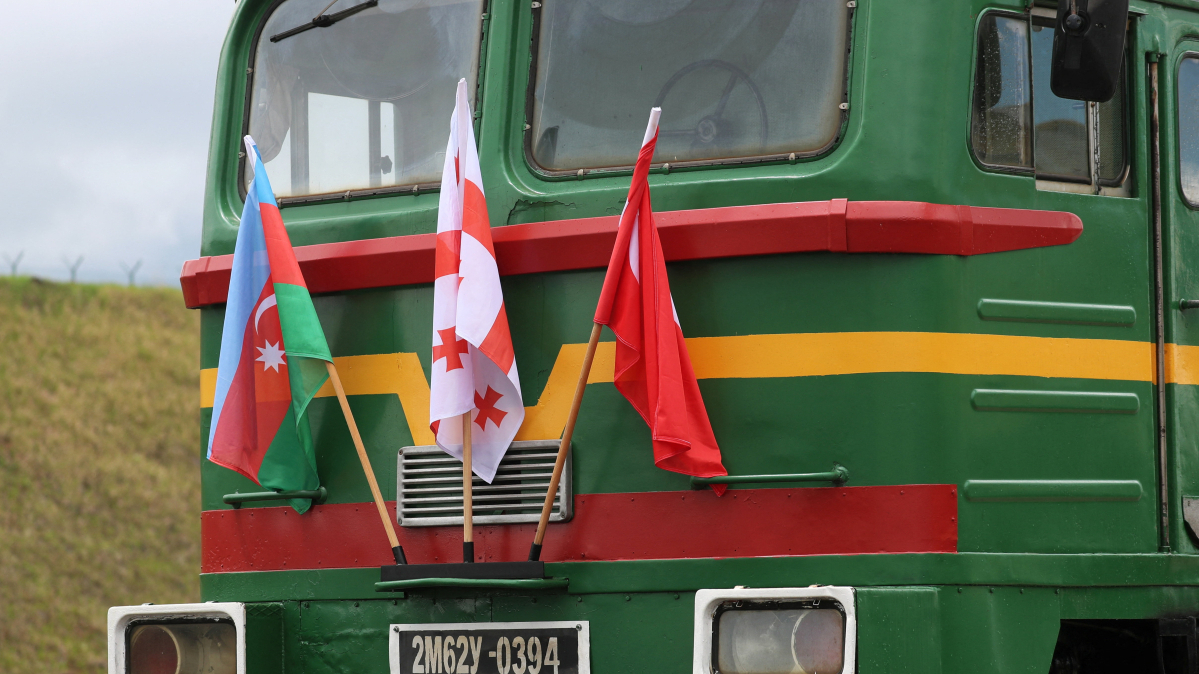
Freight on the Baku–Tbilisi–Kars railway could soon move faster across borders after Georgia, Azerbaijan and Türkiye signed a new customs protocol aimed at cutting delays and streamlining transit.
Customs chiefs from the three countries signed the protocol on 28 September in Goygol, Azerbaijan, following the fifth meeting of their trilateral customs committee. The agreement comes as the countries seek to turn investment in the regional trade route into higher freight volumes.
What the three countries agreed
The protocol covers three main areas. The first is expanded electronic data exchange, allowing customs services to receive shipment information before a train reaches the border.
The second is joint risk management, allowing officials to focus inspections on higher-risk cargo instead of checking all shipments in the same way.
The third is faster border-crossing procedures, with particular attention paid to speeding up transit on the BTK railway.
The protocol builds on an earlier agreement on advance information exchange for railway transit. The full text of the latest agreement, along with any implementation timetable or numerical targets, has not been made public.
Who was at the table
The delegations were led by Shahin Baghirov, chairman of Azerbaijan's State Customs Committee, Sezai Uçarmak, Türkiye's deputy trade minister, and Mamuka Baratashvili, head of Georgia's Revenue Service.
The sides also reviewed progress on earlier commitments, including harmonising transit procedures and combating customs violations.
Alongside the trilateral talks, Azerbaijan and Türkiye held the sixth meeting of their bilateral customs committee and signed a separate protocol.
That agreement covers information sharing, joint action against customs violations, “authorised economic operators” - trusted companies that receive simplified procedures - and mirror statistics, under which each country's trade data is cross-checked against the other's. Joint operations and training were also discussed.
Transit volumes remain 'quite low'
One of the clearest assessments came from Uçarmak, who said that despite significant investment in roads, rail and maritime infrastructure across the three countries, transit volumes along the Middle Corridor remain “quite low.”
Uçarmak said infrastructure alone would not be enough to increase freight traffic. Simpler procedures, shorter waits at border crossing points and harmonised processes within one integrated system would help increase volumes, he said.
He also highlighted the potential economic benefits of processing goods during transit, rather than simply transporting them, saying this could generate additional revenue and attract investors.
He described Azerbaijan as a vital “bridge” in the East–West corridor and noted that Caspian Sea crossings, connecting with Kazakhstan and Turkmenistan, also need to become easier.
Why the BTK railway matters
The BTK line links Azerbaijan to Türkiye through Georgia. It is 827 kilometres long, including 213 kilometres in Georgia, and has been running in test mode since 2017.
Its official inauguration took place in June at Akhalkalaki station in Georgia, attended by Georgian Prime Minister Irakli Kobakhidze and the transport ministers of Türkiye and Azerbaijan.
Following modernisation works, its annual freight capacity has grown from one million to five million tonnes, according to Kazakhstan's transport ministry.
The Goygol agreement is intended to address the customs side of that expansion. With the railway upgraded and additional capacity available, faster, more digital and predictable border procedures could help translate that capacity into higher freight volumes.
Read more:













What is your opinion on this topic?
Leave the first comment