Two of Georgia’s most senior officials used separate appearances in New York this week to deliver a similar message: the South Caucasus is gaining strategic importance, and Tbilisi wants to be at the centre of it.
Prime Minister Irakli Kobakhidze presented that case in broad, multilateral terms, while Foreign Minister Maka Botchorishvili delivered a more direct message aimed at the U.S. and EU. Taken together, their remarks offer a clearer picture of Georgia’s diplomatic pitch.
Kobakhidze stresses peace and regional opportunity
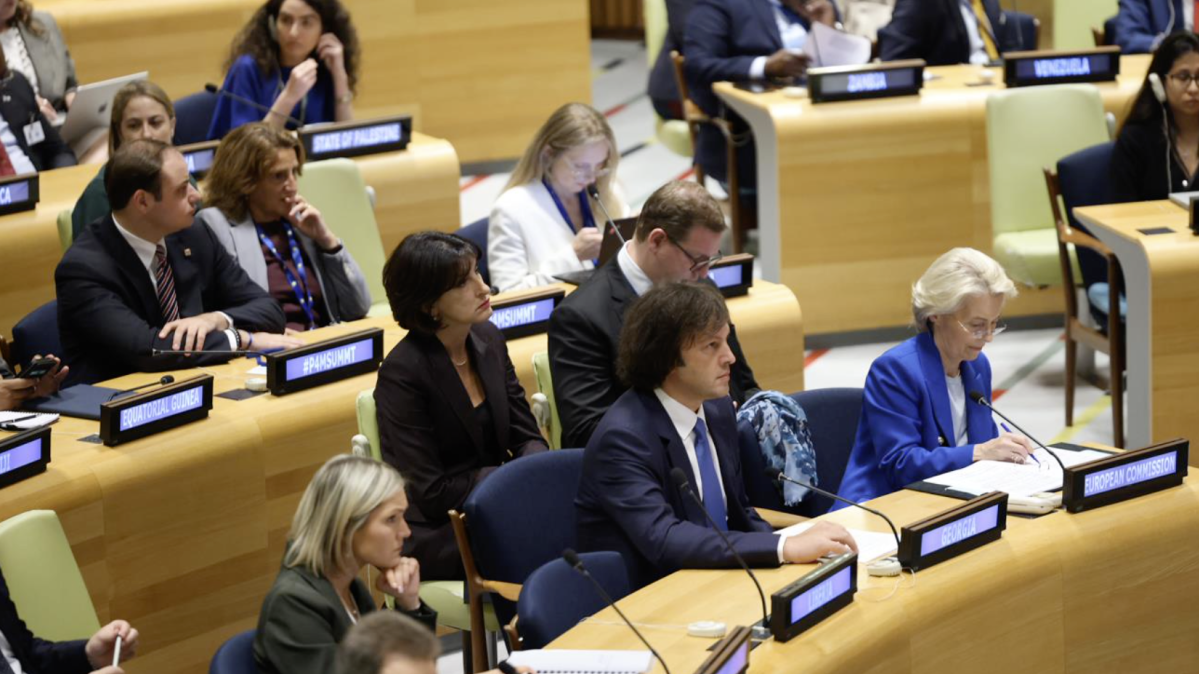
Speaking at the Partnerships for Multilateralism Summit, Kobakhidze reiterated Georgia’s long-standing position on territories it considers occupied by Russia. Twenty per cent of the country’s territory remains under occupation, according to the Georgian government, which says it is seeking a peaceful solution through “de-occupation, reconciliation, and the restoration of trust.” He also called for continued international support for Georgia’s sovereignty and territorial integrity.
The Georgian government has consistently described 20 per cent of the country’s territory as being under Russian occupation.
Kobakhidze then turned to the wider region, arguing that the South Caucasus is entering a new period of opportunity, with regional cooperation offering greater prospects for trade and connectivity.
His message was notably framed around multilateralism, international law, peace and regional cooperation rather than a direct appeal to Washington or Brussels.
Botchorishvili takes the message to the West
Foreign Minister Maka Botchorishvili made the regional argument more directly at the Concordia Annual Summit, where she appeared on a panel examining Southeast Europe and the Black Sea as pillars of stability.
Her message placed greater emphasis on Georgia’s long-standing Western partnerships and its geopolitical role between Europe and Asia. Georgia has contributed to U.S.- and NATO-led missions for decades, including in Afghanistan, where it became a major troop contributor despite not being a NATO member.
Botchorishvili has also repeatedly stressed that Georgia’s growing role as a regional connector does not alter its stated ambition to join the European Union, describing European integration as a strategic and historic choice for the country.
Rather than presenting contradictory messages, the two appearances point to a two-track diplomatic approach: Kobakhidze framing Georgia’s growing regional importance through multilateralism and connectivity, while Botchorishvili emphasises the country’s established relationships with the U.S., NATO and EU.
A region reshaped by new transport links
There is substance behind the argument that the region is changing.
On 8 August 2025, Armenian Prime Minister Nikol Pashinyan and Azerbaijani President Ilham Aliyev signed a joint declaration at the White House, witnessed by U.S. President Donald Trump, setting out plans for new regional connectivity.
The declaration includes plans for the Trump Route for International Peace and Prosperity (TRIPP), which would provide transit connectivity through Armenia between mainland Azerbaijan and its Nakhchivan Autonomous Republic. Armenia retains sovereignty, territorial integrity and jurisdiction over the project areas within its territory.
Azerbaijan followed in October 2025 by lifting restrictions on the transit of goods to Armenia. Aliyev has said the planned route could open by the end of 2028 and initially handle around 15 million tonnes of freight a year.
The project is expected to strengthen the Trans-Caspian trade route, commonly known as the Middle Corridor, linking China and Central Asia with Europe through the Caspian Sea and South Caucasus while bypassing Russia.
Georgia already occupies a strategic position on that route. Greater regional connectivity could mean more freight, transit revenue and strategic relevance for Tbilisi as a bridge between the Black Sea and Caspian regions.
Türkiye ties add another layer
That connectivity push also provides context for Kobakhidze’s meeting in New York with Turkish President Recep Tayyip Erdoğan.
Georgia, Azerbaijan and Türkiye are already connected by the Baku-Tbilisi-Kars railway, a key component of east-west transport links between the Caspian region and Europe. The railway’s capacity has been expanded following modernisation work.
For Tbilisi, deeper transport and energy cooperation with Türkiye adds another dimension to its argument that Georgia can serve as an important link between Europe, the Black Sea, the South Caucasus and Central Asia.
Diplomatic ambitions meet political reality
The diplomatic pitch comes against a more difficult backdrop in Georgia’s relations with the EU and U.S.
Georgia’s EU accession process has effectively stalled. In November 2024, Kobakhidze announced that his government would not put the opening of EU accession negotiations on its agenda until the end of 2028. EU institutions have since said the accession process has “effectively come to a standstill”, with the European Commission describing Georgia as a candidate country “in name only”.
Relations with Washington have also faced significant strain. The U.S. imposed sanctions on several Georgian officials in 2024, while Georgian Dream founder and honorary chairman Bidzina Ivanishvili was designated by the U.S. Treasury in December that year.
There have nevertheless been signs of continued diplomatic contact. Botchorishvili met the newly appointed U.S. chargé d’affaires in Tbilisi on 8 September, with both sides discussing bilateral relations and prospects for further cooperation.
Against that backdrop, the New York appearances appear designed to reinforce a central Georgian message: whatever the political tensions with Washington and Brussels, Tbilisi sees its geographical position - and the South Caucasus’s growing importance as a trade and transport hub - as an argument for continued Western engagement.
Read more:












What is your opinion on this topic?
Leave the first comment