Azerbaijan's education system is showing some of its strongest signs of progress in years, with the latest Programme for International Student Assessment (PISA) results revealing significant improvements in mathematics, science and reading.
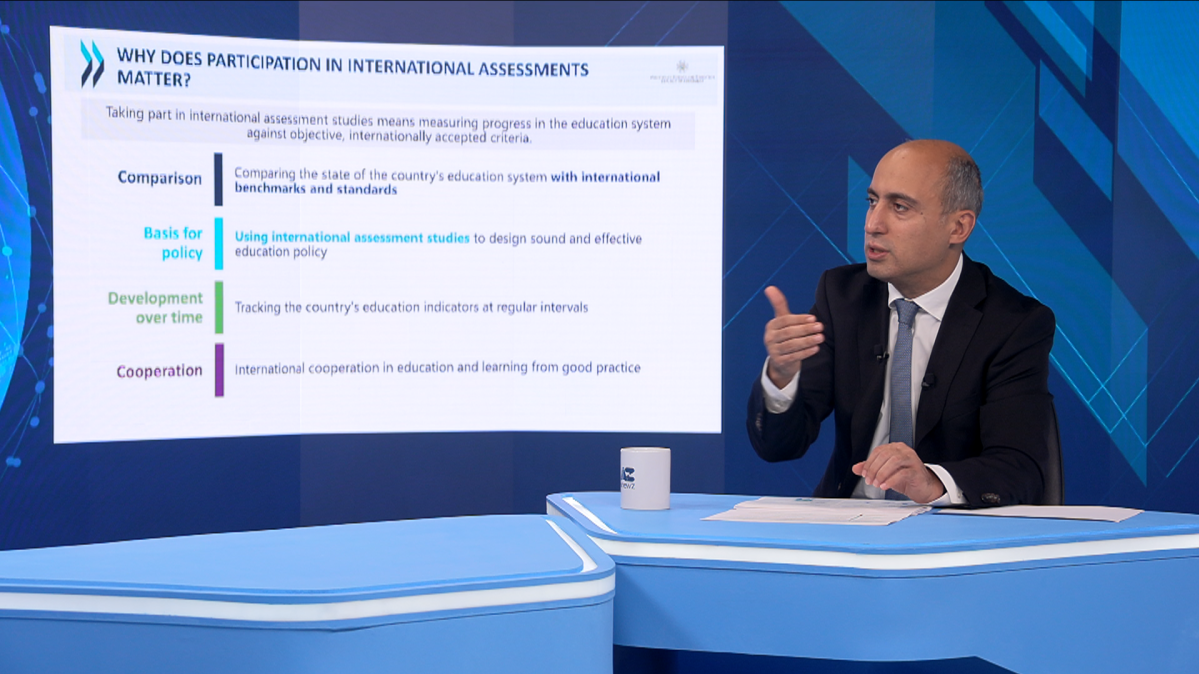
In an exclusive interview with AnewZ, Minister of Science and Education Emin Amrullayev said the results reflect the impact of reforms implemented over the past decade, while also offering a detailed roadmap for where further improvements are needed.
The latest PISA assessment, which evaluates the skills of 15-year-old students worldwide, saw Baku emerge as one of the fastest-improving education systems globally, particularly in mathematics.
PISA is about improvement, not rankings
Amrullayev emphasised that PISA should not be viewed as a competition between countries but as a research tool that helps governments understand how education systems are evolving.
According to the minister, the assessment provides policymakers, schools and researchers with valuable data on how various factors influence student performance, from classroom practices and teaching quality to home environments and parental engagement.
“PISA is one of the most powerful tools enabling educators and policymakers to make education better,” Amrullayev said.
He noted that the results often reflect reforms introduced years earlier, making the assessment particularly valuable for evaluating the long-term effectiveness of educational policies.
Baku records one of the world's fastest improvements
The strongest gains were recorded in Baku, which has participated in PISA since 2018.
The minister said the capital city's scores improved substantially across all three tested areas, with mathematics showing particularly impressive growth.
Baku's mathematics score increased by 63 points compared with the previous assessment cycle, an improvement Amrullayev described as equivalent to roughly three additional years of learning.
The results placed Baku among the top 30 performing systems globally in mathematics, while Azerbaijan as a whole ranked within the top 50.
The minister said the outcome demonstrates that education reforms introduced in previous years are beginning to produce measurable results.
“We see the fruits of the seeds that were planted a few years ago,” he said.
Teacher reforms and curriculum changes seen as key drivers
Amrullayev credited several major reforms for the gains.
Among the most important, he said, were improvements in teacher recruitment, certification and remuneration, alongside updates to curriculum content and assessment systems.
The ministry also worked to align national examinations more closely with international competency-based assessment models, encouraging students to develop problem-solving and analytical skills rather than focus solely on memorisation.
In addition, schools have increasingly been measured through performance indicators designed to improve educational outcomes and accountability.
The minister said higher investment in education has also played an important role.
“We have increased educational spending from the national budget, and I believe it has been spent efficiently,” he said.
Top performers emerge in mathematics
One of the findings highlighted by Amrullayev was the growing number of high-achieving students in mathematics.
According to the PISA data, around 8.1% of students in Baku and nearly 5% nationwide performed at the highest levels.
These students, the minister said, are capable of competing academically with their peers anywhere in the world.
He argued that this is particularly significant for Azerbaijan's future workforce as the economy continues to place greater emphasis on technology, innovation and digital skills.
Reading remains a priority
Despite the positive results, the minister acknowledged that challenges remain.
While mathematics performance has reached what he described as a “good” level, science and reading remain at a “satisfactory” stage and require further improvement.
Reading ability has emerged as a particular focus for policymakers.
Amrullayev said Azerbaijan's education system has traditionally placed greater emphasis on grammar and language rules than on reading comprehension and critical reading skills.
As a result, new education reforms are increasingly designed to strengthen literacy and reading habits from an early age.
“We need specific focus on reading,” he said.
Closing the urban-rural gap
The assessment also highlighted substantial differences between urban and rural educational outcomes.
The minister acknowledged a gap of more than 100 points between students in major cities and those living in smaller settlements and villages.
However, he argued that the disparity is driven more by school environments than by socio-economic backgrounds.
According to Amrullayev, the data suggest that family income has a smaller impact on student achievement in Azerbaijan than in many Organisation for Economic Co-operation and Development (OECD) countries.
Instead, factors such as school size, teacher availability and educational resources play a larger role.
Smaller rural schools often struggle to attract highly qualified teachers due to lower teaching loads and less competitive salaries.
To address these challenges, the ministry plans to continue rationalising school networks by consolidating very small schools and improving access to high-quality teaching.
The government is also expanding distance-learning initiatives that allow experienced teachers to support students remotely through digital technologies.
Parents have a crucial role to play
The minister repeatedly stressed the importance of parental involvement in education.
One of the most striking findings in the PISA data, he said, was the impact of a simple weekly conversation between parents and children about school.
According to the assessment, students whose parents regularly ask about what they are learning can achieve significantly higher results.
“I really want every single parent to ask their child: what have you learned today?” Amrullayev said.
He described parental engagement as one of the simplest and most effective ways to improve educational outcomes.
Looking towards PISA 2029
As Azerbaijan prepares for the next assessment cycle in 2029, the minister said the focus will shift from measuring Baku's progress to evaluating national performance across all regions.
Success, he said, will depend on reducing regional disparities, improving reading skills and addressing specific weaknesses identified in the current results.
The ministry also plans to continue investing in teacher quality, school leadership, digitalisation and assessment systems.
Amrullayev believes Azerbaijan now has the data needed to make smarter policy decisions and sustain progress over the coming years.
“We have a lot of information to understand where there are gaps, where there are opportunities and how we can improve,” he said.
For Azerbaijan's education sector, the latest PISA results appear to mark an important milestone. But for the minister, they are less a final verdict than a starting point for the next phase of reform.
Read More:












What is your opinion on this topic?
Leave the first comment