As Britain's sanctions on three Georgia-registered companies made headlines on 26 May, the Georgian side of the story was already complicated. The National Bank of Georgia had flagged Arvix LLC, Rapira Group LLC and Aifory LLC to law enforcement back in September 2025.
Arrests had reportedly been made. An investigation was under way. So when Tbilisi's parliamentary speaker stood before journalists to respond, his argument was not that Britain had got it wrong - it was that Georgia had already got there first. Whether that claim holds up depends entirely on what happened in the eight months between the referral and the sanctions.
All three of the Georgian-registered companies named in the UK's sanctions package share a striking feature: each was incorporated in Georgia after Russia launched its full-scale invasion of Ukraine in February 2022.
They were not long-established Georgian businesses that drifted into murky territory. They were set up in the specific environment created by the war - one in which Russia needed new financial infrastructure and Georgia, sitting outside the EU and not party to Western sanctions regimes, offered a relatively accessible registration point.
Focus on Russian market
Rapira Group, the largest of the three, was a crypto exchange focused almost entirely on the Russian market. Analysts identified it as one of the main successor platforms to Garantex, the large Russian exchange shut down in March 2025, and said it processed transactions in roubles with integration into Russian banks already under U.S. sanctions.
It allowed currency exchange without mandatory identity checks - a feature that made it particularly attractive for moving money with minimal paperwork. International media reported that Russian law enforcement searched Rapira's Moscow office in late 2025 in connection with alleged capital outflows. The company is currently in liquidation, with a British citizen listed as both owner and liquidator.
Aifory, also known as Aifory Pro, operated across Moscow, Dubai and Turkey. It offered users the ability to convert cash into cryptocurrency and access Western online services officially blocked inside Russia, using virtual cards linked to the USDT stablecoin. It also reportedly acted as a payment intermediary between Russia and other countries, with some transactions linked to Iranian cryptocurrency networks.
Arvix LLC was identified by both UK authorities and independent analysts as part of the same broad network - platforms that emerged in the gap left by the closure of Garantex and collectively provided the financial infrastructure Russia needed to keep money moving despite increasingly tight international restrictions.
None of the three was registered with the National Bank of Georgia as a regulated financial institution. They were operating entirely outside the formal supervisory framework.
September 2025: the referral
The National Bank of Georgia says it became aware of the three companies' activities and, in September 2025, passed the information to law enforcement in line with its legal obligations. It was clear from the outset that these entities were not just unregistered - they were, in the bank's assessment, operating in violation of Georgian financial regulations. The central bank also noted that it had implemented its own supervisory measures at the time.
That referral is the pivot point in this story. By the National Bank's own account, Georgian authorities were aware of these companies and their activities eight months before London acted.
The question neither the bank's statement nor the parliamentary response has directly addressed is what the investigation produced during that period, and why - if arrests had been made and wrongdoing established - the companies were still operating in a way that warranted British sanctions in May 2026.
Papuashvili's argument: Georgia acted first
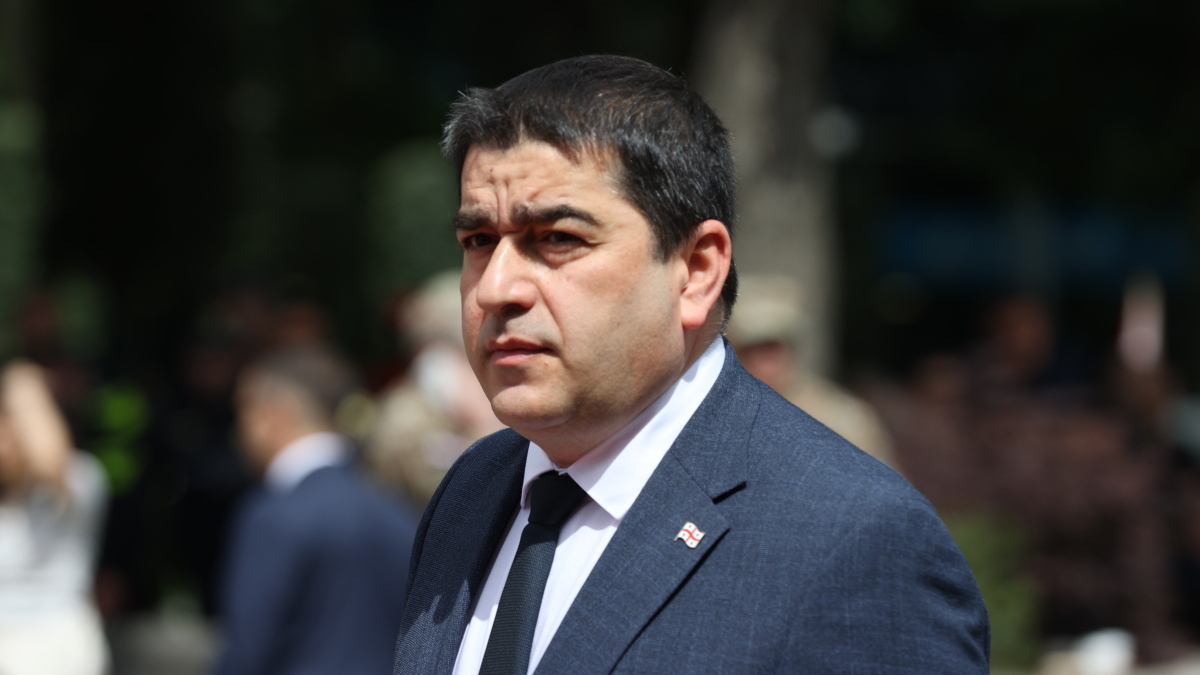
Georgia's parliamentary chairman, Shalva Papuashvili, framed the situation as a story of convergence rather than embarrassment. His core argument was simple: Britain found these companies because Georgia's own investigators had already found them. The UK's action, in his reading, was not a corrective - it was a confirmation.
"Britain traced it precisely because our investigative agencies traced it," he told journalists. He pointed to the National Bank's statement, noted that investigations were under way, that individuals had been detained, and that the sanctioned entities had been caught operating in violation of Georgian law.
"They are being held accountable for violating Georgian legislation, for evading sanctions - there is no criminal liability in our legislation [for sanctions evasion as such]. This was for violating Georgian legislation, which at the same time Britain has determined they are also violating sanctions."
That final distinction matters. Georgia does not have a domestic legal mechanism for imposing or enforcing international sanctions in the way that EU member states or the UK do.
What it can do - and what Papuashvili says it did - is pursue these companies under Georgian financial regulation. The charge is not sanctions evasion in the internationally understood sense; it is operating outside the rules of the Georgian financial system.
Papuashvili also pushed back more broadly, framing the episode as a test of good faith.
"Where [UK and Georgian decisions] coincide, it will be fair; where they do not coincide, it will be unfair," he said - a signal that Tbilisi was not prepared to treat British sanctions designations as automatically authoritative and that it would assess each case according to its own judgement.
It was a pointed remark, made in a political context in which Georgia's relationship with Western institutions has become considerably more strained over the past two years.
The 2,000 blocked transactions
Papuashvili offered one concrete piece of evidence in support of Georgia's position as an active enforcer rather than a passive bystander. He said Georgia had blocked more than 2,000 transactions linked to sanctioned companies, sanctioned goods or sanctioned recipients - and that some of those shipments had originated in Europe, not Russia.
"Georgia turned out to be the last barrier that stopped the cargoes smuggled from Europe," he said.
It was a striking claim, and not an entirely implausible one. Georgia sits at a crossroads between Europe, Russia and Central Asia, and its ports and border crossings have been scrutinised for years as potential conduits for dual-use goods heading east.
If the figure is accurate, it would suggest Georgian border and customs enforcement has been more active than the country's reputation on sanctions compliance typically implies.
What the figure does not tell us is what share of suspicious transactions Georgia identified and allowed through, nor what proportion of the financial flows processed by Arvix, Rapira and Aifory were caught versus missed. Blocking 2,000 transactions is a meaningful number; it is also not necessarily a comprehensive picture.
The tension underneath
Georgia's government is in an awkward position, and this episode illustrates it clearly. The country wants to be seen as a responsible member of the international community - one that does not allow its territory to be used as a back door for sanctioned economies.
At the same time, it is not willing to adopt Western sanctions frameworks wholesale, it has no domestic sanctions regime of its own, and its current political direction has been sharply at odds with EU and U.S. expectations on a range of issues.
The argument Papuashvili is making - that Georgian and British processes ran in parallel and arrived at the same destination - may be largely true in this particular case. The National Bank referral is real, the investigation appears to be real, and the timing does support the idea that Georgian authorities were not oblivious.
But the argument also glosses over the gap between a referral in September 2025 and sanctions in May 2026, and it does not answer why three companies operating in apparent violation of Georgian financial law were able to process hundreds of millions of dollars while already under investigation.
For Britain, the Georgian response is probably beside the point. Sanctions operate on a different logic from criminal prosecution - they are about cutting off access to the financial system immediately, not about building a court case for later. The two processes can run in parallel, but they are not the same thing, and one does not replace the other.












What is your opinion on this topic?
Leave the first comment