In an exclusive interview with AnewZ, Iran’s Deputy Foreign Minister Kazem Gharibabadi said the Islamic Republic is "not targeting neighbouring countries," amid reports of drone strikes on Nakhchivan International Airport on Thursday (5 March).
⦿ 11:32 GMT | UPDATE
Azerbaijani FM Bayramov: Drone strikes by Iran violate international law
Azertag
Azerbaijan's Foreign Minister, Jeyhun Bayramov, spoke about the drone attacks on Nakhchivan with his Uzbek counterpart, Bakhtiyor Saidov.
Bayramov described the strikes as a violation of international law that heightens regional tensions and called on Iran to provide clear explanations and take urgent steps to prevent similar incidents in the future.
⦿ 11:29 GMT | UPDATE
Four civilians injured in Iranian drone strike on Nakhchivan
The drones launched from Iranian territory that struck Azerbaijan’s Nakhchivan Autonomous Republic injured 4 civillians, according to Sahib Abuzarov, Head of the Emergency Medical Department of the hospital of Nakhchivan Autonomous Republic.
Gharibabadi, who was speaking to AnewZ when reports of the strike broke, reiterated Iran’s policy is to strike only military bases of its adversaries, including the United States and the "Zionist regimes."
“Because we have announced it from the beginning that, if there are any military bases in the region and they are used to attack Iran, we will target them. So that was the policy that we have,” Gharibabadi said.
The Deputy Foreign Minister stated that the incident must be investigated.
Drones were launched from Iranian territory struck Azerbaijan’s Nakhchivan Autonomous Republic, Azerbaijan’s Foreign Ministry said in a statement.
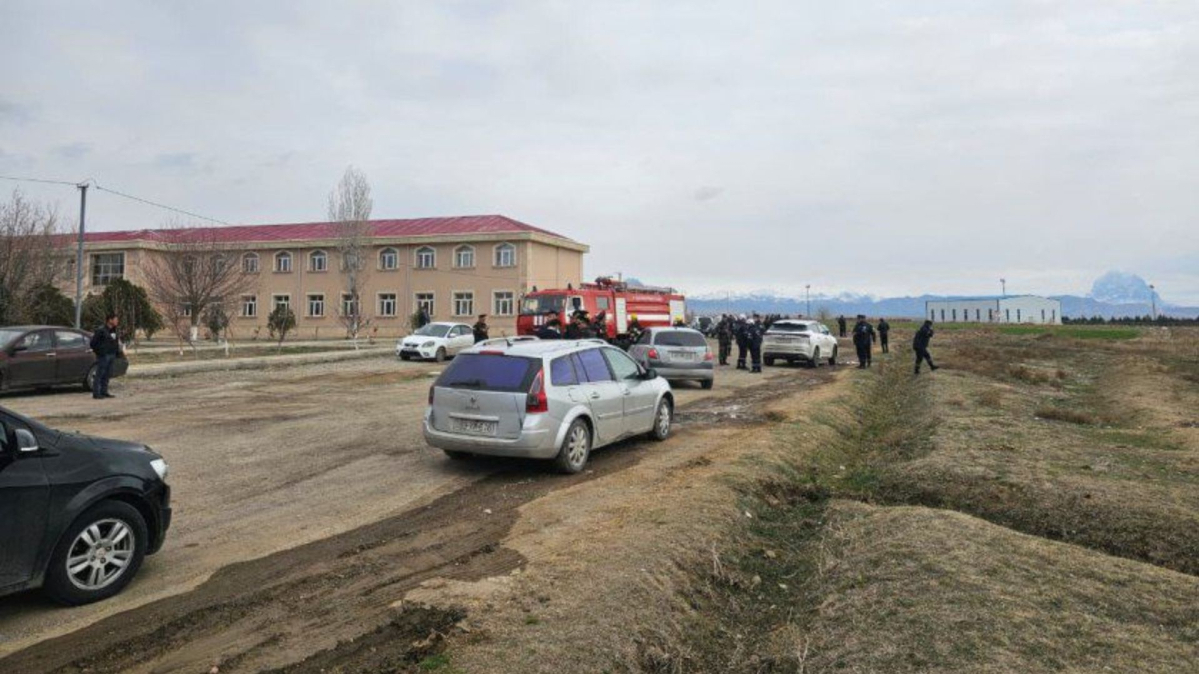
According to the Azerbaijani Foreign Ministry, the incidents occurred at around midday when drones entered the Nakhchivan Autonomous Republic from Iranian territory. One drone struck the terminal building of Nakhchivan International Airport, while another landed near a school in the village of Shakarabad.
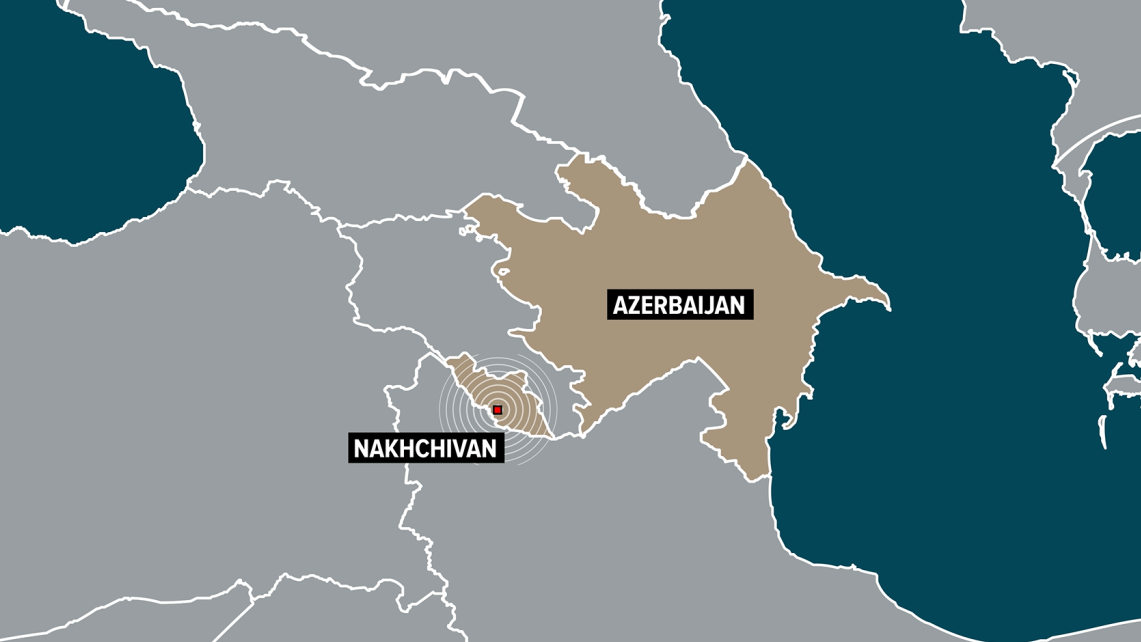
Nakhchivan International Airport lies roughly 10 km (6 miles) from the Iranian border. A source close to the Azerbaijani government told Reuters that missiles and drones had been observed flying from the direction of Iran before falling within the airport grounds.
Map showing the location of Azerbaijan and its Nakhchivan exclave.
Anewz
Increasing tension
“We strongly condemn these drone attacks carried out from the territory of the Islamic Republic of Iran,” the ministry said, adding that the incident “contradicts the norms and principles of international law and serves to increase tension in the region”.
Azerbaijan demanded that Iran clarify the incident and “take urgent and necessary measures to prevent such cases from recurring”, warning that it “reserves the right to take appropriate retaliatory measures”.
The Iranian ambassador to Azerbaijan, Mujtaba Darmichilu, was summoned to the Foreign Ministry, where a formal note of protest was presented.
A view of a school near the site where a drone landed in Nakhchivan, Azerbaijan, 5 March, 2026
Anewz
Meanwhile, the Nakhchivan Autonomous Republic’s Ministry of Education said teachers and students from two schools near the airport were evacuated.
“The evacuation was carried out to ensure the safety of the teaching staff and students,” the ministry said.
Baku has once again become a focal point for international energy diplomacy, investment and strategic cooperation, as Baku Energy Week brings together...
Trump reportedly lashed out at Netanyahu on Monday over Israel's escalation in Lebanon, describing the Israeli leader as "crazy" and warning that furt...
A launch ceremony marking the commissioning of the modernised Baku-Tbilisi-Kars (BTK) railway line was held at Akhalkalaki station in Georgia on 2 Ju...
When Armenians vote on 7 June, they will be voting in an election shaped by months of political change and a rapidly deepening relationship with the E...
Baku Energy Week has opened in Azerbaijan, bringing together global energy leaders to discuss energy security, green energy and regional cooperation, ...
Baku has once again become a focal point for international energy diplomacy, investment and strategic cooperation, as Baku Energy Week brings together policymakers, industry leaders and investors from around the world.
A launch ceremony marking the commissioning of the modernised Baku-Tbilisi-Kars (BTK) railway line was held at Akhalkalaki station in Georgia on 2 June, bringing together senior officials from Azerbaijan, Georgia and Türkiye.
Unsealed records from the U.S. Department of Justice have renewed scrutiny of lawyer Robert Amsterdam after documents revealed communications between his law firm and Jeffrey Epstein's office. The disclosures have drawn attention because of Amsterdam's prominent role in Armenia.
Kazakhstan is open to expanding its oil export routes through Azerbaijan and advancing joint energy infrastructure projects across the Caspian region, Energy Minister Yerlan Akkenzhenov told AnewZ in an exclusive interview in Baku.
Okinawa lost transport links and suffered widespread power outages on Monday (1 June) as Severe Tropical Storm Jangmi brought destructive winds and heavy rain to Japan's south-western islands.
Competing narratives continue to shape perceptions of the war in Ukraine, with Russian leadership suggesting a possible end phase while Ukrainian officials warn of renewed large-scale attacks and ongoing escalation risks.
U.S. Secretary of State Marco Rubio has held talks with Lebanese President and Israeli Prime Minister on efforts to ease tensions between Israel and Lebanon. According to a U.S. official, Washington has proposed a plan aimed at achieving a gradual de-escalation of hostilities.
Unsealed records from the U.S. Department of Justice have renewed scrutiny of lawyer Robert Amsterdam after documents revealed communications between his law firm and Jeffrey Epstein's office. The disclosures have drawn attention because of Amsterdam's prominent role in Armenia.
When Armenians vote on 7 June, they will be voting in an election shaped by months of political change and a rapidly deepening relationship with the European Union. The result may not only determine who governs Armenia but also the future direction of the country's geopolitical alignment.
Baku has once again become a focal point for international energy diplomacy, investment and strategic cooperation, as Baku Energy Week brings together policymakers, industry leaders and investors from around the world.
A launch ceremony marking the commissioning of the modernised Baku-Tbilisi-Kars (BTK) railway line was held at Akhalkalaki station in Georgia on 2 June, bringing together senior officials from Azerbaijan, Georgia and Türkiye.
Baku Energy Week has opened in Azerbaijan, bringing together global energy leaders to discuss energy security, green energy and regional cooperation, underscoring the country's growing strategic role in Eurasian connectivity.
When Armenians vote on 7 June, they will be voting in an election shaped by months of political change and a rapidly deepening relationship with the European Union. The result may not only determine who governs Armenia but also the future direction of the country's geopolitical alignment.
Kazakhstan is open to expanding its oil export routes through Azerbaijan and advancing joint energy infrastructure projects across the Caspian region, Energy Minister Yerlan Akkenzhenov told AnewZ in an exclusive interview in Baku.












What is your opinion on this topic?
Leave the first comment