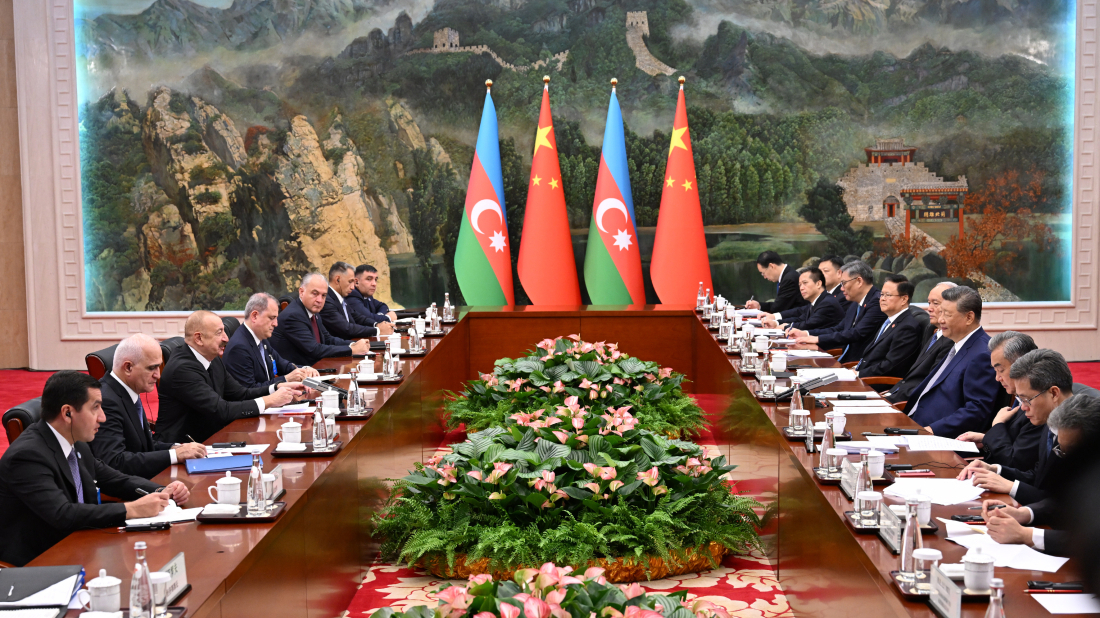
Ilham Aliyev, President of the Republic of Azerbaijan, held a meeting with Xi Jinping, President of the People's Republic of China, on August 31 in Tianjin, China.
President of the Republic of Azerbaijan Ilham Aliyev and President of the People's Republic of China Xi Jinping posed for a joint photo.
Addressing President Ilham Aliyev as “my dear friend,” President Xi Jinping thanked the head of state for accepting his invitation to participate in the SCO Plus Summit, as well as in the ceremonial events and military parade commemorating the 80th anniversary of China’s victory over foreign military aggression and fascism.
President Xi Jinping emphasized that successful cooperative relations have been established between Azerbaijan and China over the past 30 years, and that these relations are currently developing at the level of a comprehensive strategic partnership. He fondly recalled President Ilham Aliyev’s state visit to the People’s Republic of China and highlighted the significance of the discussions held during that visit.
The Chinese President noted the increase in trade turnover between the two countries and the expansion of cooperation in fields such as energy, including renewable energy, and the digital economy. Xi Jinping also stated that Azerbaijan-China cooperation has been strengthened within the framework of the “Belt and Road” initiative, emphasizing the importance of transporting Chinese goods through Azerbaijan, particularly highlighting the significance of the Trans-Caspian route.
The President of the People's Republic of China stated that his country supports the expansion of Azerbaijan’s ties with the Shanghai Cooperation Organization. Xi Jinping also noted the importance of direct dialogue in ensuring lasting peace between Azerbaijan and Armenia. Additionally, he affirmed China’s support for Azerbaijan’s sovereign development model and emphasized China’s commitment to the principle of non-interference in the internal affairs of other countries.
The head of state expressed gratitude for the invitation and conveyed congratulations on the occasion of the 80th anniversary of the People’s Republic of China’s victory over foreign military aggression.
President Ilham Aliyev, in turn, fondly recalled his state visit to the People’s Republic of China, noting that the meetings and dialogues held with President Xi Jinping during the visit significantly contributed to the comprehensive development of cooperation between the two countries. He highlighted the importance of the document signed on the comprehensive strategic partnership.
The President of Azerbaijan stated that developing relations with the People's Republic of China is one of the priority directions of the country’s foreign policy.
The head of state noted that Azerbaijan supports China’s position on the issues of Taiwan, Hong Kong, and the Xinjiang Uyghur Autonomous Region, and was among the first countries to condemn the elections held in Taiwan.
President Ilham Aliyev noted a significant increase in trade relations between the two countries. Referring to the “Belt and Road” initiative, he described the increase in transportation, particularly of Chinese cargo, through the Middle Corridor passing through Azerbaijan’s territory as an example of the corridor’s efficiency and attractiveness.
President Ilham Aliyev also stated that negotiations on normalization of relations and a peace agenda between Azerbaijan and Armenia are progressing on a bilateral basis, emphasizing that peace has already been established between the two countries.
During the meeting, they noted with satisfaction that the two countries consistently support each other within international organizations. They also highlighted that relations in the tourism sector have developed recently following the entry into force of a visa-free travel agreement.
A broad exchange of views was held on the prospects for cooperation between Azerbaijan and China.














What is your opinion on this topic?
Leave the first comment