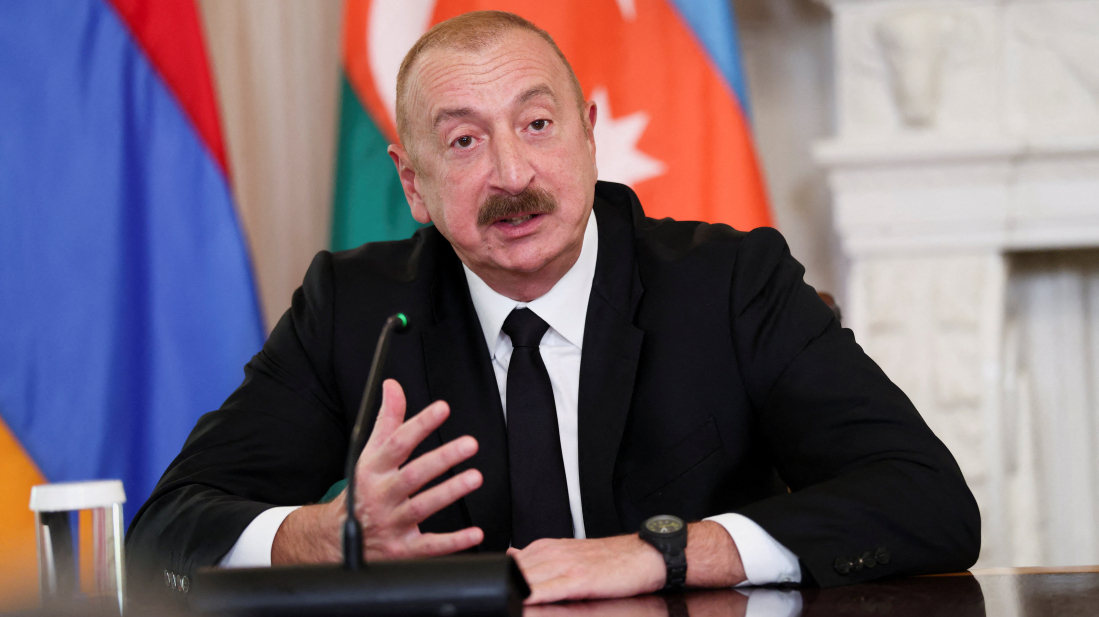
President of the Republic of Azerbaijan Ilham Aliyev gave an interview to a select group of Azerbaijani journalists in Washington on August 8, including our correspondent Oubai Shahbandar.
Aliyev hails “new page” in Azerbaijan-U.S. relations after Washington talks
President of the Republic of Azerbaijan Ilham Aliyev says his visit to Washington has opened a “new page” in relations with the United States, highlighting the repeal of Section 907, the launch of a Strategic Partnership Charter, and progress in peace efforts with Armenia. Speaking to Azerbaijani media on August 8, he described his first meeting with U.S. President Donald Trump as “friendly” and “result-oriented.”
“President Trump brings tangible results. So from this point of view, I highly value our personal relationship,” Aliyev said, praising the meeting as “friendly, cordial, and result-oriented.”
Symbolic repeal and strategic partnership
Aliyev called the waiver of the “unjust” Section 907 in his presence a move of “great symbolic significance” and said Trump chose to do it during their meeting. He announced the creation of a working group to draft a Charter on Strategic Partnership with the U.S., outlining areas such as mutual investments, energy, transport connectivity, transit, security, artificial intelligence, and defence industry cooperation.
“We do not want to waste time; the past four years under the previous administration, I consider them lost years,” Aliyev said, criticising the Biden administration for making bilateral ties “hostage to Azerbaijan-Armenia relations.” He called the launch of the strategic cooperation format “a historic event” and expressed confidence that “concrete results” would soon follow.
Peace agreement and regional stability
The President said the peace agreement with Armenia had been initialled and should be formally signed soon. He expressed confidence that Armenia’s planned constitutional changes would remove territorial claims against Azerbaijan, calling it essential for the peace process and respect toward the United States.
“What has been signed between Azerbaijan and Armenia clearly demonstrates our intentions – we want peace, but we want connectivity,” Aliyev said, adding that safe passage between the two parts of the country would benefit the wider region, including Armenia.
Aliyev also criticised what he called five years of “rumours and provocations” about Azerbaijan’s intentions toward Armenia, blaming the Biden administration for fostering “Azerbaijanphobia.”
Energy and economic cooperation
Aliyev noted that Azerbaijani natural gas is supplied to 10 NATO members and 14 countries overall, describing Azerbaijan as one of the world’s leading suppliers.
He confirmed discussions with the U.S. Export-Import Bank on resource projects, infrastructure, and transport. He called August 8 “a historic day” for regional security, stability, and economic opportunity.
On the economy, Aliyev said the memorandum between Exxon and SOCAR could lead to a “substantial project” and that there was a “high probability” of a major oil discovery. He emphasised Azerbaijan’s belief in the project’s future and Exxon’s long-standing experience in the country.
Boosting Azerbaijan’s transit role
Aliyev said Azerbaijan aims to strengthen its role as a transit hub, with corridors crossing its territory playing a greater role in cargo transport. “This brings money, jobs, and political leverage,” he noted.















What is your opinion on this topic?
Leave the first comment