Ukraine claims critical strike on Russian submarine in Novorossiysk
Ukraine’s domestic security service, the SBU, says it struck a Russian Kilo‑class submarine in the Black Sea port of Novorossiysk, causing critica...
A marine route survey has been launched for the construction of the Trans-Caspian Fiber Optic Cable which is an essential element of the 'Digital Silk Way' project, aiming to create a new digital corridor between Europe and Asia.
The survey will analyze coastal zones and conduct a detailed study of the seabed to determine the shortest, safest, and most environmentally sustainable route for this strategically significant project.
The survey, which began simultaneously in Azerbaijan and Kazakhstan, is expected to take up to four weeks.
As part of the Trans-Caspian Fiber Optic Cable project, a 380-kilometre fiber-optic line will be laid along the seabed of the Caspian Sea, linking Sumgayit (Azerbaijan) with Aktau (Kazakhstan).
The project is being jointly implemented by AzerTelecom (Azerbaijan) and Kazakhtelecom (Kazakhstan), with technical oversight and consulting provided by U.S. based Pioneer Consulting.
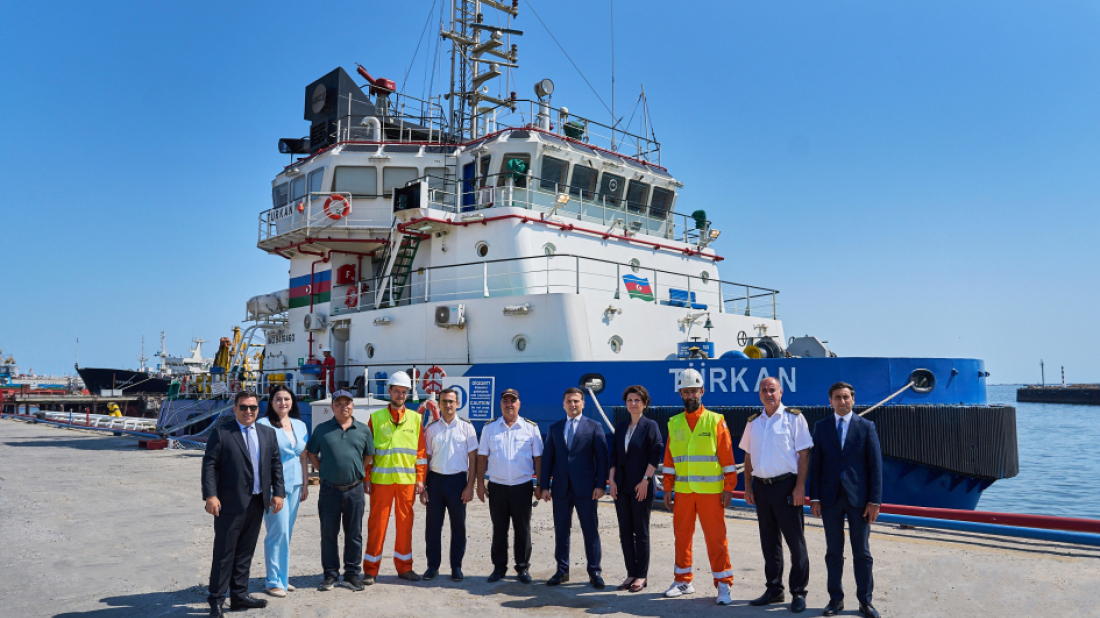
Chairman of the Board of AzerTelecom, Emil Masimov, along with the company’s management, visited the Turkan vessel to inspect its capabilities and advanced equipment.

During his meeting with the vessel’s crew and engineers, Masimov emphasized the strategic importance of the project.
“With the launch of the marine route survey, we are entering the main construction phase of the Trans-Caspian Fiber Optic Cable project. This cable will enhance regional digital connectivity and position the Caspian Sea as a vital part of global digital infrastructure. I am confident that work on both the Azerbaijani and Kazakh sides will be completed successfully and on schedule.”
Designed with a capacity of up to 400 Tbit/s, the submarine cable will enable high-volume data transmission. Construction is scheduled for completion by the end of 2026.
The Trans-Caspian Fiber Optic Cable being a key part of the 'Digital Silk Way' project, is a digital telecommunications corridor that will pass through various countries, including Georgia, Turkey, Azerbaijan, Kazakhstan, Turkmenistan.
This digital infrastructure, offering high bandwidth and low latency for data transmission, will function as the most efficient and direct route, enhancing regional collaboration and supporting sustainable development across countries.

Russia’s human rights commissioner, Tatyana Moskalkova, has said that Ukraine has not provided Moscow with a list of thousands of children it alleges were taken illegally to Russia, despite the issue being discussed during talks in Istanbul.
Iranian authorities have seized a foreign tanker carrying more than 6 million litres of smuggled fuel in the Sea of Oman, detaining all 18 crew members on board.
An explosive device found in a vehicle linked to one of the alleged attackers in Bondi shooting has been secured and removed according to Police. The incident left 12 people dead.
The latest round of clashes between Thailand and Cambodia has left 15 Thai soldiers dead and 270 others injured, Thailand’s Ministry of Defence spokesman Surasant Kongsiri said at a press conference on Saturday.
Syrian President Ahmad al-Sharaa has offered condolences to President Donald Trump following an ISIS attack near the ancient city of Palmyra that killed two U.S. soldiers and a civilian interpreter, Syrian and U.S. officials said Sunday.
The European Union’s interest in investing in regional connectivity projects in the South Caucasus, such as the Trump Route for International Peace and Prosperity (TRIPP) is driven by a need for strategic credibility and a tangible foreign policy success, according to a regional expert.
Shadow Trade is an investigative documentary by AnewZ that examines how global sanctions imposed after Russia’s 2022 war in Ukraine have been weakened through informal trade routes, permissive transit regimes, and overlooked commercial practices.
Kazakhstan and Uzbekistan have signed a new agreement on the transportation of natural gas through Uzbek territory, strengthening bilateral energy cooperation and supporting regional energy security ahead of the winter season.
Kazakhstan is assessing the scale of damage and potential losses following a recent attack on infrastructure operated by the Caspian Pipeline Consortium, a key export route for the country’s oil.
The Taliban leadership in Afghanistan opted out of a major regional meeting held in Iran’s capital Tehran on Sunday.
You can download the AnewZ application from Play Store and the App Store.
What is your opinion on this topic?
Leave the first comment