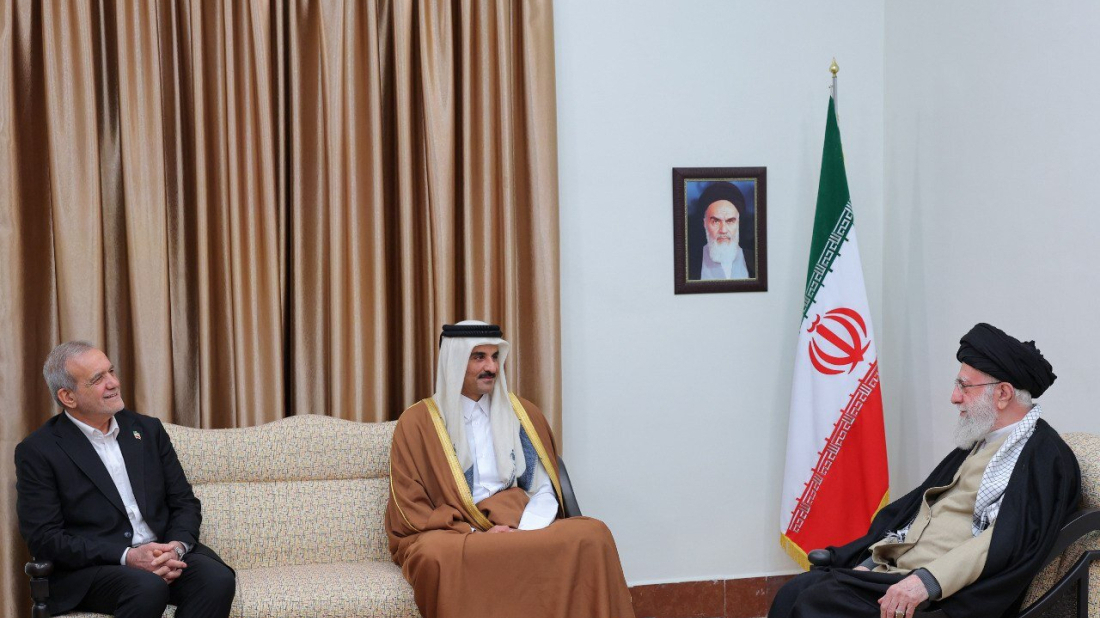
Iran's Supreme Leader, Ali Khamenei urged the Emir of Qatar to release Iranian oil revenues that had been frozen in Doha regardless of any U.S. pressure.
Qatar is “a friendly and brotherly country, although there are still ambiguous and unresolved issues,” Khamenei said in a meeting on Wednesday with Sheikh Tamim bin Hamad Al Thani, who is visiting Tehran, according to the state-run Islamic Republic News Agency.
Khamenei pointed out that Qatar has yet to fulfill previous agreements concerning the return of $6 billion held in Doha - funds that were originally frozen in South Korean banks. After Washington imposed a full ban on Iran’s oil exports and sanctions on its banking sector in 2019, these Iranian oil revenues were blocked in Seoul and subsequently transferred to Qatar.
“We recognize that the primary obstacle to implementing the agreement is the United States,” Khamenei stated, adding that if he were in the position of Qatar's rulers, he would ignore U.S. pressure and fulfill the agreement. "We continue to expect such action from Qatar," he concluded.
Sheikh Tamim mentioned that they covered various areas of cooperation, especially in trade and the economy. "We also emphasized the importance of following up on the outcomes of the recent meeting of the Joint Economic Commission and increasing trade exchange in a way that will help us achieve our goals," he said at the press conference, highlighting "the necessity of creating new opportunities for cooperation" between Iran and Qatar.
The question of Iranian access to the funds has been in the spotlight since Iran-backed Palestinian Hamas militants attacked Israel on 7th October, 2023. Former U.S. Secretary of State Antony Blinken said that Iran had not yet been able to spend a single dollar of the funds that were unfrozen in a U.S.-Iran prisoner swap in September of 2023. Five U.S. citizens detained by Tehran were allowed to leave the country in exchange for the transfer of $6 billion in Iranian funds that had been frozen in South Korea. At the same time, five Iranians held in the United States were allowed to leave.
Under the terms of the Iran prisoner deal, the money can only be used for humanitarian-related purposes, including purchasing food, medicine, medical devices, and agricultural products for the people of Iran from the abroad.
The agreement was reached through diplomatic efforts and secret talks, with Qatar playing a central role in the negotiations.














What is your opinion on this topic?
Leave the first comment