The opening day of the 24th Arab Media Summit in Dubai highlighted how geopolitical, economic and technological upheaval is reshaping not only the region, but the media industry itself.
More than 175 sessions are being held across the three-day summit, bringing together more than 400 speakers from 23 countries and around 250 media organisations. Eight specialised forums are covering everything from journalism and government communication to artificial intelligence, social media, film, gaming, podcasting and international news.
But the opening day made one thing clear: the central question is no longer simply how media organisations produce news. It is increasingly about how information shapes public opinion, how governments communicate during crises, how technology transforms production and how journalism responds when regional politics move faster than traditional news cycles.
From creating content to controlling the information space
Several sessions on the opening day reflected this shift.
Discussions including “When Public Opinion Becomes the Target,” “AI Tools for Content Creation,” “How the War Reshaped the Gulf” and “The Future of Media as Seen by Youth” addressed different parts of the same transformation.
Running through them was a common theme: the changing relationship between information and influence.
Artificial intelligence is making it possible to create, translate, edit and distribute content at speeds that would have been difficult to imagine just a few years ago. At the same time, audiences are moving further towards social platforms, short-form video and creator-led media.
For traditional news organisations, that presents a growing challenge: speed is becoming easier to achieve, while trust is becoming harder to maintain.
The question for newsrooms is therefore not simply whether they should use AI. It is how they can use it without losing editorial responsibility, verification and the human judgement that separates journalism from automated content.
That challenge is reflected across the wider Arab Media Forum agenda, which is examining geopolitical changes, the future of news and content, technology, artificial intelligence, credibility, digital platforms and the representation of the Arab world in international media.
The Gulf war changes the media conversation
The session “How the War Reshaped the Gulf” brought the region's current security environment directly into the media discussion.
For journalists working across the Gulf, the consequences of the conflict are not limited to military developments. War affects energy markets, shipping routes, aviation, investment, public communication and the way governments interact with their populations.
Regional journalism must therefore increasingly explain the connections between events that might once have been treated as separate stories.
A disruption to a shipping route, for example, can quickly become an economic story. An economic shock can become a political story. A political development, meanwhile, can almost immediately turn into an information battle on social media.
The result is a media environment in which geopolitics and information increasingly move together.
Syria takes centre stage
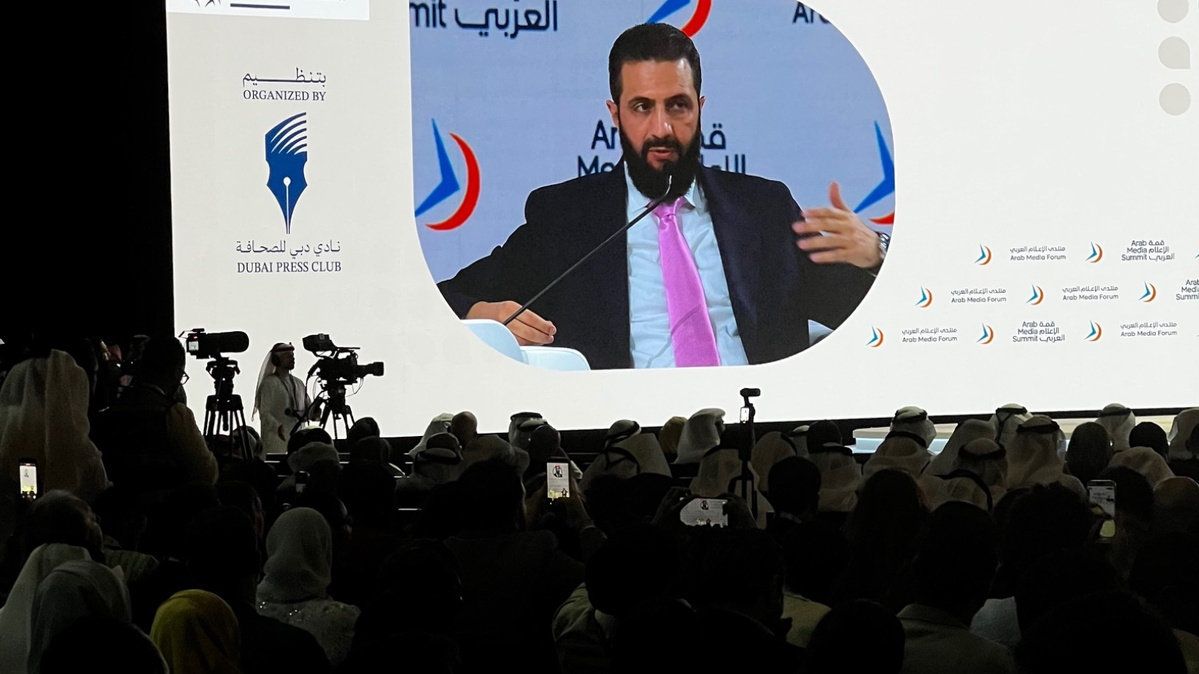
The clearest example came from the session “Syria: A Vision for the Future,” where Syrian President Ahmad al-Sharaa addressed the summit.
His appearance injected a direct political dimension into the media gathering.
Al-Sharaa presented Syria as a country entering a new phase following years of war and international isolation. He said the lifting of sanctions had opened the door to investment and economic recovery and argued that Syria had moved from being a major regional problem towards becoming an opportunity for investment and cooperation. He also linked Syria's future to regional security and trade routes.
The economic argument is particularly significant.
Washington took another major step towards opening Syria to international investment on 24 August, when the U.S.removed Syria from its list of state sponsors of terrorism and revoked related designations. The U.S. Treasury said the move was intended to help foster investment and promote political and economic stability.
For Damascus, that creates the possibility of reconnecting with international financial institutions, attracting Gulf capital and rebuilding infrastructure and trade links.
Al-Sharaa told the summit that Syria's economy could potentially reach $200 billion within five to 10 years, while highlighting Gulf investment and regional stability.
Yet the economic picture remains far more complicated.
Syria's transition remains extremely difficult. Just one day before the summit, fuel-price increases triggered widespread protests. Reuters reported that diesel prices had risen by 40 per cent, while petrol and gas prices had also increased, adding to pressure on a population already facing severe economic hardship.
That contrast is crucial to assessing the message emerging from Dubai.
Syria may be opening its doors to investment, but attracting capital is not the same as delivering economic recovery.
The country still needs functioning institutions, infrastructure, reliable energy supplies, financial access and political stability. It also needs to convince international investors that the new economic opportunities can be sustained.
That makes Syria's transformation one of the key stories emerging from the summit. The country is attempting to shift from being viewed primarily through the lens of war and crisis to being discussed as a potential economic and strategic hub.
Its geography adds to that calculation. Syria sits at a potential crossroads between the Gulf, Türkiye, the Mediterranean and the wider Levant. With regional trade routes under pressure, its future transport and energy connections could take on greater strategic importance.
Media and diplomacy increasingly overlap
Another major discussion, “Media and Diplomacy in a Changing World,” focused on the growing connection between journalism, government communication and international affairs.
That relationship is becoming increasingly visible as governments communicate directly with audiences through digital platforms, while journalists compete with official accounts, influencers and social-media personalities for public attention.
The Government Communication Forum, introduced for the first time as part of the Arab Media Summit, reflects this change.
The forum is examining how governments can communicate with broader audiences in a digital environment shaped by artificial intelligence, new technologies and rapidly changing audience behaviour. Its programme also addresses trust, transparency, crisis communication and digital transformation.
Its inclusion is more than simply an expansion of the summit programme. It reflects a fundamental shift in how public communication works.
Governments are no longer communicating with citizens only through traditional television, newspapers or official statements. They are competing for attention in the same digital environment as journalists, influencers and independent creators.
Young audiences reshape the media landscape
The session “The Future of Media as Seen by Youth” added another important dimension.
Younger audiences are no longer simply media consumers. Increasingly, they are producers, distributors and participants in shaping the wider conversation.
That shift has disrupted the traditional hierarchy of the media industry.
A major broadcaster can publish a report, but a creator with a smartphone can reach millions within minutes. A government can issue an official statement, but interpretations of it may already be spreading across social platforms before the statement itself is widely read.
For established media organisations, the challenge is to become faster and more flexible without sacrificing the standards that give professional journalism its value.









What is your opinion on this topic?
Leave the first comment