Tehran and Baghdad pledged to boost their security cooperation across all areas especially ratifying a security treaty signed by both countries in March 2023 and reinforcing border security.
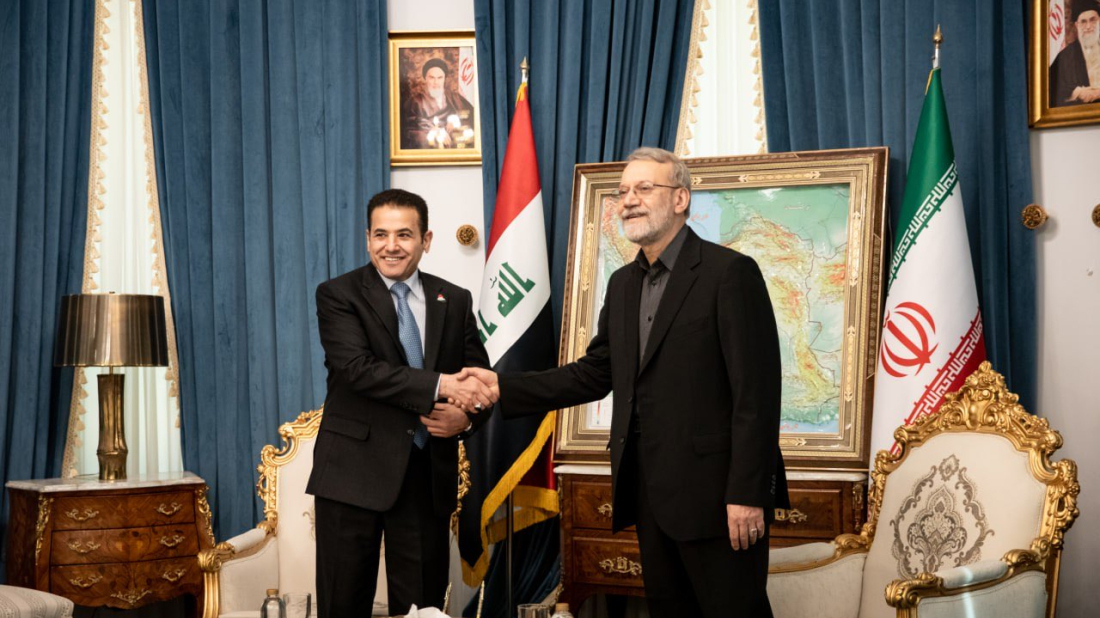
This took place when the National Security Advisor of Iraq Qasim Al-Araji visited Tehran for two days from Monday, following the invitation of his Iranian counterpart Ali Larijani who himself visited Baghdad in August.
In a statement released by Al-Araji’s office in Baghdad, the meeting with Larijani was focused on Iran and Iraq relations, economic issues, amongst others.
“The parties reviewed relations between Iraq and the Islamic Republic of Iran and discussed the joint security agreement for border security and the status of the anti-Iran Kurdish parties.
As well as Iraq’s commitments to keep them away from the borders and stop all their military and political activities,” the statement said.
The meeting also discussed the challenges on the borders, the statement added, with the Iraqi side “stressing its firm commitment not to allow any party to use Iraqi territory against any of Iraq’s neighbouring countries”.
Iran and Iraq signed a Security Treaty in March 2023 in Baghdad where Iraq pledged it would not allow militant groups to use its territory in the Iraqi Kurdish region to launch border-crossing attacks on areas close to Iran's borders.
“Iran and Iraq finally agreed to form a field committee to follow up on the implementation of the measures agreed upon in the security agreement,” the statement said.
Al-Araji was accompanied by the Interior Minister of Kurdistan Regional Government of Iraq Rebar Ahmed.
Besides meeting with his counterpart, Al-Araji met other senior Iranian officials including President Masoud Pezeshkian, Parliament Speaker Mohammad Bagher Ghalibaf, Foreign Minister Abbas Araghchi, and Major General Abdolrahim Mousavi Chief of Staff of Armed Forces.
“President Pezeshkian emphasized the significance of connecting Iran and Iraq's rail transport networks as a vital aspect of bilateral cooperation during a meeting with Iraq's National Security Advisor Qasim al-Araji and his delegation in Tehran on Tuesday,” the Iranian President’s Office said.
In the meeting with Iran’s Foreign Minister Abbas Araghchi, the Iranian side referred to the friendly relations between Tehran and Baghdad in all spheres, according to a Foreign Ministry press release.
“Araghchi stressed the necessity of continued regular consultations between officials of the two countries, as well as the need to strengthen cooperation in security matters, including border security.”
The visit by Iraq’s top security official to neighbouring Iran comes as the Arab country topped the headlines in recent days.
In another major development, the Turkish parliament extended the mandate of its troops stationed in Syria and Iraq for three years.
The necessity of deploying Turkish contingents in these countries is justified by the importance of fighting militants of the Islamic State and the Kurdistan Workers' Party (PKK), according to the official Anadolu Ajansi (AA).
The mandate authorizing Türkiye's cross-border military operation in Syria and Iraq expires on 30th October this year.











What is your opinion on this topic?
Leave the first comment