A newly created pro-government political party has secured a commanding victory in Kazakhstan's snap parliamentary election, according to exit polls, strengthening President Kassym-Jomart Tokayev's influence at a pivotal moment in the country's political transition.
The vote marks the first parliamentary election under Kazakhstan's new constitutional framework and is expected to further consolidate Tokayev's authority as he reshapes the political system following years of dominance by the country's former leader, Nursultan Nazarbayev.
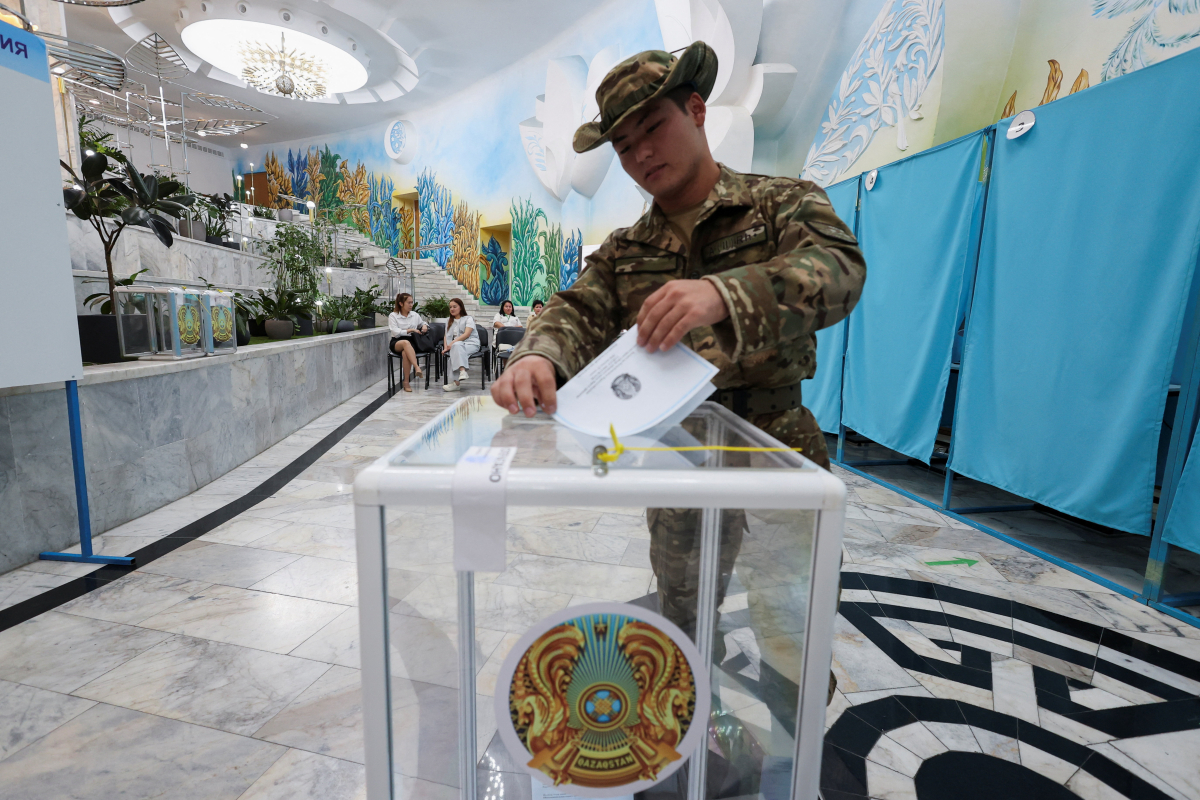
Exit polls broadcast by state media indicated that the Adilet Democratic Party (Adilet means justice or fairness) party won between 70 per cent and 72 per cent of the vote, giving it a dominant position in the country's legislature. Voter turnout was reported at more than 74 per cent, suggesting strong participation in the election.
Several smaller opposition parties are also expected to enter parliament. However, political observers generally view them as operating within a system that remains broadly supportive of the president's agenda.
New political force
Adilet was established earlier this year by senior figures close to Tokayev and quickly absorbed Amanat, the party that had dominated Kazakhstan's political landscape for years.
Its strong electoral performance is likely to reinforce Tokayev's position and further reduce the influence of political networks associated with Nazarbayev, who ruled Kazakhstan from independence in 1991 until stepping down in 2019.
Although Tokayev initially came to power as Nazarbayev's chosen successor, relations between the two camps deteriorated after unrest rocked the country in January 2022. Tokayev later characterised those events as an attempted coup involving individuals linked to the former ruling elite.
Since then, the president has steadily worked to reshape Kazakhstan's political institutions and strengthen his own base of support.
Election follows constitutional changes
The snap election was triggered by constitutional reforms approved earlier this year.
Under the new system, Kazakhstan's parliament has been streamlined from a bicameral legislature to a single chamber, a change the government says is designed to improve efficiency and simplify decision-making.
The reforms also altered the country's political architecture in other ways. Last month, Kazakhstan's Supreme Court ruled that the new constitution allows Tokayev to seek another seven-year presidential term.
The election is therefore being viewed as an important step in the broader restructuring of Kazakhstan's political system.
Balancing global relationships
Tokayev, a career diplomat and former senior United Nations official, has led Central Asia's largest economy since 2019.
During his presidency, he has sought to maintain balanced relations with major global powers, including Russia, China and Western countries, while positioning Kazakhstan as a reliable supplier of energy and critical minerals.
The country is one of the world's leading producers of uranium and a major exporter of oil, making political stability a key concern for international investors and trading partners.
Supporters argue that Tokayev's reforms have modernised the state's institutions and strengthened governance. Critics, however, have questioned the competitiveness of Kazakhstan's political environment and the extent to which opposition parties can challenge the ruling establishment.
Looking ahead
After casting his vote in the capital, Astana, Tokayev declined to indicate whether he intends to run for another presidential term, saying it was too early to discuss the issue.
He did, however, confirm that he would soon appoint Kazakhstan's first vice president, a new position created under the constitutional reforms.
The president told reporters that the announcement could come within the next week and suggested the appointee would be a well-known public figure.
With Adilet on course for a decisive parliamentary majority, attention is now likely to shift toward the formation of the next government and how Tokayev plans to use his strengthened mandate as Kazakhstan enters a new phase of political and constitutional change.













What is your opinion on this topic?
Leave the first comment