Kazakhstan's Ministry of Transport and Afghanistan's Ministry of Public Works have reached an agreement on the construction of a new railway line to connect Central Asia and South Asia, which will increase the efficiency of the North-South corridor.
The project is of particular importance for Kazakhstan in terms of expanding regional transit interconnectivity, strengthening transport and logistics links between Central and South Asia, and providing access to Indian Ocean ports. The new railway line will become a key link in the future transnational corridor passing through the territory of Afghanistan and providing the shortest route for freight traffic in the southern direction.
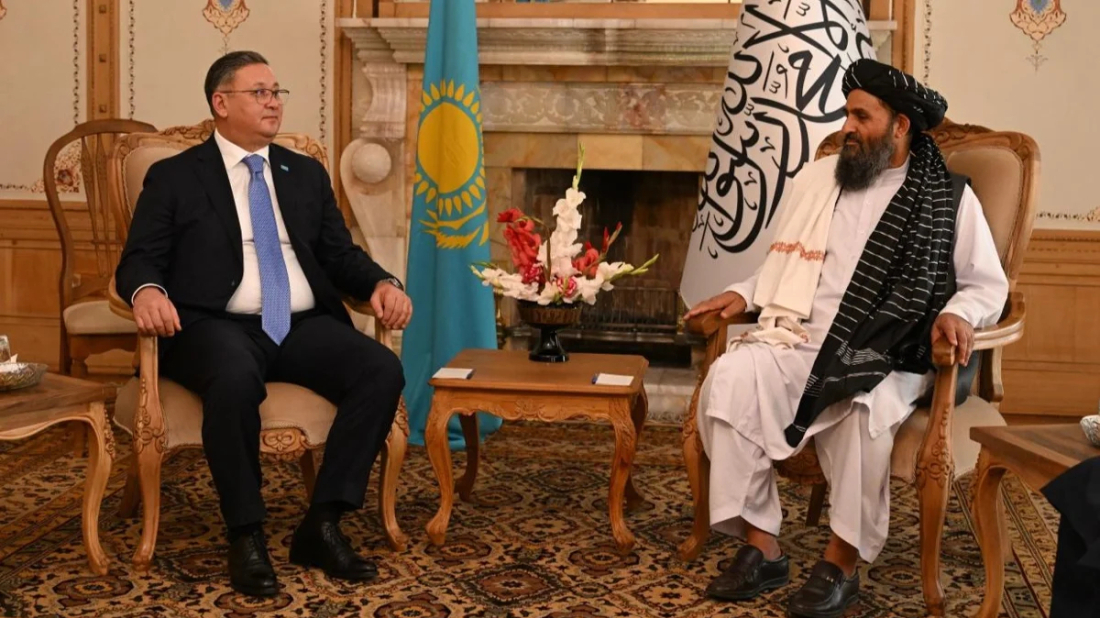
The agreement was reached during the working visit of Kazakhstan’s Deputy Prime Minister and Minister of Foreign Affairs, Murat Nurtleu, to Afghanistan.
At his meeting with Afghanistan’s Acting Deputy Prime Minister for Economic Affairs, Abdul Ghani Baradar, the parties discussed prospects for cooperation in the trade, economic, transit and agricultural spheres, as well as in geological exploration and digitalization.
The creation of an efficient transport and logistics infrastructure—including the development of the Trans-Afghan route—was highlighted as a key factor in ensuring sustainable and mutually beneficial trade across the region. In this context, Kazakhstan reaffirmed its intention to invest in the construction of the Turgundi–Herat railway line.
Kazakhstan and Afghanistan signed a protocol of intent on April 24 to jointly develop the Turgundi–Herat–Kandahar–Spin Boldak railway, including a logistics hub in Herat and fiber optic infrastructure to support digital connectivity.
Particular emphasis was placed on expanding the presence of Afghan products in the Kazakhstani market. In recent years, Afghanistan has begun exporting fresh and dried fruits, mineral water, and soft drinks to Kazakhstan. To further boost trade, a proposal was made to establish supply routes to western Kazakhstan via the border town of Turgundi and through Turkmenistan. This initiative would give Kazakhstani consumers access to fresh produce during the off-season, while enabling Afghan farmers to tap into a large and expanding market.
Kazakhstan is one of the ten main trading partners of Afghanistan. Trade turnover last year amounted to $545.2 million, of which the export of Kazakh products was $527.7 million.



















What is your opinion on this topic?
Leave the first comment