The AnewZ Opinion section provides a platform for independent voices to share expert perspectives on global and regional issues. The views expressed are solely those of the authors and do not represent the official position of AnewZ
As geopolitical tensions threaten the world’s vital energy corridors, the Strait of Malacca is emerging as a critical vulnerability in the strategic rivalry between China and the United States. Could the next major disruption to global trade unfold in Asian waters?
The global economy rests on a surprisingly fragile geographical foundation.
Trillions of dollars in investment, enormous industrial complexes, artificial intelligence infrastructure, oil refineries and the daily livelihoods of billions depend on a handful of narrow maritime passages.
Hormuz. Malacca. Bab el-Mandeb. Suez. The Turkish Straits. Panama.
These are not merely waterways. They are the arteries of the global economy — and increasingly, potential frontlines in a struggle for geopolitical influence.
For decades, energy security was largely about who controlled oil and gas reserves, who produced them and at what price.
Today, another question has become equally important: Can energy and strategic commodities reach their destinations safely, reliably and affordably?
Owning resources is one thing. Delivering them to markets is quite another.
Hormuz: The world’s vulnerable energy gateway
The Strait of Hormuz connects the Persian Gulf to international markets and remains indispensable to global energy security.
According to the US Energy Information Administration, approximately 20.9 million barrels of oil and petroleum products passed through Hormuz daily in the first half of 2025 — equivalent to roughly one-fifth of global petroleum consumption.
Saudi Arabia, Iraq, Kuwait, the United Arab Emirates and Iran depend heavily on this passage. Qatar’s liquefied natural gas exports are similarly exposed.
Any serious disruption would reverberate far beyond the Gulf.
Oil prices could surge, maritime insurance premiums rise and tankers be forced to seek alternative routes. Inflationary pressures would spread through manufacturing, transportation and consumer markets.
Even central bank decisions could be affected.
Crucially, a chokepoint does not have to be physically closed to cause economic damage. Missile threats, maritime attacks, uncertainty over navigation or the withdrawal of insurance coverage can be enough to disrupt commercial shipping.
Modern economic warfare increasingly operates through the threat of interruption rather than outright blockade.
Malacca: China’s strategic Achilles’ heel
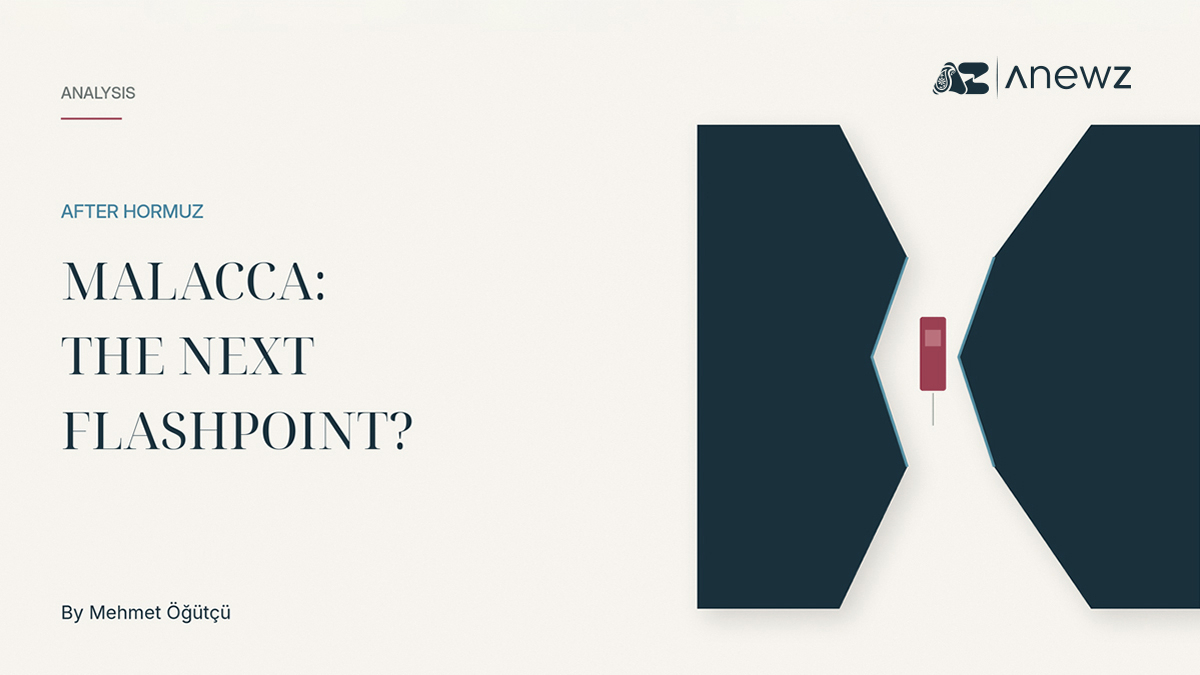
If Hormuz is the world’s most politically exposed energy gateway, Malacca may be its most consequential strategic vulnerability.
Stretching between Malaysia, Indonesia and Singapore, the Strait of Malacca connects the Indian Ocean with the South China Sea and the wider Pacific economy.
During the first half of 2025, approximately 23.2 million barrels of oil and petroleum products passed through this corridor daily, exceeding the volumes recorded at Hormuz.
But Malacca’s significance extends far beyond oil.
It connects China’s manufacturing economy, Japan’s industrial base, South Korea’s export industries and Southeast Asia’s commercial networks with energy suppliers and markets across the Middle East, Africa and Europe.
For Beijing, this dependence presents a fundamental strategic dilemma.
Chinese policymakers have long discussed the Malacca Dilemma: the vulnerability created by relying on maritime routes whose security China cannot independently guarantee.
The United States maintains a powerful naval presence across the Indo-Pacific, supported by alliances and security partnerships with Japan, Australia, the Philippines and Singapore.
This does not mean Washington can simply close Malacca at will. Such an action would involve enormous legal, diplomatic, military and economic consequences.
Nevertheless, in a major confrontation, China’s maritime energy supplies and commercial shipping could face serious pressure.
Beijing’s response has been to diversify.
Oil and gas pipelines through Myanmar, infrastructure investments at Pakistan’s Gwadar port, stronger overland energy connections with Russia and Central Asia, and the rapid expansion of China’s navy all reflect the same strategic objective.
China does not want its economic future held hostage by a single maritime passage.
Could Malacca become the next confrontation?
There is no inevitability that Malacca will become a military flashpoint.
Yet several scenarios deserve attention.
A major confrontation over Taiwan could threaten shipping across the wider Western Pacific. Escalating disputes in the South China Sea, particularly involving the Philippines, could create additional risks. A broader US-China conflict might bring maritime trade routes in the Indian Ocean into the strategic equation.
The consequences would not be confined to China.
Japan, South Korea and other Asian economies are also heavily dependent on the Malacca corridor. Any major disruption would damage American allies and global supply chains alongside Chinese interests.
This creates a geopolitical paradox.
The same economic interdependence that makes Malacca vulnerable also provides powerful incentives for restraint.
India adds another dimension. Its geographical position in the Indian Ocean, expanding naval capabilities and growing relationships with Washington, Moscow and Gulf capitals make New Delhi an increasingly important maritime actor.
The competition for influence over the Indian Ocean may become as consequential as the competition for oil-producing regions themselves.
The Red Sea has already delivered a warning
Disruptions around Bab el-Mandeb and the Suez Canal have demonstrated how relatively limited military capabilities can impose disproportionate costs on global commerce.
Missiles, drones and attacks on merchant vessels have prompted shipping companies to divert some traffic around Africa’s Cape of Good Hope.
Longer voyages mean greater fuel consumption, higher operating costs, delayed deliveries and additional pressure on supply chains.
The costs are ultimately passed on to manufacturers, exporters and consumers.
Globalisation was built around efficiency, speed and low transportation costs.
Increasingly, companies must prioritise resilience, security and predictability.
The global economy is moving from an age of maximum efficiency towards one in which resilience carries a premium.
Türkiye’s strategic opportunity
Türkiye occupies a distinctive position in this changing maritime landscape.
The Turkish Straits connect the Black Sea with the Mediterranean and provide a vital route for energy, grain, industrial commodities and regional trade.
Their significance cannot be measured by oil volumes alone.
The Montreux Convention gives Türkiye particular responsibilities concerning the passage of warships, as demonstrated during the Russia-Ukraine war.
But geography does not automatically translate into strategic influence or economic prosperity.
Türkiye must connect its maritime position with a broader energy and logistics strategy.
The Baku-Tbilisi-Ceyhan pipeline, TANAP, TurkStream, Black Sea gas production, LNG terminals, storage facilities, the Middle Corridor and the Development Road project should be viewed as complementary elements of a larger regional connectivity system.
The objective should be more ambitious than serving as a transit country.
Türkiye can seek a greater role in energy trading, storage, pricing, logistics, insurance and the financing of cross-border infrastructure.
In a world searching for diversified supply chains, dependable corridors will become increasingly valuable.
The new Great Game is moving to the seas
The nineteenth-century Great Game was fought primarily across the landmass of Central Asia between the British and Russian empires.
The twenty-first-century version is unfolding simultaneously on land, at sea, in space and across digital networks.
Oil tankers, LNG carriers, container ships, undersea data cables and critical mineral supply chains are now interconnected elements of strategic competition.
China’s Belt and Road Initiative, America’s maritime alliances, India’s Indian Ocean ambitions and Europe’s search for alternative trade corridors are different expressions of the same transformation.
The central issue is no longer simply who possesses strategic resources.
It is who can guarantee their movement — and who has the capacity to interrupt it.
Yesterday, attention focused on Bab el-Mandeb and Suez. Today, Hormuz dominates the debate. Tomorrow, Malacca or the waters surrounding Taiwan could become the centre of another crisis.
But geopolitical foresight should not become a prediction of inevitable conflict.
The real challenge is reducing the world’s dependence on a small number of vulnerable passages while preventing great-power rivalry from paralysing international commerce.
For middle powers, including Türkiye, that means diversifying energy supplies, developing alternative corridors, strengthening maritime security and investing in strategic resilience.
The global economy is growing larger, more technologically advanced and more interconnected.
Yet its foundations remain remarkably narrow.
After Hormuz, will Malacca be next?
Nobody can say with certainty.
But history reminds us that the course of world affairs can sometimes be changed not by an invading army or a dramatic political declaration, but by a tanker unable to pass through a narrow stretch of water.


















What is your opinion on this topic?
Leave the first comment