The AnewZ Opinion section provides a platform for independent voices to share expert perspectives on global and regional issues. The views expressed are solely those of the authors and do not represent the official position of AnewZ
The latest clashes between Thailand and Cambodia mark a dangerous escalation in one of Southeast Asia’s oldest and most sensitive disputes.
What might appear as another border skirmish has in fact become a significant test of regional diplomacy, leadership restraint, and the credibility of peace mechanisms in an era of renewed geopolitical complexity.
Thailand and Cambodia share an 817-kilometre border, much of which remains disputed due to colonial-era ambiguities. Over the decades, both sides have occasionally exchanged fire over small stretches of land, but the recent fighting — the most intense since mid-2025 — has raised fears of a wider conflict.
The border between Thailand and Cambodia was originally drawn under French colonial supervision in the early 1900s, but parts of it were never clearly demarcated. The most famous flashpoint remains the area surrounding the 11th-century Preah Vihear Temple, which the International Court of Justice awarded to Cambodia in 1962. However, the adjacent territory continues to be claimed by both nations, symbolising a deeper struggle between history, identity, and sovereignty.
While diplomatic efforts have occasionally produced temporary calm, the situation has often been vulnerable to political shifts and local military posturing. The renewed hostilities this December reportedly began after a Thai soldier was severely injured by a newly planted landmine, which Bangkok blamed on Cambodia — an accusation Phnom Penh firmly denied. The incident angered Thailand’s political and military leadership, triggering a wave of cross-border artillery exchanges.
The fighting quickly spread across multiple border provinces. Heavy weapons, air operations, and artillery strikes were used by both sides. Thailand claimed it destroyed a bridge allegedly used by Cambodian forces to move weapons and imposed curfews in its frontier provinces to protect civilians.
Bangkok’s stance has been unequivocal: “We will continue military action until there is no longer a threat.” In contrast, Cambodia has accused Thailand of striking civilian infrastructure and insisted it is open to peace negotiations — but only under regional or international observation. The result is a tense standoff, with both nations trading accusations while civilians on both sides bear the brunt. Reports indicate that hundreds of thousands have been displaced, and local economies are reeling under disrupted trade, restricted movement, and the suspension of tourism.
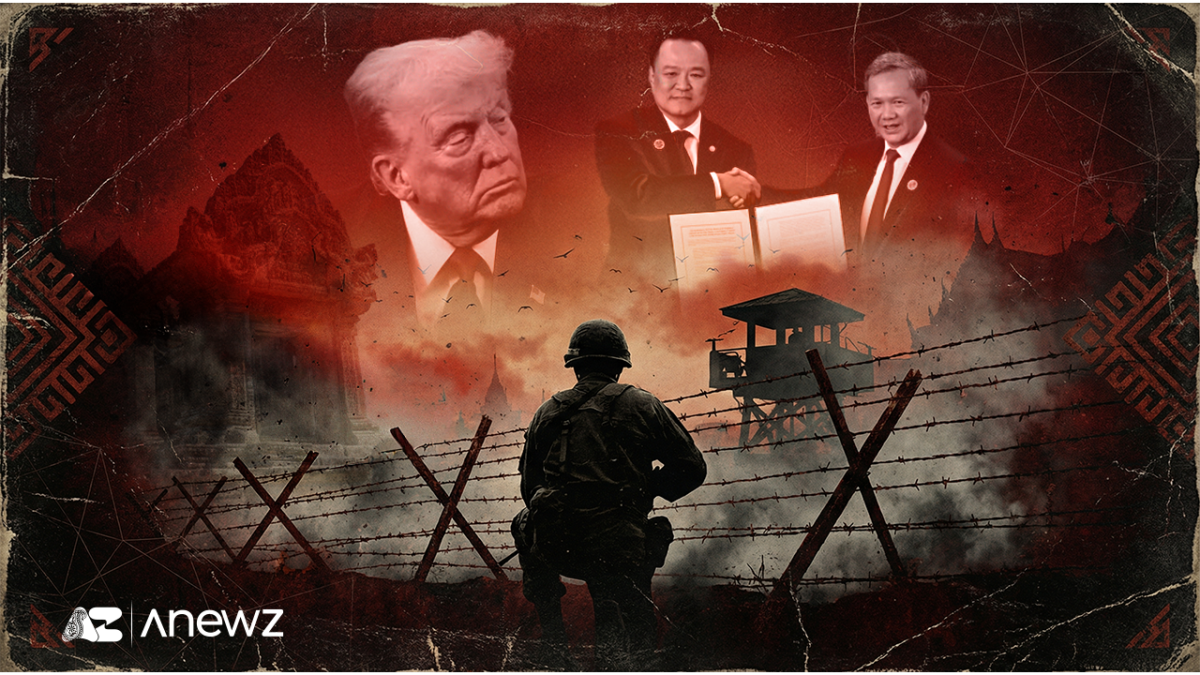
Into this volatile environment stepped U.S. President Donald Trump, who announced he had spoken separately with Thailand’s caretaker Prime Minister Anutin Charnvirakul and Cambodia’s Prime Minister Hun Manet — claiming both had agreed to “cease all shooting.” However, within hours, Thai officials publicly denied that any ceasefire had been reached. Military operations continued that very morning, directly contradicting the White House statement.
This episode underscores the limits of U.S. influence in a region increasingly shaped by regional diplomacy. As one Thai official put it, “You cannot announce peace while bullets are still flying.” The disagreement was not personal, but procedural — Thailand argued that security threats must first be neutralized and that ceasefire terms must be jointly agreed before being announced.
In contrast, ASEAN’s role has emerged as both credible and constructive. Malaysian Prime Minister Anwar Ibrahim, serving as ASEAN Chair, swiftly proposed the deployment of a regional observer team led by Malaysia’s defence chief, supported by U.S. satellite monitoring to verify ceasefire compliance. Both sides have expressed conditional willingness to cooperate with these observers — a step that signals ASEAN’s increasing maturity as a conflict-mediation platform.
This crisis has highlighted a crucial shift: external powers can support peace efforts, but regional actors must lead them. ASEAN’s call for “immediate restraint and dialogue” reflects not only institutional wisdom but also the region’s hard-earned understanding that sustainable peace must come from within, not be imposed from abroad.
Beyond geopolitics lies a stark humanitarian reality. Civilians caught in the conflict face curfews, displacement, and economic devastation. Border villages are struggling with food shortages, while families remain separated by security restrictions. This crisis has effectively turned a territorial issue into a human security challenge, underscoring the need for regional development frameworks that integrate peacebuilding and conflict prevention.
Peace is the foundation of prosperity. Infrastructure, trade, and cultural exchange can only flourish when mutual trust prevails. Regional connectivity — whether through the Belt and Road, ASEAN economic corridors, or other platforms — must rest on the pillars of stability and cooperation.
Both Thailand and Cambodia have a responsibility to de-escalate and return to negotiation. National pride and security concerns are understandable, but the long-term costs of prolonged confrontation will outweigh any short-term military gains. The humanitarian and economic implications are too grave to ignore.
ASEAN, too, faces a defining moment. The bloc’s credibility depends on its ability to not only manage crises but to prevent them. Malaysia’s proactive diplomacy provides a hopeful sign, demonstrating that the ASEAN principle of “regional solutions for regional problems” remains relevant and effective.
The Thailand–Cambodia clashes are more than a border dispute — they are a reminder that peace cannot be declared; it must be built. President Trump’s ceasefire claim may have momentarily captured headlines, but the responsibility for lasting calm lies with the region itself.
For Southeast Asia, this is a chance to reaffirm its commitment to cooperation, restraint, and shared development. For Thailand and Cambodia, it is an opportunity to turn a painful chapter of history into a platform for future partnership.
In an interconnected world, true strength lies not in confrontation but in collaboration. And for Southeast Asia, the path to lasting peace begins where the guns fall silent — at the table of diplomacy.
















What is your opinion on this topic?
Leave the first comment