Chinese researchers have developed the world’s smallest CT scanner, a portable device designed to produce images of tiny fossils and archaeological relics.
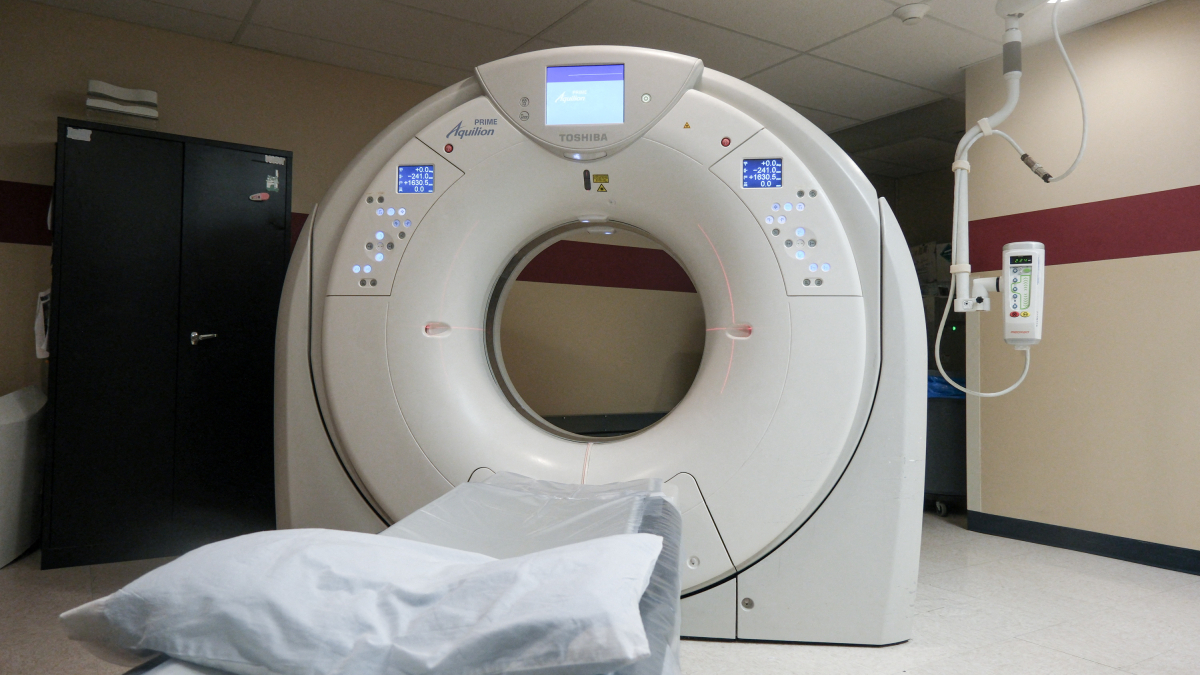
When most people think of a CT scanner, they picture something large, heavy, and firmly fixed to the floor of a hospital radiology department - a machine the size of a small car, weighing several tonnes, requiring its own room and a significant amount of electrical power to operate. A team of Chinese researchers has just built one the size of a desktop speaker.
The Xtomo-Cube, developed by a company called Rayim based in Jinan, Shandong Province, weighs just six kilograms, about the same as a bag of groceries and measures roughly 14 by 13 by 22 centimetres.
Liu Baodong, Rayim's general manager and a senior engineer at the Chinese Academy of Sciences, described it simply: “The device can be held in one hand and is the world's smallest and lightest CT system.”
It has already earned itself a nickname; the palm-sized CT scanner.
To put that in perspective, the previous record holder for the world's smallest portable CT scanner was developed in Germany and weighed 19 kilograms which is more than three times heavier. The Xtomo-Cube cuts that down to almost nothing.
Rayim was founded by a research team from the Institute of High Energy Physics at the Chinese Academy of Sciences, and everything inside the machine (the X-ray source, the rotating stage, the detector, and the software) was developed domestically.
It draws only around 200 watts of power, which means it can run outdoors on an ordinary portable power supply.
The Xtomo-Cube was designed specifically for analysing small objects, like fossils, archaeological relics, snail shells, chicken bones, and medicine capsules.
It has a spatial resolution of 80 micrometres which is roughly the width of a single human hair and is precise enough to map the internal three-dimensional structure of delicate objects without touching or damaging them.
Its scanning field covers objects up to 16 millimetres across.
The practical applications are immediately obvious for anyone who works with fragile or historically significant objects.
An archaeologist on a dig in a remote location could pull the device out of a bag, place a newly discovered artefact on the scanning stage, and get a detailed three-dimensional image of its interior structure on the spot without having to transport a potentially fragile object to a laboratory.
A palaeontologist could scan a fossil in the field. A museum conservator could examine the inside of an ancient relic without putting it at risk.
It could also have applications in quality control for manufacturing, pharmaceutical research, and materials science, anywhere that a quick, precise, non-destructive look inside a small object would be useful.
The device is not commercially available yet, and there are still questions about how it would perform compared to larger, more powerful CT systems in terms of the range and complexity of objects it can scan.
But the fact that a team of Chinese researchers has shrunk a technology that has historically required a room and a team of specialists into something you can carry in a backpack is a genuine engineering achievement pointing to the future of compact imaging technology.






















What is your opinion on this topic?
Leave the first comment