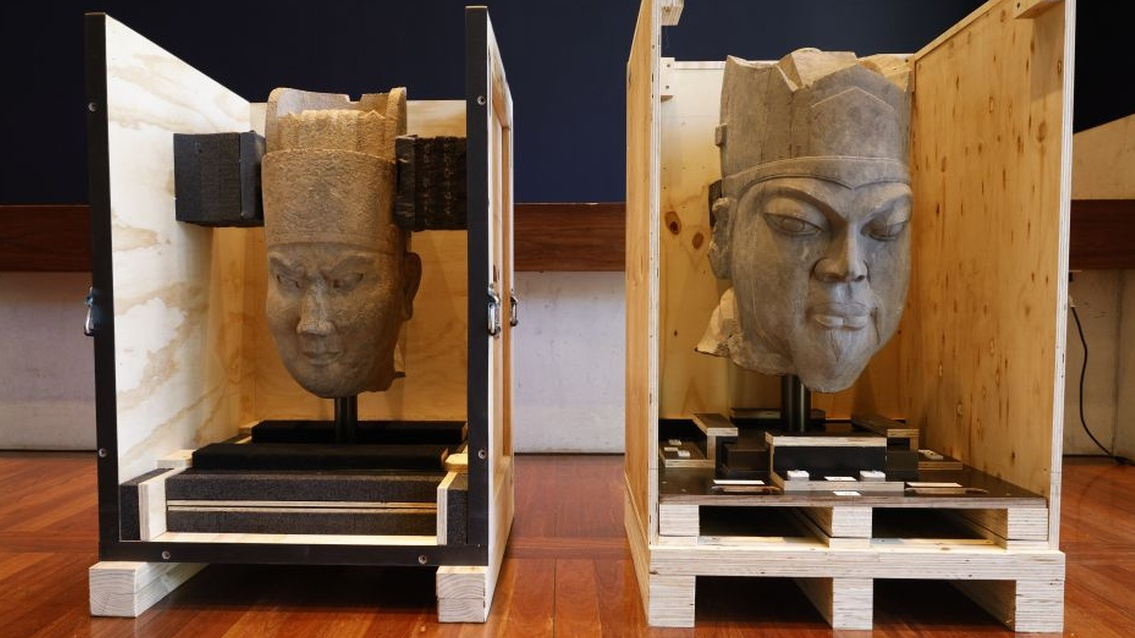
Australia has returned two ancient stone statue heads to China, more than 30 years after they were taken from imperial tombs in central China.
The Northern Song Dynasty (960–1127) sculptures were formally handed over at a ceremony in Canberra on Wednesday, where representatives of China's National Cultural Heritage Administration received them at the National Gallery of Australia.
Ancient treasures from imperial tombs
One head belonged to a statue of a civil official from the Yongchang Mausoleum, while the other came from a statue of a military official at the Yongyu Mausoleum.
Both tombs are in Gongyi, Henan Province, which is home to China's largest and best-preserved collection of stone sculptures from Northern Song imperial burial grounds.
Renowned for their intricate carvings, the sculptures are considered important examples of Song Dynasty stone art.
Decades after their disappearance
The heads are believed to have been stolen from the mausoleums in the 1990s before being donated to the National Gallery of Australia by a private collector.
China faced widespread illegal trafficking of ancient artefacts during the 1980s and 1990s, with imperial burial sites particularly vulnerable to theft.
The Gongyi burial grounds span 189 square kilometres. With security limited at the time, thieves targeted the heads rather than the entire stone figures, which weighed several tonnes each.
China and Australia strengthen heritage cooperation
The repatriation process began in 2025, when China requested the return of the sculptures following investigations and research by Chinese authorities.
At Wednesday's ceremony, Tang Wei, deputy director of China's National Cultural Heritage Administration, presented National Gallery of Australia director Nick Mitzevich with a certificate of appreciation.
Chinese Ambassador to Australia Liu Jinsong said the statues had stood guard over the ancient imperial tombs for centuries.
He also highlighted cooperation between government agencies, museums and heritage institutions in both countries, saying they had worked closely in recent years to fulfil their commitments to protecting cultural heritage under international frameworks.
A history of returning cultural treasures
This is not the first time Australia has returned cultural artefacts to China. In 2005, it handed back 10,000 fossils that had been illegally exported from the country.
The latest handover marks another step in cultural heritage cooperation between Beijing and Canberra, bringing two pieces of China's imperial history home after more than three decades.
Read more:












What is your opinion on this topic?
Leave the first comment