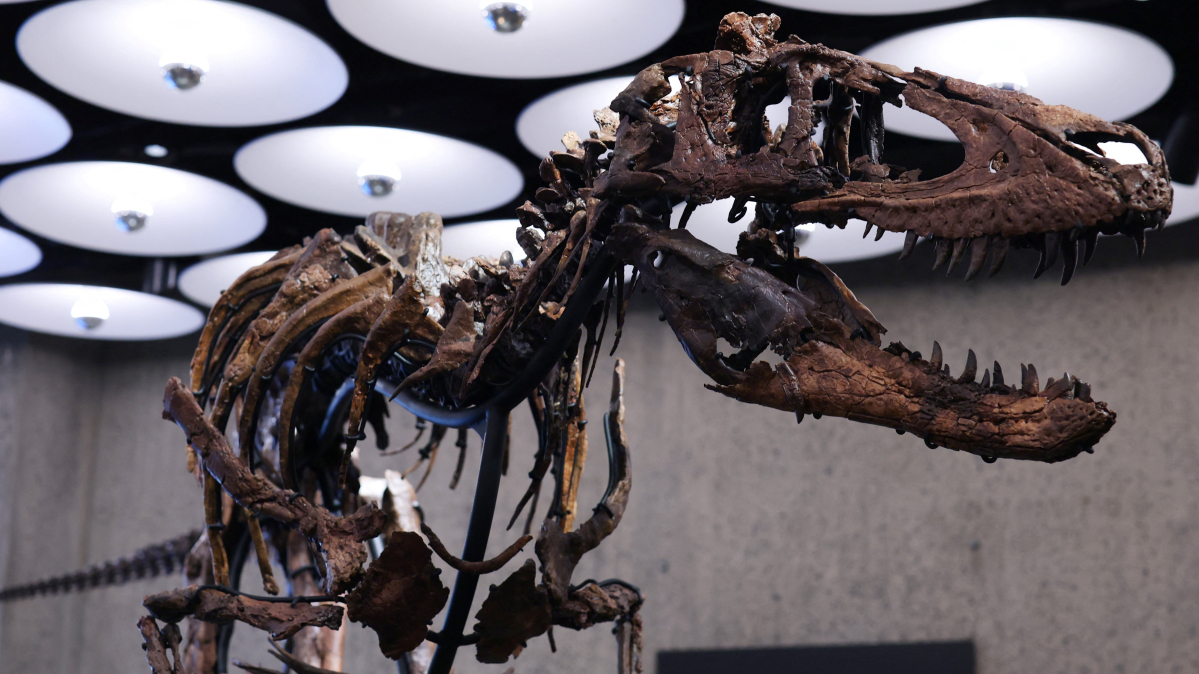
A rare 67-million-year-old dinosaur skeleton known as “Jodi” has sold for $47.3 million at Sotheby’s in New York, smashing its pre-sale estimate and becoming the second-most expensive dinosaur fossil ever sold at auction.
Six bidders battled it out by telephone and online for 12 minutes before an anonymous telephone bidder won the auction. Auctioneer Quig Bruning brought the hammer down at $40.5 million, with the final price reaching $47.255 million after fees.
The sale far exceeded the skeleton’s estimated value of $6 million to $9 million, placing Jodi behind the Tyrannosaurus rex skeleton “Gus”, which fetched a record $50.1 million in July 2026, according to Sotheby’s.
Jodi also overtook “Apex”, a Stegosaurus skeleton that sold for $44.6 million in 2024 and is now on long-term loan to the American Museum of Natural History in New York.
A dinosaur that challenged decades of research
Dating back approximately 67 million years, Jodi was once thought to be a juvenile Tyrannosaurus rex. However, research into the fossil has helped resolve a decades-long scientific debate, providing evidence that Nanotyrannus was a separate genus that lived alongside T. rex during the Late Cretaceous period.
Sotheby’s head of science and natural history, Cassandra Hatton, called the discovery a major breakthrough in palaeontology.
“Jodi is a very exciting dinosaur - a newly proven genus,” Hatton said, explaining that the animal occupied a different ecological niche from T. rex.
Unlike its larger relative, Nanotyrannus was built for speed, with longer arms, larger hand claws and more slender legs.
While T. rex had powerful jaws and bone-crushing teeth, Nanotyrannus possessed narrower teeth designed to slice through flesh.
Hatton also pointed to key differences in their skulls and jaws. Nanotyrannus had up to 17 tooth sockets in certain parts of its jaw, compared with around 12 in T. rex.
A rare fossil with scientific value
Measuring around six metres long and standing 2.9 metres tall on its display mount, the adult specimen contains approximately 191 fossil bone elements.
These include a virtually complete skull comprising 53 bones, a complete wishbone and all four hand claws.
“The whole specimen has about 191 bones, which is a huge number of bones for a skeleton,” Hatton said, highlighting the importance of its well-preserved skull in identifying the dinosaur’s anatomical features.
Montana rancher Jodi Pierson discovered the fossil in 2019 on her property near the town of Jordan in the U.S. The skeleton was later named in her honour.
According to Sotheby’s, it is one of just three substantial Nanotyrannus skeletons known to science and the second most complete specimen.
Private ownership raises research concerns
The multimillion-dollar sale highlights the growing demand for rare dinosaur fossils, as soaring auction prices attract wealthy collectors and raise questions about scientific access.
The purchase also includes the rights to produce and sell casts and replicas of the skeleton.
Some researchers have warned that fossils acquired by private collectors could become inaccessible to scientists and the public, potentially restricting future research and museum exhibitions.
For now, the buyer remains anonymous, leaving unanswered questions about whether Jodi will eventually be made available for scientific study or put on public display.
Read more:















What is your opinion on this topic?
Leave the first comment