UN adds 61 companies to database linked to Israeli settlements
The United Nations human rights office has added 61 companies to its database of businesses involved in activities linked to Israeli settlements in...
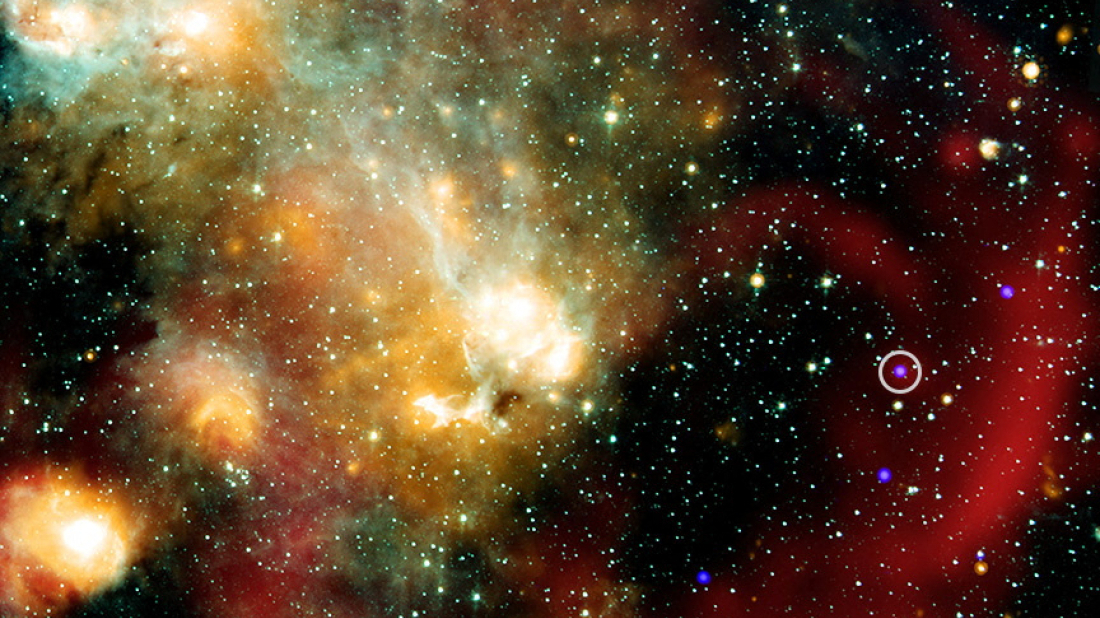
A newly discovered object in the Milky Way is baffling astronomers with bursts of radio and X-rays every 44 minutes.
Astronomers have identified a mysterious new object in the Milky Way, named ASKAP J1832-0911, which emits bursts of radio waves and X-rays for two minutes every 44 minutes.
An international team reports that the object—possibly a star, a binary system, or something else entirely—releases X-rays at the same time it sends out radio pulses.
Located about 15,000 light-years away in a dense region filled with stars, gas, and dust, the object may be a highly magnetized dead star, such as a neutron star or white dwarf.
NASA’s Chandra X-ray Observatory first detected the X-ray emissions by chance last year while observing a nearby supernova remnant. It marks the first time X-rays have been linked to a long-period radio transient—an extremely rare type of object that pulses on timescales of tens of minutes.
The object’s hyperactive phase lasted roughly a month. Outside that window, it showed no X-ray activity, leading scientists to suggest that more such hidden objects could be waiting to be found.

Leaders from around the world are gathering in New York for the latest session of the United Nations General Assembly, with conflicts in Ukraine and the Middle East, global security, trade, artificial intelligence, climate change and economic development dominating the agenda.
World leaders return to the United Nations headquarters in New York on Friday for the fourth day of the high-level General Debate, with speeches and diplomatic meetings continuing throughout the day.
Fourteen Kazakh military personnel died after being swept out to sea during a naval training exercise in the western Mangistau region, authorities said on Thursday.
Finland and Sweden deployed fighter aircraft on Thursday after a group of Russian military planes was detected over the Gulf of Finland, the Finnish Air Force reported on Friday (25 September).
Iran on Saturday awaited a U.S. response to its proposal to reopen the Strait of Hormuz and end fighting in the Middle East war after the Wall Street Journal reported that President Donald Trump had rejected the deal.
Meta has unveiled a new generation of wearables, including lightweight virtual reality glasses and camera-free smart spectacles, as it pushes AI-powered devices further into the mainstream while seeking to address privacy concerns.
U.S. President Donald Trump announced on Saturday (19 September) the creation of an “AI Force” and plans to appoint an artificial intelligence (AI) czar, while rejecting calls to slow the development of increasingly powerful AI systems.
Google’s Gemini AI model accessed the internet and hacked three companies during a cybersecurity test, in what is believed to be the first known case of the company’s AI systems autonomously carrying out such activity.
Here's your AnewZ Daily Brief for 18 September 2026. These are the top five stories making headlines in the field of science.
French prosecutors have launched a criminal investigation into suspected sexual harassment involving smart glasses, amid mounting global concern over the privacy risks posed by the devices.
You can download the AnewZ application from Play Store and the App Store.
What is your opinion on this topic?
Leave the first comment