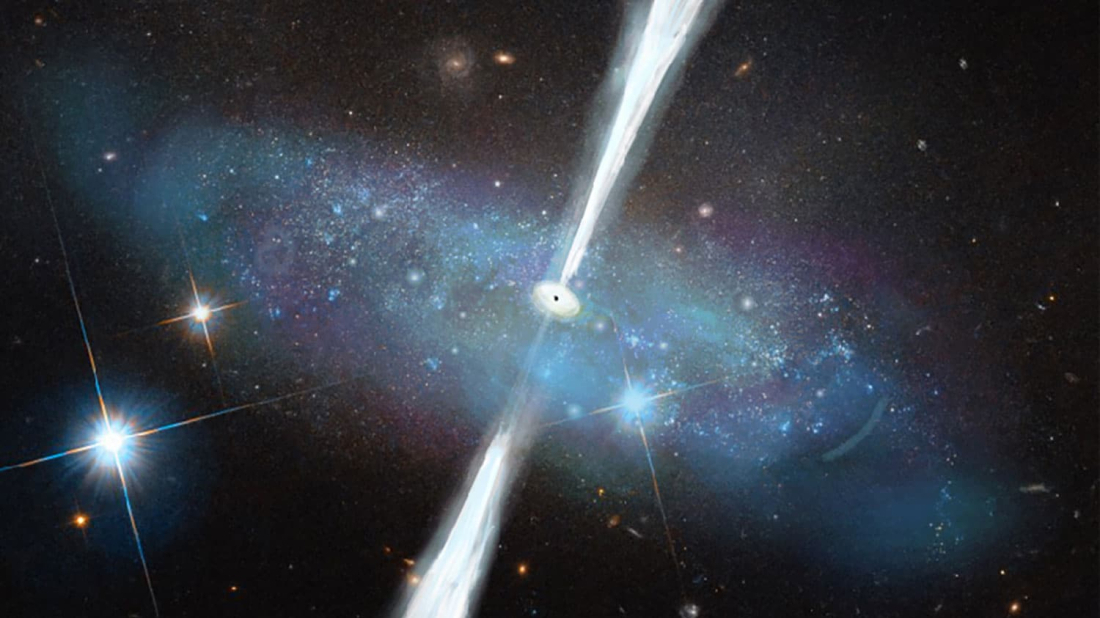
A groundbreaking study using early data from the Dark Energy Spectroscopic Instrument (DESI) has uncovered the largest-ever sample of dwarf galaxies hosting actively feeding black holes, as well as the most extensive collection of intermediate-mass black hole candidates.
A team of scientists, including experts from the University of Portsmouth, has made a monumental breakthrough in understanding the relationship between black holes and galaxy evolution. By using early data from the Dark Energy Spectroscopic Instrument (DESI), they’ve compiled the largest sample ever of dwarf galaxies that host actively feeding black holes, alongside the most extensive collection of intermediate-mass black hole candidates to date. This dual achievement has profound implications for our understanding of the black hole population in the universe, offering fresh insights into the origins and evolution of these enigmatic cosmic objects.
The Significance of the Discovery
The significance of this discovery cannot be overstated. The data expands scientists’ knowledge of how dwarf galaxies and black holes interact, shedding light on the formation of the very first black holes and their role in shaping the evolution of galaxies. These findings set the stage for deeper explorations into the formation of black holes and the mechanisms driving galaxy evolution.
The DESI instrument, a state-of-the-art telescope capable of capturing light from 5,000 galaxies simultaneously, has proven essential in gathering the data. The international collaboration behind DESI, consisting of over 900 researchers from more than 70 institutions, has enabled the project to push the boundaries of astronomical discovery. Managed by the Lawrence Berkeley National Laboratory, DESI has already made significant strides in mapping the universe.
Exploring the Dwarf Galaxies and Black Holes
The team, led by University of Utah postdoctoral researcher Ragadeepika Pucha, analyzed early DESI data from a vast sample of 410,000 galaxies, including approximately 115,000 dwarf galaxies. Dwarf galaxies are smaller and contain fewer stars and gas than their larger counterparts, making them a challenging environment for scientists to study black holes. However, the active galactic nuclei (AGN) in these galaxies—black holes actively feeding on surrounding material—are easier to detect, as they emit a tremendous amount of energy when they start “feeding.”
Pucha’s team identified an impressive 2,500 candidate dwarf galaxies hosting an AGN, marking the largest sample of its kind. This discovery highlights a much higher fraction of dwarf galaxies with AGNs than previously thought, indicating that scientists may have been overlooking a significant number of low-mass black holes. The finding is exciting, as it opens the door to a new era of discovery regarding black holes that lie in the intermediate-mass range—those that fall between the lightweight black holes (less than 100 times the mass of our Sun) and the supermassive black holes (more than one million times the mass of our Sun).
The Elusive Intermediate-Mass Black Holes
In addition to discovering dwarf galaxies hosting AGNs, the team also identified 300 intermediate-mass black hole candidates, marking the largest collection of such candidates to date. These intermediate-mass black holes, theorized to be the remnants of the first black holes formed in the early universe, bridge the gap between the lightweight and supermassive varieties. Until now, only about 100-150 intermediate-mass black hole candidates had been identified. The new dataset offers a promising resource for studying these elusive objects and their role in the formation of supermassive black holes at the centers of large galaxies.
Interestingly, only 70 of the newly discovered intermediate-mass black hole candidates overlapped with the dwarf AGN candidates. This surprising result raises important questions about the mechanisms of black hole formation and their relationships with the galaxies they inhabit. Could the formation processes differ between galaxies of varying sizes? These questions are at the forefront of ongoing research and offer a tantalizing glimpse into the unknown.
Looking Ahead: The Path to Understanding Black Holes
The data gathered by DESI is just the beginning of a new chapter in black hole research. With this treasure trove of information, scientists can now investigate the complex relationship between galaxy evolution and black hole growth. As DESI continues its mission, which is set to observe roughly 40 million galaxies and quasars by its conclusion in 2025, the potential for groundbreaking discoveries in astrophysics is vast.
Rahma Alfarsy, from the University of Portsmouth’s Institute of Cosmology and Gravitation, expressed excitement about the findings: "Having witnessed the development and outcomes of this brilliant work, we are really excited to see what else will be unearthed from DESI's treasure trove of extra-galactic observations."
As the fourth year of the DESI survey progresses, scientists are eager to use this invaluable dataset to uncover the secrets of the universe’s earliest black holes and deepen our understanding of their role in the cosmic landscape.
This remarkable work, “Tripling the Census of Dwarf AGN Candidates Using DESI Early Data,” has been published in The Astrophysical Journal on February 19, 2025, marking a significant milestone in black hole research.
Conclusion
With the DESI project continuing to revolutionize our understanding of the universe, scientists now have the tools to unravel mysteries that were once thought to be beyond our reach. As these discoveries unfold, the potential for new insights into black hole formation, galaxy evolution, and the early universe is greater than ever.





















What is your opinion on this topic?
Leave the first comment