Astronomers have observed a white dwarf - a highly compact Earth-sized stellar ember - that is creating a colourful shockwave as it moves through space, leaving them searching for an explanation.
The highly magnetised white dwarf is gravitationally bound to another star in what is called a binary system.
The white dwarf is siphoning gas from its companion as the two orbit close to each other. The system is located in the Milky Way about 730 light-years from Earth - relatively nearby in cosmic terms - in the constellation Auriga.
A light-year is the distance light travels in a year, 9.5 trillion km (5.9 trillion miles).
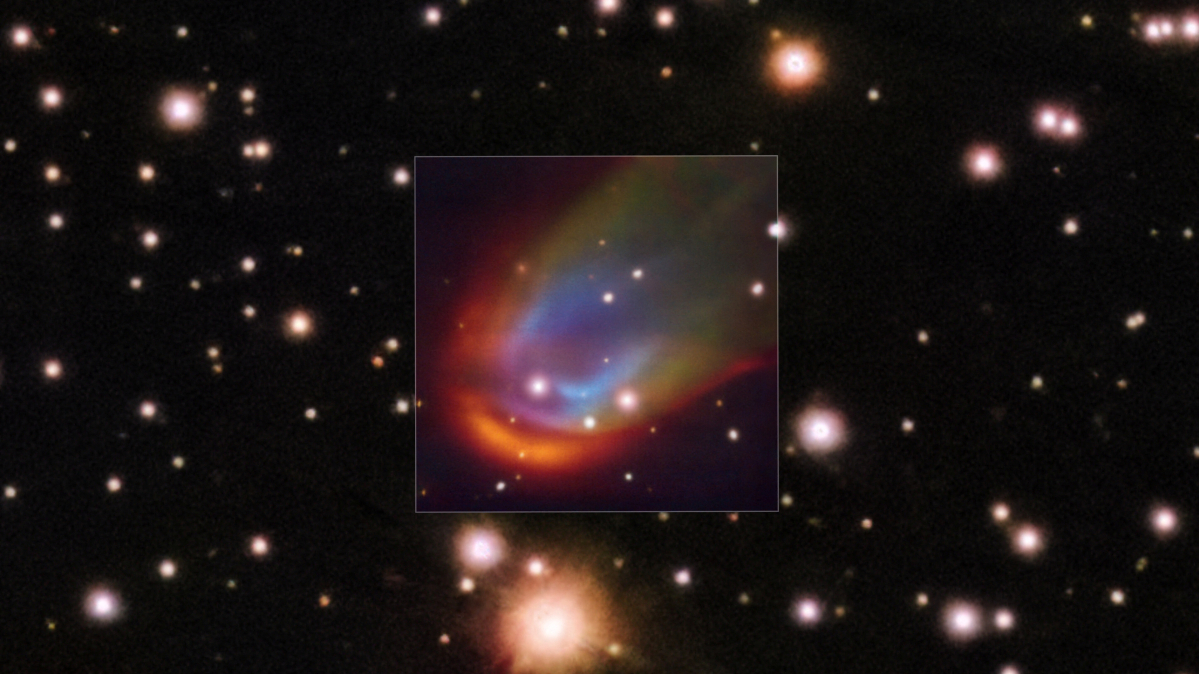
The shockwave - more specifically a bow shock - caused by the white dwarf was observed using the European Southern Observatory's Chile-based Very Large Telescope. It was seen in an image released by the scientists glowing in various colours produced when material flowing outward from the white dwarf collided with interstellar gas.
"A shockwave is created when fast-moving material plows into surrounding gas, suddenly compressing and heating it. A bow shock is the curved shock front that forms when an object moves rapidly through space, similar to the wave in front of a boat moving through water," said astrophysicist Simone Scaringi of Durham University in England, co-lead author of the study published on Monday (12 January) in the journal Nature Astronomy.
"The colours come from interstellar gas that is being heated and excited by the shock. Different chemical elements glow at specific colours when this happens," Scaringi added.
White dwarfs are among the universe's most compact objects, though not as dense as black holes.
In this one, a red hue represented hydrogen, green represented nitrogen and blue represented oxygen residing in interstellar space.
This white dwarf has a mass comparable to the sun contained in a body slightly larger than Earth. Its binary companion is a type of low-mass star called a red dwarf that is about a tenth the mass of the sun and thousands of times less luminous. It orbits the white dwarf every 80 minutes, with the two extremely close to each other - approximately the distance between the moon and Earth.
The gravitational strength of the white dwarf is pulling gas off the red dwarf along its strong magnetic field, eventually landing at its magnetic poles. While this process releases energy and radiation, it cannot account for the outflow of material needed to produce the observed shockwave, Scaringi said.
"Every mechanism with outflowing gas we have considered does not explain our observation, and we still remain puzzled by this system, which is why this result is so interesting and exciting," Scaringi said.
"The shape and length of the (shockwave) structure show that this process has been ongoing for at least about 1,000 years, making it long-lived rather than a one-off event," Scaringi added.
"Beyond the science, it's a striking reminder that space is not empty or static as we may naively imagine it. It's dynamic and sculpted by motion and energy," Scaringi explained.
'There are plenty of white dwarfs'
A handful of other white dwarfs have been observed creating shockwaves. But all of those were surrounded by disks of gas siphoned from a binary partner. Although this white dwarf is siphoning gas from its companion, it lacks any such disk and is releasing gas into space for unknown reasons.
Stars with up to eight times the mass of the sun appear destined to end up as a white dwarf. They eventually burn up all the hydrogen they use as fuel. Gravity then causes them to collapse and blow off their outer layers in a "red giant" stage, eventually leaving behind a compact core - the white dwarf.
"There are plenty of white dwarfs out there, as these are the most common endpoints of stellar evolution," Scaringi said.
The sun appears fated to end its existence as a white dwarf, billions of years from now.






















What is your opinion on this topic?
Leave the first comment