Scientists studying a distant planet may have found the strongest evidence yet of life beyond Earth. Gases linked to living organisms were detected on K2-18b, a discovery that could bring us closer to answering one of humanity’s oldest questions.
Could this be the breakthrough humanity has waited for?
For the first time in history, scientists may have found signs of life beyond Earth.
Using NASA’s powerful James Webb Space Telescope (JWST), researchers studying a distant planet called K2-18b have detected gases in its atmosphere that, on Earth, are only made by living organisms. While it’s not confirmation of alien life, it’s the strongest evidence yet that we might not be alone in the universe.
“This is the strongest evidence yet that there is possibly life out there,” said Professor Nikku Madhusudhan of the University of Cambridge, who led the research.
So, what exactly is K2-18b?
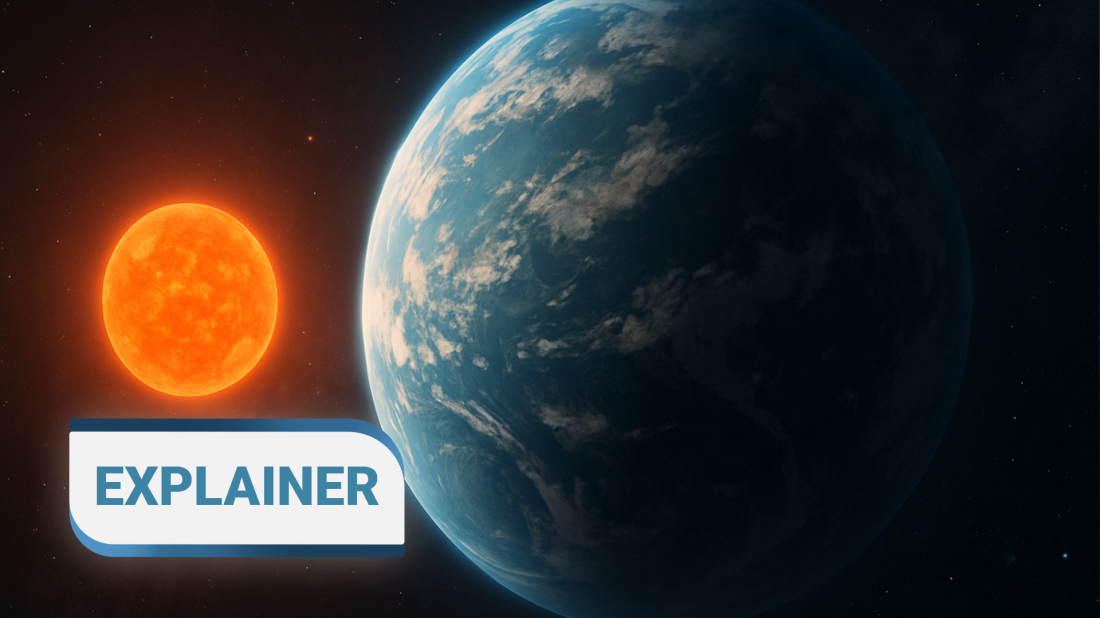
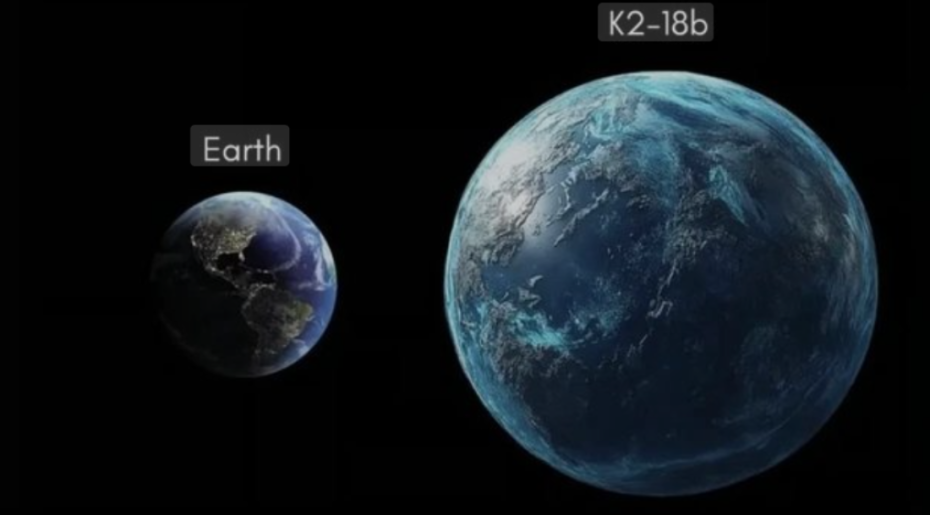
K2-18b is an exoplanet, a planet outside our solar system. It’s about 2.5 times the size of Earth, orbits a small red star, and sits 124 light-years away in the constellation Leo.
Importantly, it’s located in what scientists call the “habitable zone” — a not-too-hot, not-too-cold region where liquid water could exist on the planet’s surface. That makes it one of the best candidates for hosting life as we know it.
In 2019, the Hubble Space Telescope found water vapour in its atmosphere. But the real excitement came in 2023–2025, when JWST spotted carbon-based molecules — including methane and carbon dioxide — and possibly even dimethyl sulfide (DMS), a gas on Earth that is produced only by marine life.
“This is the strongest evidence yet that there is possibly life out there,” said Professor Nikku Madhusudhan of the University of Cambridge, who led the research.
What is dimethyl sulfide — and why does it matter?
On Earth, DMS is made almost entirely by tiny sea creatures called phytoplankton. Its presence in a planet’s atmosphere could suggest that similar life forms exist there.
“If this gas really comes from living things, then this planet could be teeming with life,” Madhusudhan explained. “But we need to be sure.”
Right now, the findings are still being double-checked. The researchers say they’re about 99.7% sure — impressive, but not enough for a scientific breakthrough, which usually needs 99.9999% certainty. Still, this is a giant step closer.
How do scientists detect life on faraway planets?
They use light — not telescopes with direct images, but light from distant stars that passes through a planet’s atmosphere.
When that light is broken into a spectrum (like a rainbow), certain parts are missing. These missing “slices” act like a barcode, telling scientists which gases are in the atmosphere. This technique is called transit spectroscopy.
“It’s like reading a planet’s breath,” explains astrophysicist Dr. Alan Robock. “Every gas leaves a fingerprint.”
If we find gases like oxygen, methane, and carbon dioxide together, that could be a strong sign of life — because those gases wouldn’t stay balanced unless something living was constantly making them.
But… what if we’re wrong?
It’s possible that the gases we’ve seen could come from non-living processes, like volcanic activity or chemical reactions in a strange atmosphere. That’s why scientists are being cautious.
“Even with perfect data, we can’t yet say for sure this gas is biological,” says Professor Catherine Heymans, Scotland’s Astronomer Royal.
Other experts point out we still don’t fully understand what K2-18b is made of. Is it an ocean world with liquid water? A mini gas giant with no surface? Or something else entirely?
There’s still a lot of debate, and many questions.
What if we find nothing at all?
Even if K2-18b turns out to be a false alarm, the search for life continues. A study by Dr. Daniel Angerhausen at ETH Zurich showed that even null results teach us something.
“Even if we find nothing, that’s still something,” said Dr. Daniel Angerhausen from ETH Zurich. “It tells us life is rare — and that Earth may be even more special than we thought.”
If scientists study dozens of planets and find no signs of life, they can still estimate how rare (or common) life might be in the universe. That information will guide future missions and improve our understanding of where to look next.
“Even not finding life helps us learn,” said Angerhausen. “It shows us how unusual our own planet really is.”
So, what happens next?
The Cambridge team hopes to gather more observations of K2-18b in the next 1–2 years. If future data confirms the presence of DMS or similar molecules — and we can rule out non-living sources — it would be one of the most important scientific discoveries of all time.
“Decades from now, we may look back at this moment as the point when the living universe came into view,” said Professor Madhusudhan.
Whether or not K2-18b holds life, one thing is clear: we’re getting closer to the answer.
Final thought
For thousands of years, humans have looked to the stars and asked, “Are we alone?”
Now, for the first time, we may be approaching a real answer. The discovery of possible life on a distant exoplanet like K2-18b would reshape how we see ourselves, our place in the cosmos, and what it means to be alive.
The universe just got a little more familiar, and a lot more exciting.






















What is your opinion on this topic?
Leave the first comment