Uzbekistan and Georgia launch digital permits to speed up freight
Uzbekistan and Georgia have launched an electronic permit system for international road freight, replacing paper documents in a move aimed at speed...
China has taken a major step in deep space exploration with the launch of Tianwen-2, aiming to become the third nation to return samples from an asteroid.
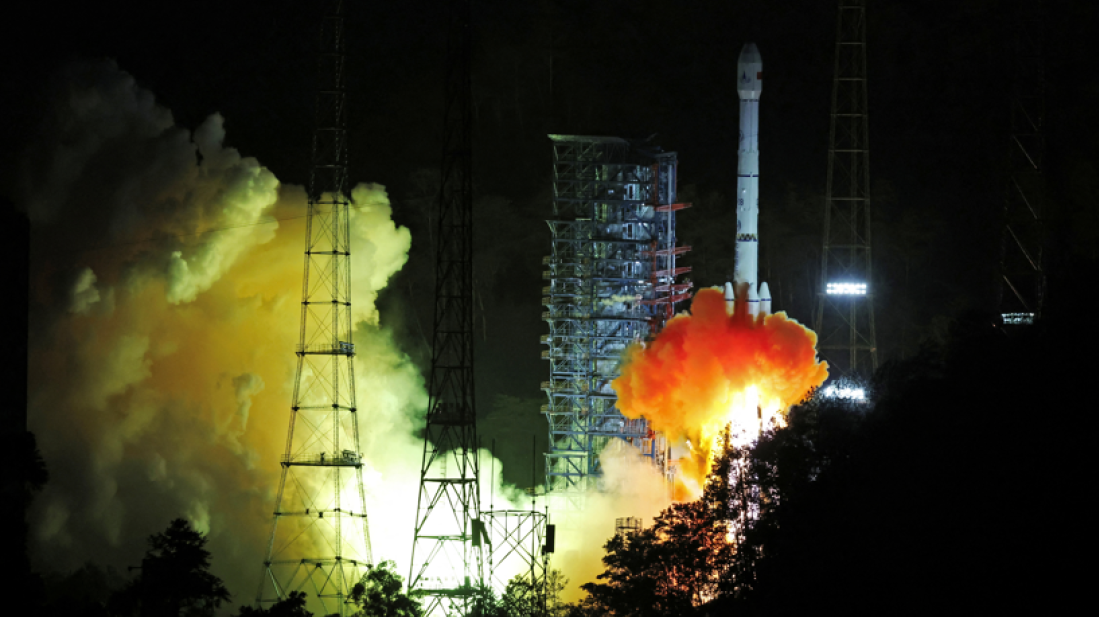
China launched its Tianwen-2 spacecraft early Wednesday in a landmark mission to retrieve samples from a near-Earth asteroid, 469219 Kamoʻoalewa. The Long March 3B rocket carrying the probe lifted off at around 1:31 a.m. local time from the Xichang Satellite Launch Center in southwest China. State media Xinhua confirmed the launch as a "complete success."
The robotic spacecraft is expected to approach the small asteroid—located about 10 million miles from Earth—over the next year, reaching its destination by July 2026. Tianwen-2 will collect rock samples and return them to Earth via capsule in November 2027.
This mission underscores China’s rapidly advancing space ambitions. In recent years, China has landed robotic missions on the far side of the moon, launched and operated its own space station, and is preparing to send astronauts to the lunar surface by 2030.
If successful, China will become the third country to recover asteroid samples. Japan pioneered such missions with Hayabusa in 2010 and Hayabusa2 in 2019. The United States followed with its OSIRIS-REx mission, which retrieved samples from asteroid Bennu in 2020.
Kamoʻoalewa, Tianwen-2’s target, is classified as a quasi-satellite of Earth—an object that follows a similar orbit around the sun. NASA estimates its size to range from 40 to 100 metres. Scientists hope the mission will offer insights into the early solar system and the origins of water and life on Earth.

Shipping traffic through the Strait of Hormuz remains limited on Thursday, with no increase in vessel crossings as U.S.-Iran talks to resolve the conflict remained stalled. Nine commodity vessels transited the key waterway on Wednesday, unchanged from the previous day, according to Kpler data.
Shipping through the Strait of Hormuz has slowed, according to the latest data, as uncertainty over the waterway’s reopening kept most shipowners away. Six commodity vessels crossed the strait on Tuesday, down from nine the day before and below the 10-day daily average of 11.
Russia is open to listening to new proposals on how to reach a settlement on the Ukraine conflict, a senior Russian diplomat said, but any proposals should reflect the "realities on the ground".
Start your day informed with AnewZ Morning Brief. Here are the top news stories for the 20th of August, covering the latest developments.
Five years after Evergrande's debt crisis rattled global markets, founder Hui Ka Yan has been sentenced to life in prison, marking a dramatic new chapter in the downfall of China's former property giant.
An artificial intelligence agent running an experimental store in San Francisco has recommended dismissing a human employee after the worker repeatedly arrived late for shifts.
Nvidia is teaming up with some of the biggest names in global finance in a move that underscores how artificial intelligence is rapidly becoming one of the world's most sought-after investment themes.
Parts of Europe and the Arctic will briefly fall into darkness on Wednesday, 12 August, as the Moon passes between Earth and the Sun in a total solar eclipse.
Meta said one of its AI models hacked another company's systems during cybersecurity testing, intensifying concerns about how developers can contain increasingly capable AI systems following similar incidents involving Anthropic and OpenAI.
Scientists say the accidental crash of a discarded SpaceX rocket stage into the moon has provided valuable data on impact cratering while posing no threat to Earth or lunar hardware.
You can download the AnewZ application from Play Store and the App Store.
What is your opinion on this topic?
Leave the first comment