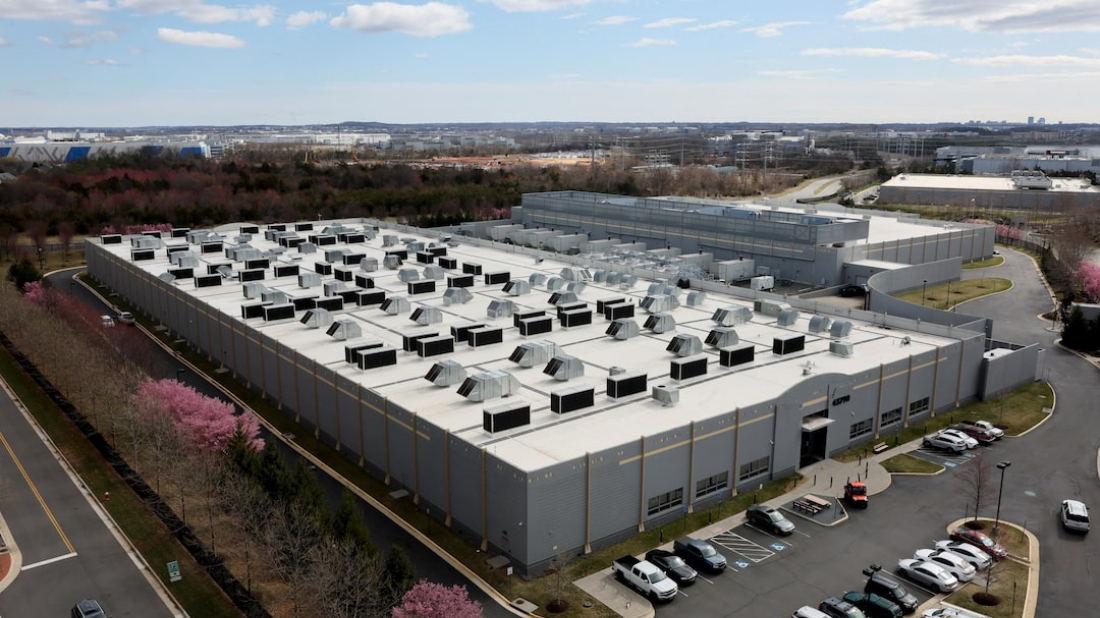
A massive, unanticipated disconnection of data centers in a 30-square-mile area outside Washington, D.C. has exposed a fresh vulnerability in America’s electrical grid, raising concerns that the rapid expansion of Big Tech’s energy-hungry facilities could trigger cascading outages.
In an incident last July, about 60 out of more than 200 data centers in what’s known as Data Center Alley suddenly dropped off the grid and switched to on-site generators. This mass reaction was triggered by a standard safety mechanism designed to protect sensitive computer chips and electronic equipment from voltage fluctuations. However, the abrupt shift caused a huge surge in excess electricity, forcing grid operator PJM and local utility Dominion Energy to rapidly scale back power plant output to protect the grid infrastructure.
“The grid is simply not designed to withstand the loss of 1,500 megawatts from data centers,” said John Moura, Director of Reliability Assessment and System Analysis for the North American Electric Reliability Corporation (NERC). “As these facilities grow in size and number, they present a risk that grid operators have not previously had to manage.”
The incident, which occurred near Fairfax, Virginia, highlights a broader trend. Data center energy consumption has tripled over the past decade and could triple again by 2028, according to a report by the Lawrence Berkeley National Laboratory for the Department of Energy. Disclosure filings from the Electric Reliability Council of Texas (ERCOT) have identified over 30 similar near-miss events since 2020, involving data centers and crypto miners suddenly disconnecting from the grid.
In one notable event in December 2022, a failed transformer at a substation in west Texas led nearly 400 large energy users—comprising crypto miners, data centers, and oil and gas production facilities—to unplug without warning. The resulting oversupply of roughly 1,700 megawatts of electricity, equivalent to about 5% of the grid's total demand, forced 112 megawatts of power generation to shut down.
Federal regulators and utility executives now see these unannounced disconnections as a growing threat. With more data centers coming online, experts warn that the risk of power outages will only increase, prompting calls for updated federal reliability standards tailored to these modern, high-energy consumers.
Some grid operators have proposed requiring data centers to “ride through” routine voltage dips without disconnecting. However, industry groups—including the Data Center Coalition, whose members include Amazon, Google, and Meta—oppose such measures, arguing that even brief voltage fluctuations can damage delicate electronic components and cooling systems.
“Data center hardware and power supplies are extremely sensitive to power supply stability,” the coalition stated in comments filed with ERCOT. “Deviating from the optimal voltage range can deteriorate performance, reduce longevity, or even irreparably damage components.”
ERCOT’s Patrick Gravois noted that as larger operations plug into the grid, the magnitude of these disconnection events is likely to grow. “There’s high potential for more significant events, and we’re still working to understand exactly what triggers these large-scale disconnections,” he said.
Jim Simonelli, Chief Technology Officer for Schneider Electric’s secure power division, emphasized that both utilities and the data center industry have critical lessons to learn from the recent near-miss in Data Center Alley. “We have to figure out how to make these large, energy-intensive operations more grid-friendly,” he said.
As the nation’s reliance on data centers and crypto mining operations continues to surge, grid operators face a challenging balancing act: ensuring the reliability of the nation’s electrical infrastructure while accommodating the growing energy demands of Big Tech.






















What is your opinion on this topic?
Leave the first comment