live Saudi-led coalition intercepts 2 Houthi ballistic missiles
The Saudi-led coalition in Yemen said late Monday that it intercepted and destroyed two ballistic missiles laun...
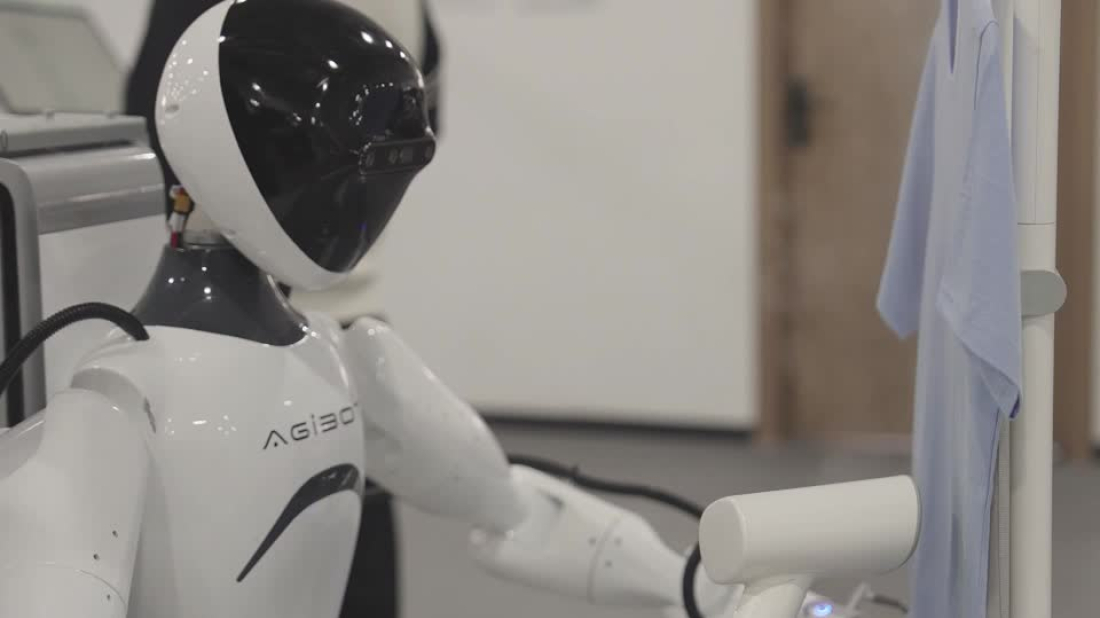
In a warehouse in Shanghai, approximately one hundred humanoid robots are being manufactured to perform everyday tasks with the help of Artificial Intelligence.
On the outskirts of Shanghai, around one hundred humanoid robots are learning to make sandwiches, clean counters and arrange flowers for 17 hours a day. Their repetitive movements are part of a data-driven effort to advance Artificial Intelligence-powered automation.
The Chinese robotics firm 'Agibot' is developing what they've called Genie-1 robots, to be trained like a human and perform real-world tasks autonomously.
Company President Yao Maoqing believes the devices could eventually be in our homes.
So far, more than a thousand humanoid robots have been produced and the company has delivered 700 of them to customers, mainly in China. Some of the models have gone to auto showrooms to interact with visitors.
The company potentially sees these robots performing complex tasks and maybe assembling themselves in Agibot's factories.

One person was killed and nearly a dozen hurt in a fresh attack on Riyadh's international airport on Sunday, Saudi authorities reported, a day after a strike claimed by Yemen's Houthis killed 13 people and wounded more than 300.
Yemen's Houthis renewed warning to airlines, airport workers, and travellers against using Saudi airports, saying the warning should be taken seriously and that the kingdom “bore responsibility for failed interceptions”, a day after an attack on Riyadh's international airport that killed 12 people.
The Saudi-led coalition in Yemen said late Monday that it intercepted and destroyed two ballistic missiles launched by the Houthi group toward Khamis Mushait in southwestern Saudi Arabia.
The Houthi movement has escalated their attacks on Saudi Arabia, targeting the airport in Riyadh and other cities, killing more than a dozen people.
The Kremlin on Monday rejected a 60-day ceasefire idea proposed by Ukrainian President Volodymyr Zelenskyy to allow his country to hold presidential elections, saying it wanted an overall peace deal instead.
Small AI models could soon spread without human intervention across internet-connected devices, from smart appliances to Android TVs, Anthropic has warned, raising fears that self-replicating systems could become increasingly difficult to contain.
Here's your AnewZ Daily Brief for 13 October 2026 with the top five science and technology news happening around the world.
AnewZ’s recent reporting from Kazakhstan and the United Arab Emirates brings audiences closer to the technologies, and the decisions, shaping the future of artificial intelligence.
Anthropic has announced that it is updating its usage policy to allow its AI agents to end conversations involving repeated abuse or cruel behaviour towards them, citing previous incidents.
Türkiye has banned children under 15 from using social media under new regulations published on Saturday. The new regulations prohibit firms from providing services to children “who have not reached the age of 15.”
You can download the AnewZ application from Play Store and the App Store.
What is your opinion on this topic?
Leave the first comment