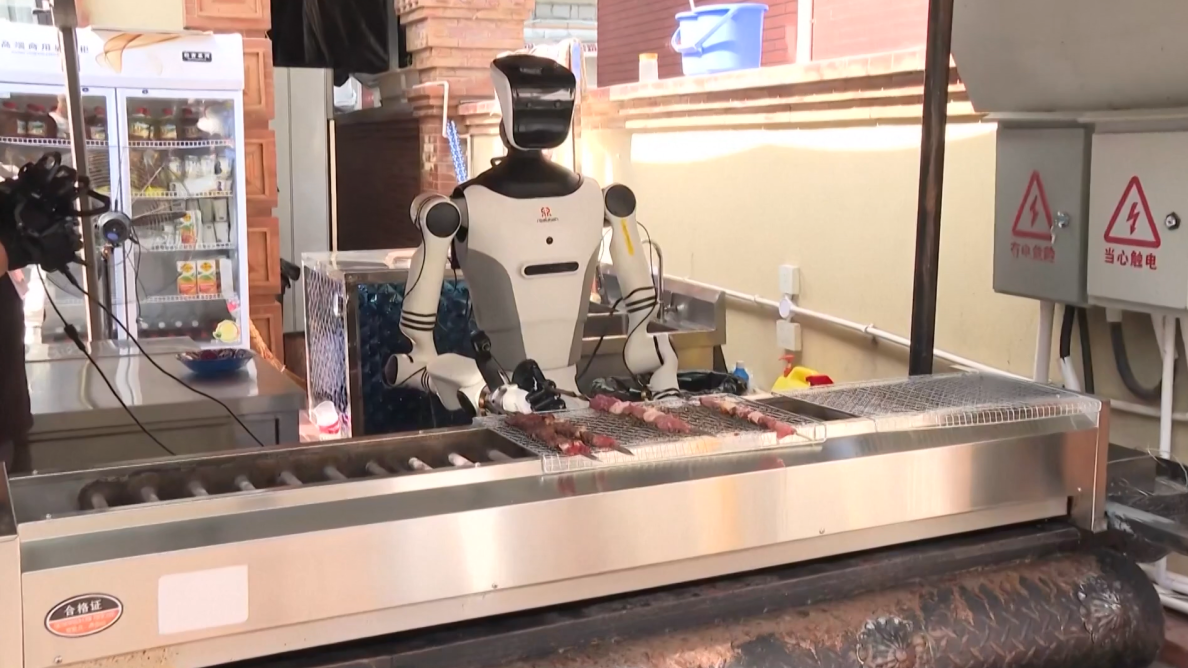
A humanoid robot demonstrated its ability to prepare regional dishes during a live cooking show in northwest China’s Xinjiang Uygur Autonomous Region, highlighting advances in embodied artificial intelligence (AI) and dexterous robotics.
The event took place on Wednesday at Liuxing Street in Yining City, a national-level tourism and leisure district known for its distinctive hexagonal street layout.
Visitors gathered at a local restaurant to watch the humanoid robot perform a series of cooking tasks involving local specialities.
The demonstration was designed to test the machine’s coordination, force control and ability to handle soft and irregular ingredients.
Robot grills kebabs and skewers meat
The robot began by grilling kebabs and placing pieces of meat onto skewers.
Both tasks require precise coordination of the fingers, wrists and arms. The robot also had to carefully regulate the amount of force used when handling the soft pieces of meat.
After less than a week of task-specific training, the machine was able to complete the basic operations, although its movements remained significantly less skilled than those of an experienced chef.
Hand-pulled noodles pose biggest challenge
The most difficult task involved preparing hand-pulled noodles, one of Xinjiang’s best-known dishes.
The soft and slippery dough required the robot to apply enough force to stretch it without tearing or dropping it.
Its dexterous hands were fitted with tactile sensors capable of detecting changes in pressure and movement during the process.
The system recorded force from different directions, allowing engineers to analyse each attempt and improve the robot’s performance through repeated training and data collection.
Developers collect real-world training data
Developers said every movement and tactile interaction generated useful data that could be used to refine the robot’s capabilities.
They believe challenging robots with real-world tasks will help accelerate their adaptation to a wider range of practical activities.
The technology could eventually support broader applications in industrial settings as well as everyday life.
Demonstration precedes robot games
The cooking show was held ahead of the second World Humanoid Robot Games.
The event is scheduled to take place in Beijing from 22 to 26 August.
Read more:






















What is your opinion on this topic?
Leave the first comment