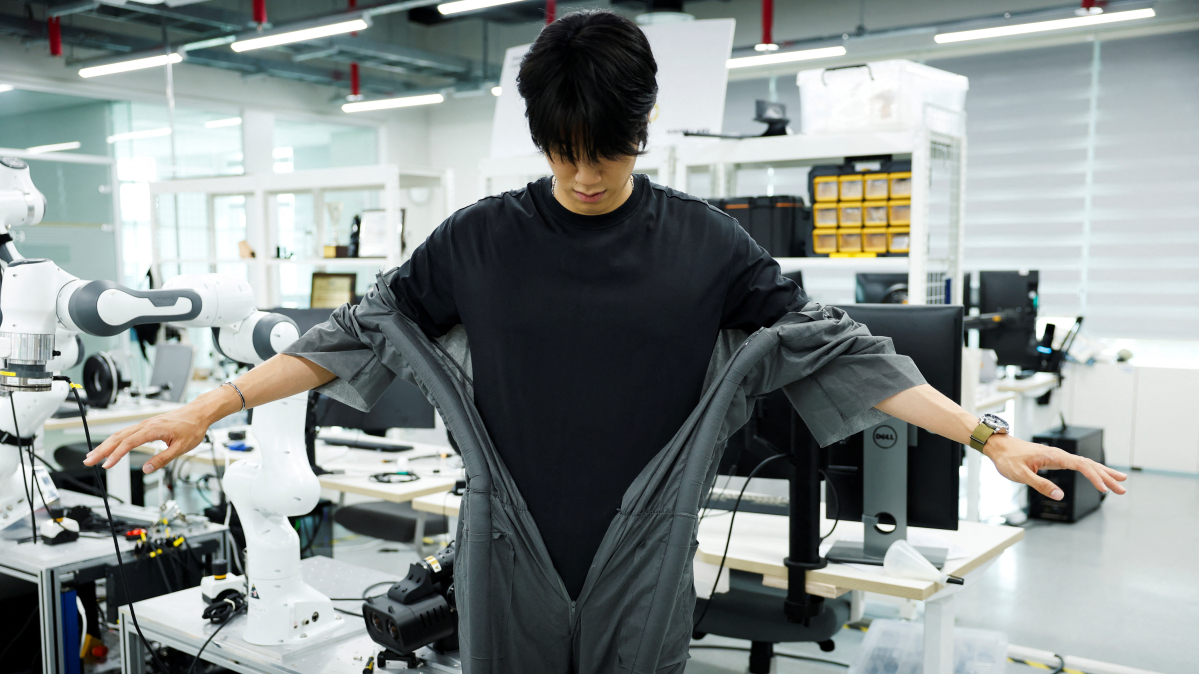
A team of South Korean and U.S. researchers has developed a robotic system that allows people to put on clothing without using their hands or needing help from someone else.
The technology, created by researchers at South Korea's KAIST and Stanford University, uses soft, flexible "vines" powered by air pressure.
Built into the clothing, the vines move the fabric around the wearer, gently pulling it into place in around 10 seconds.
The researchers believe the system could be useful in semiconductor cleanrooms, where workers need to dress quickly without contaminating protective clothing, as well as for emergency responders who must put on protective equipment in a hurry.
Inspired by a rainy bike ride
The idea came from an everyday problem.
"When I was riding a bicycle, it started to rain ... and I thought it would be helpful if a raincoat could be put on automatically (as I ride)," said Kim Nam Gyun, a KAIST postdoctoral researcher and lead author of the study.
"The vine robot stays close to the person and dresses them by turning the clothing inside out as it moves, allowing it to climb stably along the shape of the body," Kim said. He added that it takes about 10 seconds to put on a full suit.
Unlike many robotic systems, the wearer does not have to stand completely still. The technology also works without relying on a complex control algorithm, making it simpler and more adaptable.
Modelled on climbing ivy
The system is inspired by the way ivy climbs.
Rather than moving its entire body, the robotic vine grows forward from its tip. This helps it move smoothly around curved surfaces and stay close to the wearer.
"It can pass through narrow gaps, grow while adapting to the shape of its surrounding environment, and move regardless of whether the surface is slippery, sticky, or sloped," said Ryu Jee-Hwan, a professor of civil and environmental engineering at KAIST.
Helping people and supporting industry
The researchers say the technology could improve daily life for older people and those with disabilities by making it easier to get dressed independently.
They also see industrial uses, particularly in semiconductor manufacturing and emergency services, where workers often need to put on protective clothing quickly while keeping their hands free.
Ryu said the rapid growth of artificial intelligence has focused attention on software, but innovations in mechanical engineering remain just as important.
The research was published in the peer-reviewed journal IEEE Robotics and Automation Letters.
Read more:























What is your opinion on this topic?
Leave the first comment