The U.S. government has announced a major plan to use artificial intelligence (AI) to speed up scientific discoveries.
Eighty-one years ago, President Franklin D. Roosevelt asked scientist Vannevar Bush to rethink America’s scientific roadmap after World War II.
Bush’s response was a landmark 1945 report titled "Science: The Endless Frontier", which led to the creation of the National Science Foundation and fueled nearly a century (80 years) of American technological dominance.
Now, as the United States approaches its 250th anniversary, the White House Office of Science and Technology Policy (OSTP) has released a major modern sequel called "Science: A New Golden Age".
This report, delivered to President Donald Trump by OSTP Director Michael Kratsios, presents an ambitious blueprint to fix a major problem in modern research. The report states that while government spending on science has grown, actual scientific progress has slowed down.
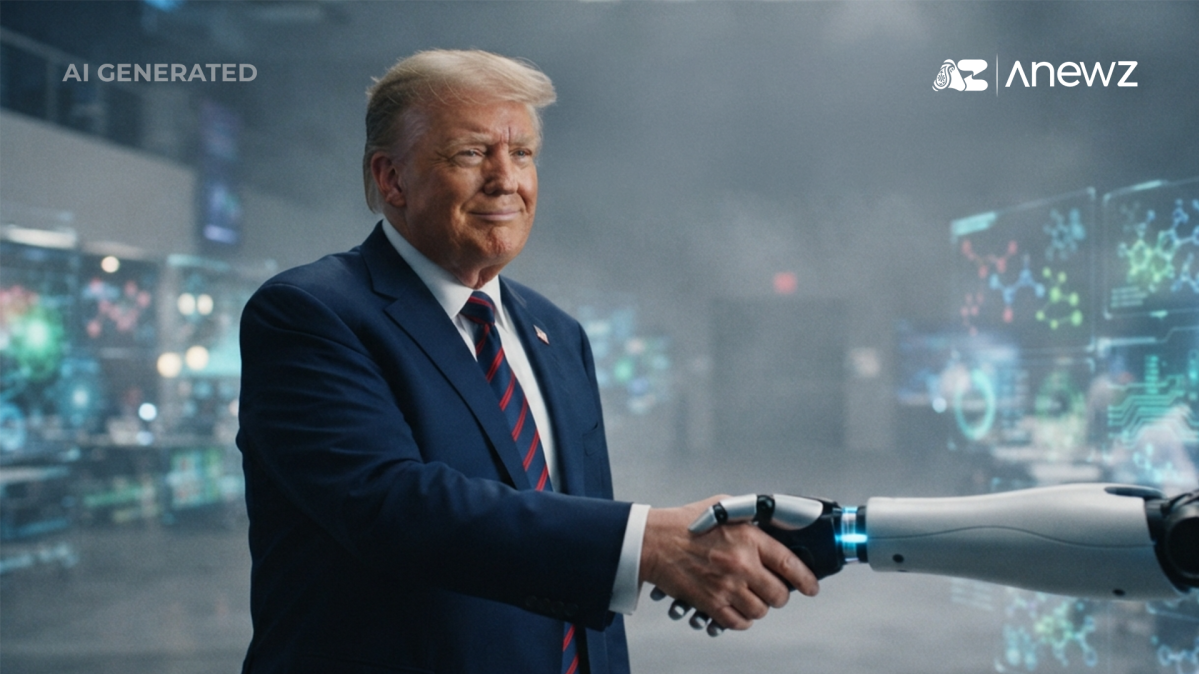
To solve this, the White House is betting big on artificial intelligence through its central project: The Genesis Mission.
What does the White House strategy do differently?
According to the official strategy outlined at the White House science website, the plan sets out four major shifts from how the U.S. has done science in the past:
- Support for people, not legacy institutions: Instead of routing money through slow-moving academic bureaucracies, federal agencies will fund visionary individual researchers, fast-moving "X-Labs" and new mission-driven teams.
- Flexible grant allocations: The government will break away from slow consensus peer review by introducing flexible fast-track grants, long-term funding and mechanisms for high-risk, radical ideas.
- Linking discovery directly to U.S. manufacturing: Instead of letting inventions get offshored, the government will build domestic industrial strength to make sure discoveries are manufactured right in America.
- Re-engineering science for the AI age: Laboratories, datasets, supercomputers, and workforce training are being overhauled so that AI can act as an engine for scientific discovery.
What exactly is the Genesis Mission?
The Genesis Mission is America’s flagship "AI for science" initiative. It connects national supercomputers, advanced AI models, scientific tools, and massive datasets across all U.S. national laboratories into one unified network. The goal is simply to double the productivity and speed of American science within 10 years.
Instead of spreading resources thin, the mission focuses on major "cross-cutting" problems, the kind of core scientific hurdles that, once solved, instantly unlock breakthroughs in medicine, clean energy, and advanced materials.
Why now?
The White House frames this as an urgent response to two problems:
- Scientific slowdown: Breakthroughs have gotten harder and slower, even though more money is being spent on research than ever before.
- Global competition: Foreign rivals, especially China, have closed the funding gap and are coordinating its scientific efforts aggressively.
Making sure the science is trustworthy
One major warning in the report states that AI is only as smart as the data you feed it. If an AI model learns from bad or flawed research, it will just produce bad science on a massive scale.
To stop that, the White House paired the Genesis Mission with "Gold Standard Science," a strict push for transparency, open data, and mandatory proof that experiments can be repeated.
The plan also calls for new AI toolkits designed to automatically check and re-run experiments to verify claims.
Robot labs and a scientific rethink
The report envisions automated, "closed-loop" laboratories. These are smart facilities where robots and AI run experiments around the clock with little human intervention, squeezing years of tedious lab work into weeks or days.
Beyond tech, the report calls for a cultural overhaul that will entail changing how scientific papers are published, how researchers share credit, and how funding flows to the biggest real-world problems.
The Genesis Mission is the centrepiece of a broader White House push for a "Golden Age" of American innovation. The goal is to do for 21st-century science what the Apollo moonshot did for space travel in the 1960s.
Whether that vision succeeds will depend on how well it survives the financial and political realities of Washington.
What’s changed since Vannevar Bush’s 1945 blueprint?
The new report openly compares itself to Vannevar Bush's 1945 report, but explains why the world has completely changed since World War II:
- Who pays for science: In the 1950s, the government funded almost everything. Today, private companies spend over $700 billion a year on research, which is more than triple what the government and universities spend combined.
- How discoveries happen: Bush assumed a straight line; basic theory leads to applied science, which leads to a product. Today, discovery is a back-and-forth loop; engineering problems often force us to discover new basic science.
- Where breakthroughs come from: Bush thought universities did all the thinking and factories did the building. Today, Nobel Prize-winning work comes out of corporate labs and multi-disciplinary teams.
- The speed of information: In 1950, scientists typed manuscripts and waited months for peer reviews by mail. Today, research is published online in hours and reviewed globally in real time.
- The role of AI: Bush’s era had no concept of Artificial Intelligence. Today, AI can compress years of lab work into days as long as the data is verified.
- Global rivalry: After WWII, America had no scientific rivals. Today, China’s Research & Development spending has surged to near the same amount as the U.S.
- How grants work: Bush’s model relied on university professors getting standard government grants. The new report calls for agile funding, quick-grant systems, and non-traditional organisations.
In short, Bush’s 1945 plan was designed for a slow, paper-based, human-only era of science. The White House argues it is time to rebuild American institutions for an age where machines generate discoveries faster than traditional bureaucracies can handle them.























What is your opinion on this topic?
Leave the first comment