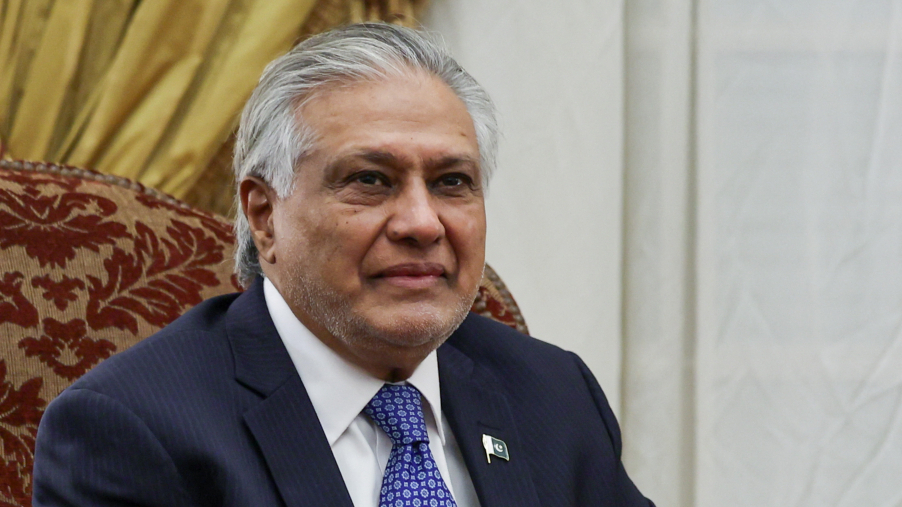
Pakistan is set to become a founding member of the China-led World Artificial Intelligence Cooperation Organisation (WAICO), with Deputy Prime Minister and Foreign Minister Ishaq Dar travelling to Shanghai on Thursday to sign the founding agreement during a two-day visit.
The move gives Islamabad a seat in a new international platform on artificial intelligence cooperation and governance, as countries increasingly seek to shape global rules for one of the world's fastest evolving technologies.
Dar will also attend the 2026 World Artificial Intelligence Conference (WAIC), hold bilateral talks with Chinese Foreign Minister Wang Yi and meet other foreign ministers and senior officials on the sidelines.
China proposed WAICO in 2025 to promote international cooperation on artificial intelligence. Pakistan endorsed the initiative during Prime Minister Shehbaz Sharif's visit to China in May.
According to the Foreign Office, Dar will present Pakistan's priorities for international AI cooperation, with particular emphasis on the development needs of the Global South. Pakistan will advocate equitable access to AI technologies, stronger capacity building and efforts to bridge the global AI divide.
Pakistan steps up domestic AI drive
Pakistan's international engagement comes as it accelerates efforts to build its domestic artificial intelligence ecosystem.
The government approved the National AI Policy in July 2025 to expand AI adoption and strengthen digital transformation. Earlier this year, Prime Minister Shehbaz Sharif announced $1 billion in government investment in artificial intelligence by 2030, alongside 1,000 fully funded PhD scholarships, AI curricula in federally administered schools, Pakistan Administered Jammu & Kashmir and Gilgit Baltistan, and a programme to train one million non-IT professionals in AI skills.
The government has also endorsed an implementation roadmap aimed at strengthening AI research, improving governance and expanding the use of artificial intelligence across sectors including healthcare, education, agriculture, manufacturing, energy and climate change.
AI ambitions face implementation challenges
Pakistan's founding membership reflects its ambition to play a larger role in global AI governance. However, the country remains at an early stage of AI adoption.
Despite new policies and investment commitments, Pakistan still lacks comprehensive data on AI adoption across its economy. Analysts and government officials have also identified fragmented public data systems, limited high-performance computing infrastructure, uneven digitisation and shortages of specialised AI talent as major obstacles to wider deployment.
Pakistan's participation in WAICO gives Islamabad an opportunity to contribute to international discussions on artificial intelligence. The longer challenge will be translating those policy commitments into domestic capability and building the infrastructure, skills and institutions needed to compete in the global AI economy.




















What is your opinion on this topic?
Leave the first comment