Zelenskyy's plane 'almost hit' by drone, Norwegian PM says
Ukrainian President Volodymyr Zelenskyy's aircraft was nearly struck by a drone while departing Moldova on ...
As competition over artificial intelligence intensifies, U.S. tech leaders are warning that China’s rapid state-backed progress could soon outpace the West, raising concerns that America is losing its technological edge.
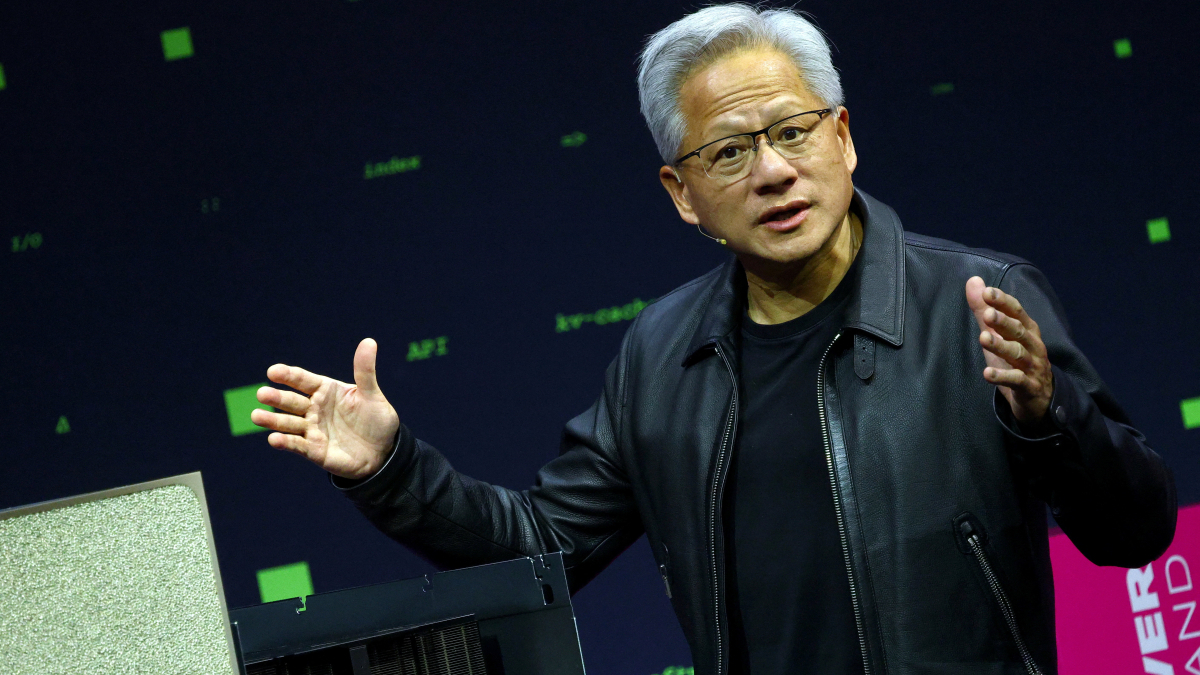
At a time when artificial intelligence is reshaping global power, Nvidia's chief executive has warned that the U.S. risks surrendering its lead to China. Speaking at the Financial Times' Future of AI Summit, Jensen Huang said the West is being held back by "cynicism" and regulatory overreach, while Beijing's state-backed push is fuelling rapid advances in AI development.
Huang cautioned that a growing patchwork of state-level rules in the U.S. could soon create "50 new regulations," splintering innovation and slowing progress. By contrast, he pointed to China's energy subsidies that make it cheaper for companies to power massive data centres and train AI systems, remarking that "power is free" for Chinese firms developing domestic alternatives to Nvidia's chips.
His remarks come as the Trump administration maintains its export ban on Nvidia's most advanced Blackwell chips to China, despite a recent meeting between U.S. President Donald Trump and Chinese leader Xi Jinping.
Huang has previously warned that China's AI systems are fast closing the gap with American models and that restricting chip exports may backfire by driving Beijing toward full technological self-sufficiency.
Following his meeting with Xi, Trump told CBS News that the U.S. would retain exclusive access to the most sophisticated chips, saying, "The most advanced, we will not let anybody have them other than the United States."
White House spokesperson Karoline Leavitt reinforced that stance on Tuesday, stating, "As for the most advanced chips, the Blackwell chip, that's not something we're interested in selling to China at this time."

Four people were killed, including a child, in Ukrainian strikes on the Russian port city of Novorossiysk overnight, according to the governor of the Krasnodar region. Ukraine's drone forces commander, Robert Brovdi, said Russian military ships were destroyed in the attacks.
A TV channel was struck during a live broadcast on Tuesday, Ukrainian President Volodymyr Zelenskyy said, as Russian strikes on Kyiv killed at least three people, the city's Mayor Vitali Klitschko said. Meanwhile, drones hit civilian infrastructure in Russia's southwestern Saratov region.
U.S. Central Command (CENTCOM) said its forces destroyed five Iranian crude oil carriers after the Islamic Revolutionary Guard Corps (IRGC) allegedly launched two ballistic missile attacks against a U.S. Navy warship over the past two days.
Wildfires have broken out in Türkiye’s Antalya province, forcing hundreds of people to evacuate as strong winds fuelled the flames.
Indonesia has reopened Jakarta's main airport and four others after volcanic ash from Mount Anak Krakatau forced widespread flight cancellations, though fresh eruptions have kept authorities on alert.
Nobel laureate Geoffrey Hinton has warned against rushing to develop artificial superintelligence, arguing that scientists still do not know how to ensure systems more capable than humans remain safe and under control.
The United States and China are preparing to hold their first official bilateral talks focused exclusively on artificial intelligence as concerns grow over the risks posed by increasingly capable AI systems.
AI may live in the cloud, but the infrastructure powering it is anything but virtual. As data centres consume ever more electricity and water, the race is on to find new ways to keep the machines running.
Hua Hong Semiconductor, China's second-largest contract chipmaker, is investing $2 billion to build a new fabrication plant in Wuxi, China as part of a push to expand capacity as domestic demand for AI-related chips outstrips what the industry can currently produce.
A humanoid robot developed by Chinese smartphone maker Honor has run 100 metres in 9.32 seconds, beating Usain Bolt's men's world record of 9.58 seconds, China's state broadcaster reported on Saturday.
You can download the AnewZ application from Play Store and the App Store.
What is your opinion on this topic?
Leave the first comment