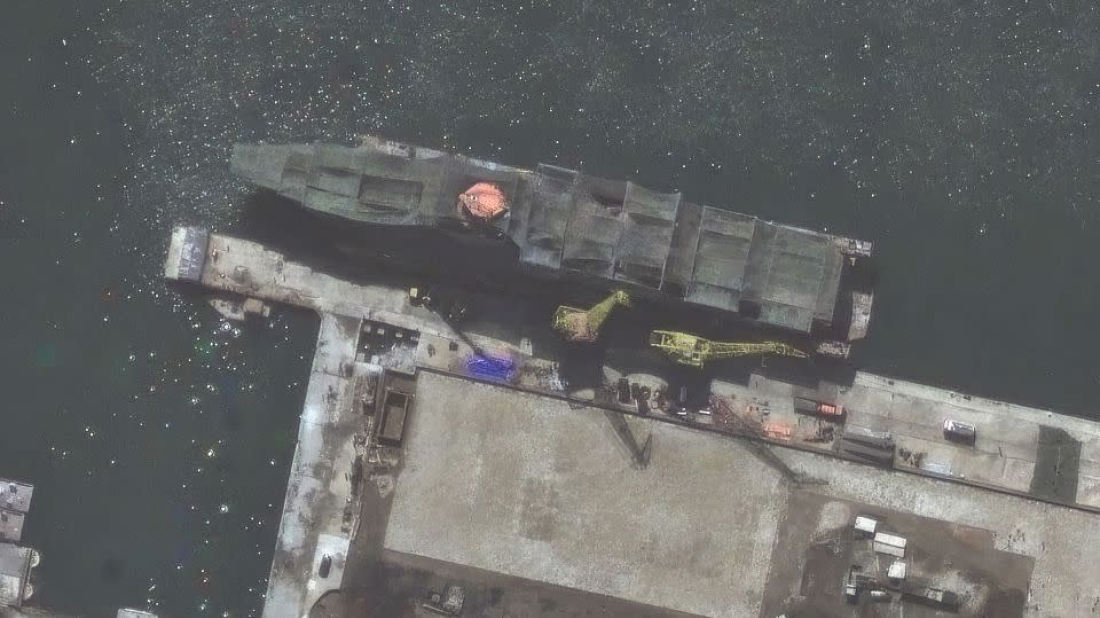
Satellite images have revealed that North Korea is constructing what could be its largest and most advanced warship to date, potentially more than double the size of any vessel previously built by the regime.
The warship is being constructed at the Nampo shipyard, located on the country’s west coast, approximately 60 kilometers southwest of the capital, Pyongyang.
The ship under construction is believed to be a guided-missile frigate (FFG), which will likely carry missiles in vertical launch tubes for both land and sea targets. At approximately 140 meters (459 feet) in length, it would be the largest warship ever manufactured by North Korea, according to analysis from Joseph Bermudez Jr. and Jennifer Jun at the Center for Strategic and International Studies.
While North Korea has been rapidly modernizing its military, including testing intercontinental ballistic missiles (ICBMs) capable of reaching the U.S., the construction of such a large warship represents a significant leap in its naval capabilities. This comes despite continued United Nations sanctions that limit the country’s access to materials and technology required for such advanced military projects.
The construction of the ship is seen as part of Kim Jong Un’s push to modernize the North Korean military, including developing more sophisticated weapons systems and larger surface combatants. North Korea’s current naval fleet is largely composed of older, smaller vessels, with only two principal surface combatants: the aging Najin-class frigates, which were built in the 1970s.
Despite North Korea’s relatively limited naval infrastructure, Kim Jong Un has expressed a desire for more advanced capabilities, including large surface warships and nuclear-powered submarines. Kim has also emphasized the construction of a new naval base to accommodate these larger vessels, which could give North Korea greater operational flexibility.
Analysts are cautious, however, about the ship’s eventual operational capabilities. While North Korea has made significant strides in the development of advanced weapons, including hypersonic missiles, there are doubts regarding the country’s ability to integrate the complex systems required for such a large warship. The challenges include integrating radar, communications, and weapons systems, which may take years of work to fully develop and deploy.
Despite these challenges, North Korea’s efforts to modernize its navy are clear. Satellite images show ongoing construction, but experts believe the ship may take at least another year before it is ready for sea trials. The regime’s ambition for a modern, capable naval force underscores its long-term military goals and its pursuit of greater regional power.
North Korea’s push to modernize its navy could also be influenced by its growing ties with Russia, with some analysts suggesting that Moscow may be providing technological support for the development of the new frigate’s missile systems. This development further complicates the security situation on the Korean Peninsula, as it signals North Korea’s intent to enhance its military capabilities amid continued tensions with both the United States and South Korea.



















What is your opinion on this topic?
Leave the first comment