U.S. President Donald Trump's temporary rollback of newly imposed tariffs has eased market volatility but left many global businesses grappling with ongoing uncertainty over trade policy and supply chain disruptions.
U.S. President Donald Trump's sudden about-face on sweeping import tariffs did little to soothe companies' worries about the fallout from his trade war and its chaotic implementation: soaring costs, falling orders and snarled supply chains.
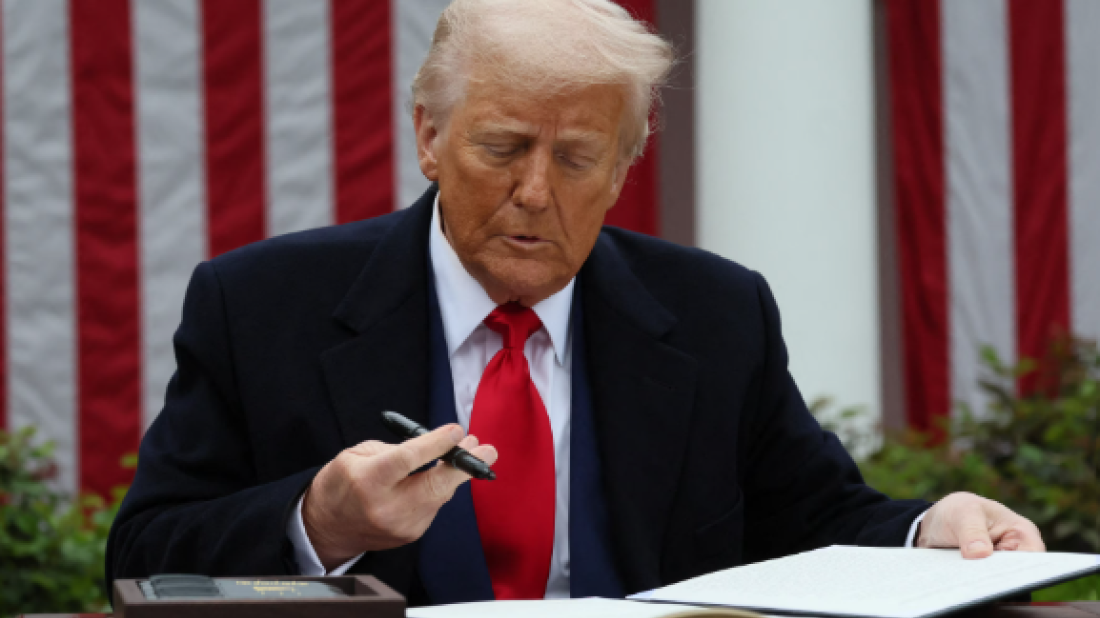
In a stunning reversal, the president said on Wednesday he would temporarily lower the hefty tariffs he had just imposed on dozens of countries, though he also hiked duties for China and kept 25% tariffs levied on aluminium, steel and autos in place.
The news sent global stocks soaring after an intense bout of volatility that wiped trillions of dollars off equity markets. Investors hope there will now be time for negotiations to avert a full-blown global trade war. MKTS/GLOB
On Thursday, the European Union said it would pause its first countermeasures on about 21 billion euros ($23 billion) of U.S. imports.
But for company executives, the latest reversal in Trump's tariff agenda has only added to confusion about its objective.
Companies with complex and diverse supply chains spanning multiple countries from China to Germany were already scrambling to work out how they would be affected by duties and grappling with possible price hikes to mitigate tariff risks.
Now they are questioning what happens after the 90-day pause.
Those tricky calculations come at a time when consumer confidence is waning and worries are growing about a global recession.
"Global trade flows are complex and the (...) conditions for cross-border trade are currently changing rapidly," German chemicals company BASF said on Thursday.
The company said the direct impact of U.S. tariffs would be limited due to its high proportion of local production, but added it was difficult to estimate the effects of a trade war on demand for its products and its customers.
Tech giant Apple AAPL.O has chartered cargo flights to ferry 600 tons of iPhones, or as many as 1.5 million, to the United States from India.
Analysts have warned that U.S. prices of iPhones could surge, given Apple's high reliance on imports from China, the main manufacturing hub of the devices, which is now subject to Trump's highest tariff rate - an eye-watering 125%.
CONSIDERABLE UNCERTAINTY
"A 90-day pause on tariffs, while framed as a temporary relief, creates considerable uncertainty for businesses," said Anita Wright, chartered financial planner at Bolton James.
Trump says he wants to bring back manufacturing to the United States, but the constantly changing policy makes it risky to invest for the long term.
"Companies are likely to remain hesitant to make spending or hiring commitments without clarity on long-term trade policy," Wright said.
Some companies, including General Motors GM.N Porsche P911_p.DE and Mercedes-Benz MBGn.DE, have built up inventory in the U.S. to get ahead of tariffs.
But the uncertainty is dimming the outlook for later this year, trade executives said. Weaker U.S. consumer confidence is already hurting spending on items like sneakers.
According to a weekly sales survey by industry association Footwear Distributors and Retailers of America, in the eleven weeks since Trump's inauguration, shoe sales in stores are down by 9.5% from the same period last year. Their members include Nike NKE.N, Adidas ADSGn.DE, Skechers, and Walmart WMT.N.
A spokesperson for Inter IKEA, which makes IKEA products and supplies them to franchisees around the world, said tariffs make it more difficult to keep prices of home furnishings affordable.
"It's too early to say what level the tariffs will affect the prices of our products, but we are closely monitoring the situation and will continue to evaluate how it evolves," they said.
The outlook for earnings season, which kicks off in earnest next week with LVMH LVMH.PA, ASML ASML.AS and L'Oreal OREP.PA, is increasingly gloomy.
Volkswagen VOWG_p.DEwarned late on Wednesday that first-quarter profits were much weaker than expected and included a charge for the cars it's sending to the United States.
Trump's temporary cuts offer little relief to auto, steel and aluminium companies still incurring 25% U.S. tariffs.
Serbia's Testeral, which makes aluminium and PVC products for the construction industry, may have to lay off staff if tariffs remain in place, CEO Sanja Stanimirovic told Reuters.
The company cannot easily raise prices to cover the additional cost because it is locked into long-term contracts, she said. The company employs about 120 full-time staff and 80 seasonal or part-time workers.
"This (the tariffs) poses a significant risk to our company at present," she said.
($1 = 0.9007 euros)












What is your opinion on this topic?
Leave the first comment