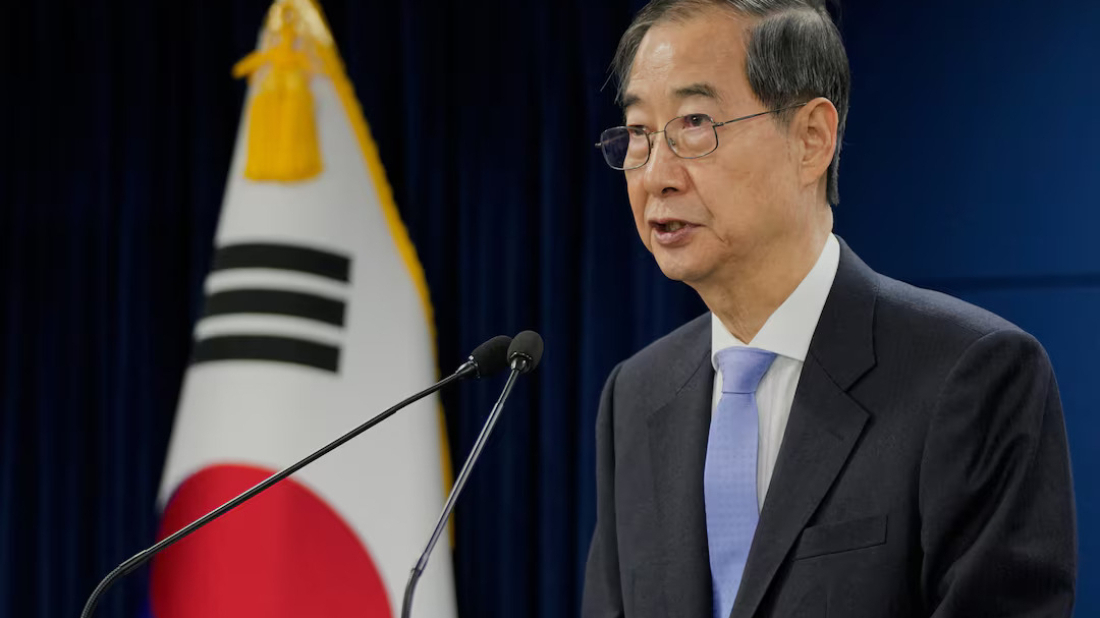
South Korea’s Constitutional Court reinstated Prime Minister Han Duck-soo to the position of acting president on Monday, overturning his impeachment.
Han, who had been suspended from his role following a clash with the opposition-led parliament, returned to office as the country faces significant political turmoil and economic challenges.
In televised remarks, Han, 75, thanked the court for its "wise decision" and praised the cabinet for its efforts during his suspension. He expressed his commitment to steering South Korea through a challenging "trade war" with the United States, particularly concerning tariffs imposed by U.S. President Donald Trump. "As acting president, I will do my best to maintain stable state administration and safeguard national interests in the trade war," Han said.
South Korea, one of the world’s leading exporters, has been grappling with the impact of U.S. tariffs on steel and aluminum. The country is also seeking an exemption from further U.S. tariffs expected next month. Trump recently criticized South Korea for its high tariffs on U.S. exports, adding pressure to the already strained relations.
Han’s reinstatement comes after a dramatic political crisis triggered by President Yoon Suk Yeol’s declaration of martial law in December 2024. This move plunged the nation into its worst political upheaval in decades, leading to widespread protests, impeachments, and criminal charges against top officials. Han had initially served as acting president for less than two weeks before his impeachment, which was sparked by his refusal to appoint three new justices to the Constitutional Court.
The court’s ruling, which struck down the impeachment with a seven-to-one decision, concluded that Han had not violated the constitution or the law concerning martial law. The decision comes as the court continues to deliberate on Yoon’s impeachment, with a ruling expected soon. If Yoon is removed, a new presidential election will be held within 60 days.
The ongoing political crisis has deepened divisions within South Korea, with opposition leaders warning that continued delays in the judicial process could escalate tensions. Lee Jae-myung, leader of the opposition Democratic Party, urged the court to swiftly resolve the issue, warning that the country’s political conflict could spiral into a more serious and dangerous situation.
As the country grapples with these challenges, Han Duck-soo’s leadership is seen as crucial to maintaining stability during a critical period in South Korea’s history.












What is your opinion on this topic?
Leave the first comment