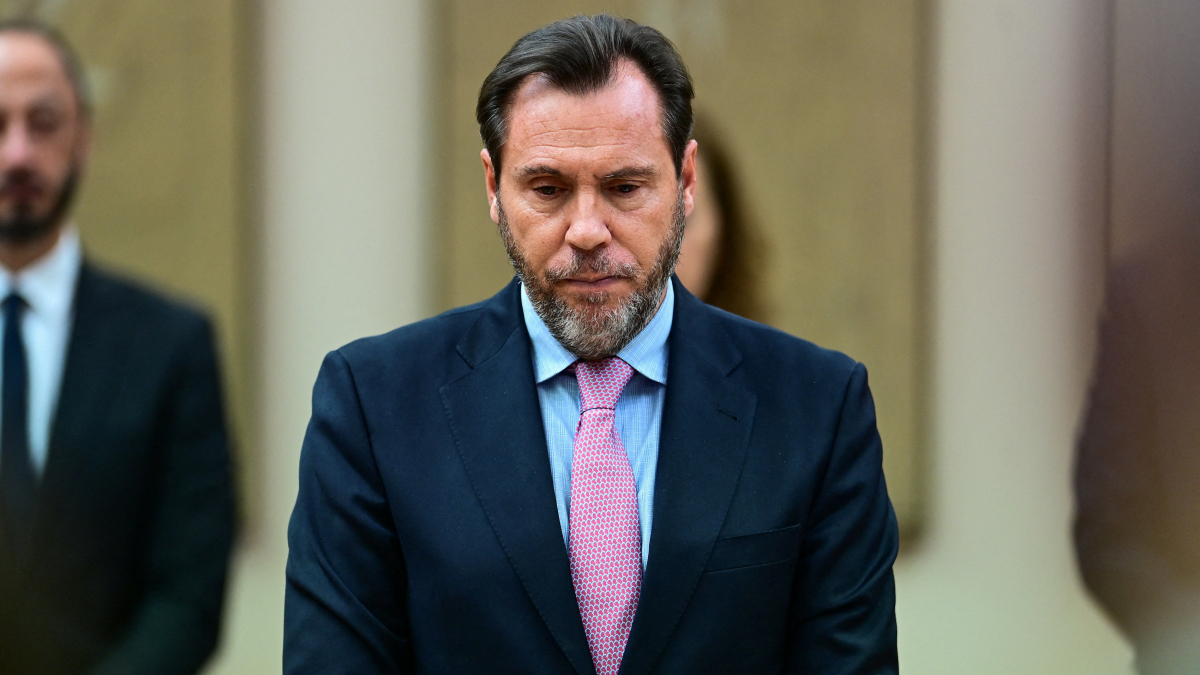
Spain's Transport Minister Óscar Puente has resigned six days after a deadly high-speed train collision that killed at least 69 people, amid mounting political pressure and growing concerns over the country's railway safety.
Puente announced his resignation on Tuesday (3 November) following a lengthy parliamentary session in which he outlined new railway safety measures and faced questions from opposition lawmakers.
“A transport minister in a country like Spain cannot remain in office after two accidents of this seriousness in less than a year,” he said, referring to a separate crash in January that killed 46 people.
He also confirmed that he would withdraw from the candidate lists for Spain's early general election, scheduled for 29 November.
The conservative People's Party (PP) and far-right Vox had called for Puente's resignation, alongside some of the government's political allies.
Opposition parties argued that the minister should accept responsibility for the railway system's safety failures. They also criticised his initial suggestion that human error may have contributed to the collision.
Prime Minister Pedro Sánchez acknowledged that public confidence in Spain's railway system had been damaged.
Puente, who had previously insisted he would remain in office, said his decision to resign was motivated by “political dignity”.
Sánchez praised the outgoing minister for addressing the crisis and stepping aside out of respect for the victims.
The collision involved a train operated by state-owned Renfe, carrying 397 passengers, and a stationary train operated by private company Iryo, with 147 people on board.
Reports suggest that a failure in the automatic signalling system had forced trains to stop along the affected section of track.
Audio recordings published by Spanish media appear to show that the Renfe driver was instructed to continue at normal speed despite another train remaining stationary approximately 25 kilometres ahead.
In one recording, a control centre operator told the Renfe driver to proceed using a backup signalling system. The driver sought confirmation before continuing.
Meanwhile, the Iryo driver repeatedly informed controllers that the train could not move because of technical difficulties.
The recordings suggest that controllers had been notified of the stationary train before the collision, although the precise circumstances remain under investigation.
Elections approach amid rail safety concerns
The incident and Puente's resignation come weeks before Spain's early general election on 29 November.
The opposition has intensified its criticism of Sánchez's Socialist-led government, making railway safety a major political issue ahead of the vote.
The government now faces pressure to explain the circumstances surrounding the crash, strengthen safety procedures and restore public confidence in the country's high-speed rail network.
For many Spaniards, the central question remains whether the changes promised by the authorities will prevent another tragedy.
Read more of the latest news:









What is your opinion on this topic?
Leave the first comment