ADIPEC 2026, the world's largest energy event, opened in the UAE capital on Monday, bringing governments and energy companies together at a time of heavy pressure on global supply.
Against the backdrop of a Middle East war and the choking off of the Strait of Hormuz that have disrupted global oil and gas supply, energy security and investment are the main subjects of the four-day event.
At the opening of ADIPEC 2026 on Monday, Dr. Sultan Al Jaber, CEO of the Abu Dhabi National Oil Company (ADNOC), said the world has used up its energy safety margins and global energy security has to be rebuilt. He said disruption in the Strait of Hormuz is draining oil inventories and pushing shipping costs sharply higher.
Al Jaber added that nearly one billion barrels of crude have been drawn from global inventories since the disruption began. Diesel stocks in some markets have dropped to their lowest seasonal level in 35 years, and some markets face a liquefied natural gas supply gap of 600 billion cubic feet.
“Simply put, the world has eroded its supply buffers,” he said.
He said delivery now matters as much as production. Before the disruption, logistics accounted for less than five per cent of the cost of a barrel of oil. Today the figure is more than 30 per cent.
Five priorities from the UAE
In his opening speech, Al Jaber set out five priorities for the industry.
First is having larger strategic oil reserves, bigger fuel stockpiles and refining capacity built closer to customers. The second is more investment in transport and logistics, so that oil and gas can reach markets even during a disruption. The third is the use of artificial intelligence to predict risks, improve operations and lower production costs. The fourth is policy that encourages investment, with banks and insurers taking a bigger part in keeping trade moving.
The fifth, which he said was the most important priority, is the workforce.
“Systems don’t carry responsibility, people do,” he said.
ADNOC, OpenAI and G42
Earlier on Monday, ADNOC announced a multi-year partnership with OpenAI and the Abu Dhabi technology group G42. ADNOC will be the first energy company to deploy OpenAI Frontier, which connects AI agents across its business and runs on G42’s UAE-based infrastructure. The company says the technology will be used in oilfield development, well management and commercial operations. It will help assess the value of oil before extraction, and cut development planning from months to hours.
The chief executive of OpenAI, Sam Altman, also spoke at the opening ceremony.
“Now AI can benefit energy,” he said, arguing that more capable models can help energy companies work on new materials, turbine designs and operations. Asked to name the biggest challenge he faces today, he gave a one-word answer: energy. He also said people must stay in control of how the technology is used.
The ADIPEC exhibition
ADIPEC runs until 5 November at the ADNEC Centre Abu Dhabi. It is held under the patronage of UAE President Sheikh Mohamed bin Zayed Al Nahyan and hosted by ADNOC. Organisers expect more than 239,000 attendees from over 170 countries. A record 2,260 companies are exhibiting and all 16 halls are sold out. More than 40 ministers are attending, and 1,800 speakers will take part in 13 conference programmes and over 380 sessions.
BP, Shell, TotalEnergies, Eni, ExxonMobil, Chevron and Occidental Petroleum are among the oil and gas companies exhibiting, along with Siemens, IBM and Microsoft. Halliburton is showing AI-powered drilling and production tools, and its chairman and chief executive, Jeff Miller, is due to speak on Tuesday about handling volatility while keeping profits up. GE Vernova is presenting gas turbines, grid modernisation and carbon management technology. Emerson, Schneider Electric, SLB, Aveva and Honeywell are showing automation and digital systems.
Research published before the event found that 76 per cent of surveyed Middle East energy leaders had raised investment in autonomous technology over the past year. A study by ADNOC and Microsoft found that 89 per cent had increased spending on AI, and 81 per cent of executives expect AI-related electricity demand to exceed current forecasts.
On Monday, energy ministers from the UAE, Germany, Türkiye and Egypt are discussing energy security with Suhail Al Mazrouei, Katherina Reiche, Alparslan Bayraktar and Karim Badawi from the respective countries taking part.
Asia's presence at ADIPEC
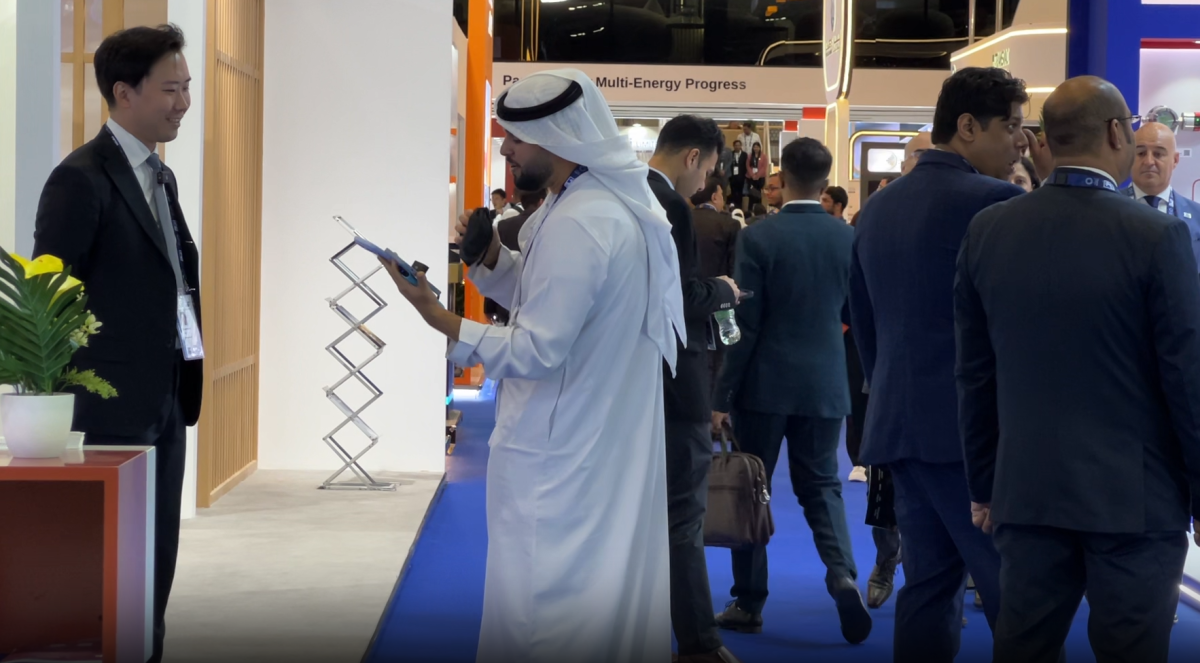
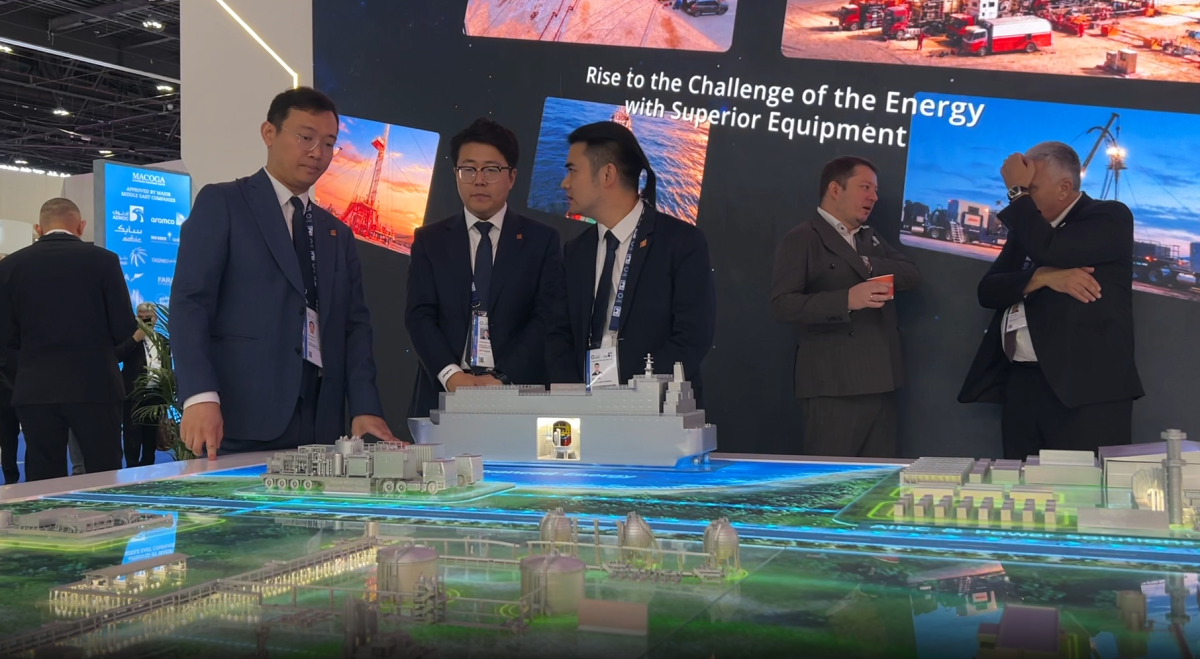
Asia has its largest presence yet, with 353 companies and six national pavilions from China, India, Japan, Malaysia, Singapore and South Korea. Exhibitors include Sinopec, CNPC, CNOOC, CATL, Petronas, INPEX and Mitsubishi Heavy Industries. Before the Iran war, nearly 90 per cent of the crude oil and condensate passing through the Strait of Hormuz was bound for Asia, according to the U.S. Energy Information Administration.
Azerbaijan and SOCAR
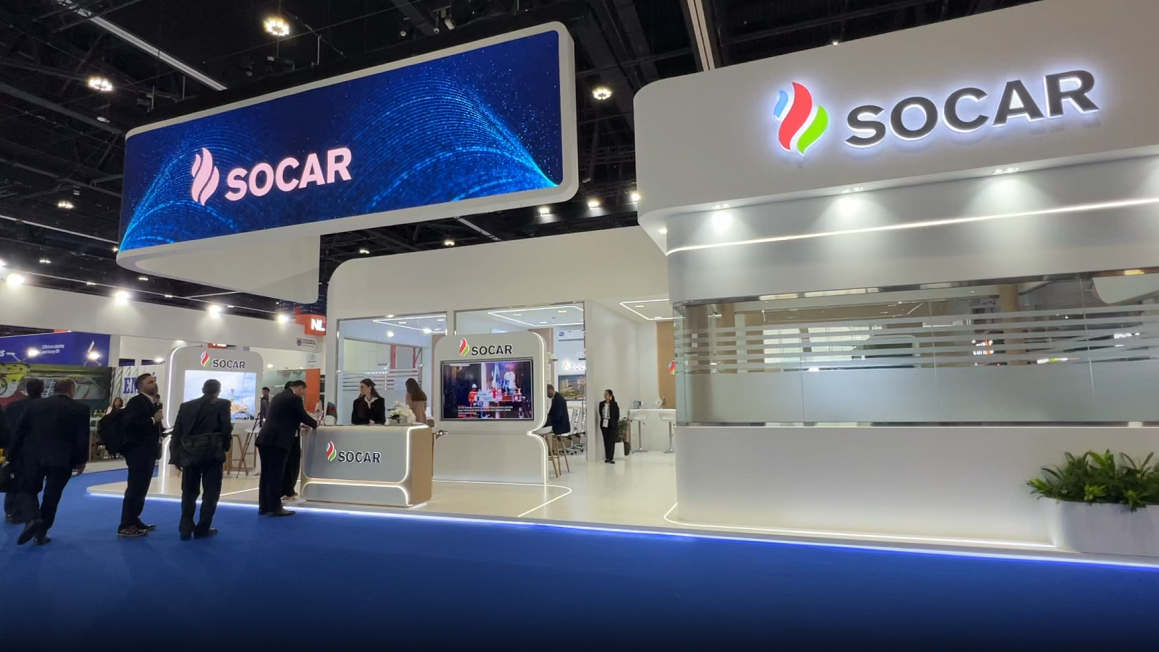
Azerbaijan is also represented in Abu Dhabi through its national oil company, SOCAR.
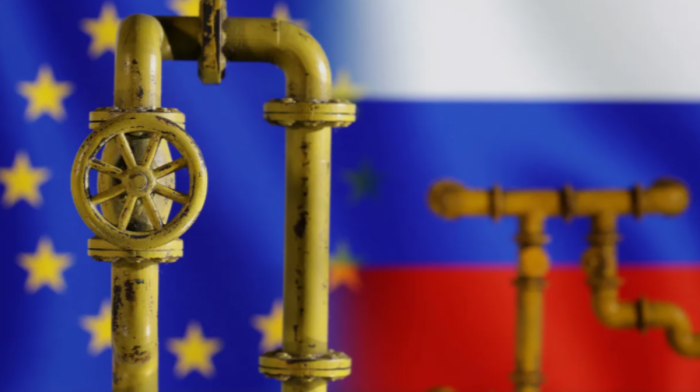
The country has become one of Europe’s main alternative gas suppliers, with Azerbaijani gas reaching the European Union through the Southern Gas Corridor since the Trans Adriatic Pipeline, its final link, began operating at the end of 2020. The pipeline delivers gas to Italy, Greece and Bulgaria and has carried more than 60 billion cubic metres to European customers so far. About 12 billion cubic metres reached the EU in 2025, according to the head of the corridor’s operator.
Most of the gas comes from the Shah Deniz field in the Caspian Sea, operated by BP, which holds about one trillion cubic metres. Azerbaijan’s proven gas reserves are put at around 2.6 trillion cubic metres, and it produced 51.5 billion cubic metres in 2025. Its oil comes mainly from the offshore Azeri-Chirag-Gunashli block. Baku has said it wants to raise annual gas exports to Europe to 20 billion cubic metres.
With sea routes through the Gulf under pressure, pipeline gas from the Caspian carries more weight in European supply planning. ADIPEC continues until Thursday, November 5.









What is your opinion on this topic?
Leave the first comment