Türkiye, Qatar, Pakistan and Indonesia have signed a new defence industry agreement in Doha, bringing existing military projects under a shared framework as Turkish defence exports reach record highs.
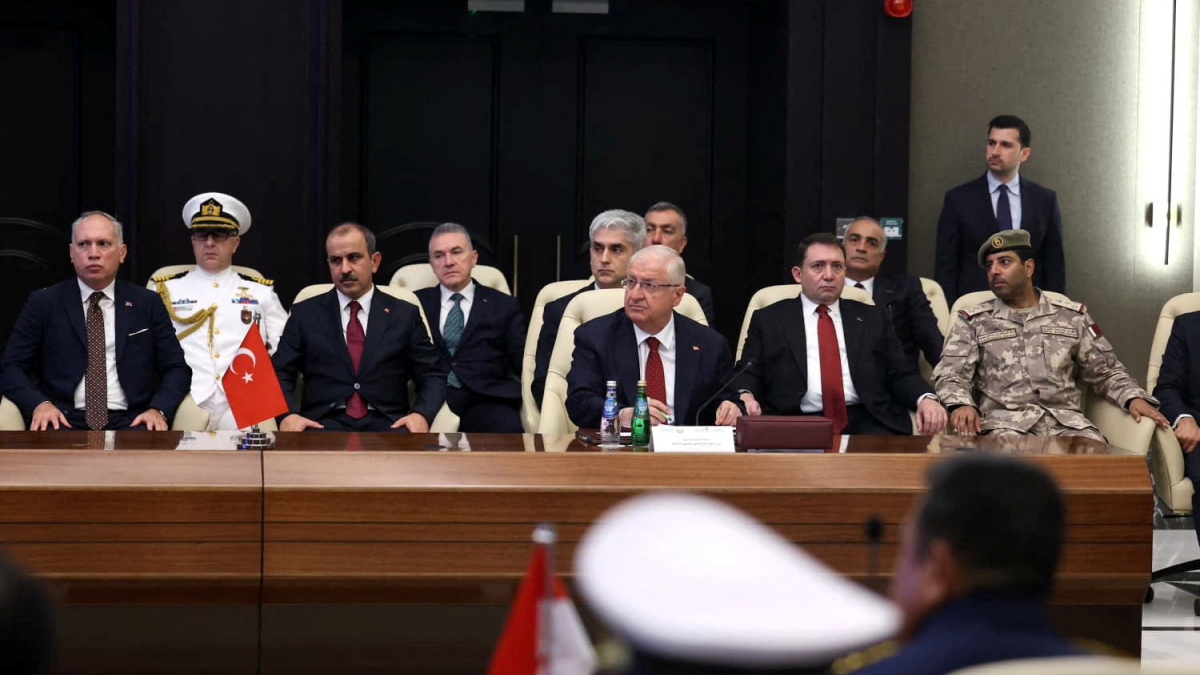
Türkiye, Qatar, Pakistan and Indonesia signed a memorandum of understanding on Wednesday aimed at expanding defence cooperation and strengthening military capabilities, according to Türkiye’s Ministry of National Defence.
The agreement, named “Badr”, meaning “full moon”, seeks to deepen cooperation between the four countries in defence production, technology and training.
Qatar’s Deputy Prime Minister and Minister of State for Defence Affairs, Sheikh Saud bin Abdulrahman bin Hassan Al Thani, signed the memorandum alongside Indonesia’s Deputy Defence Minister Yusuf Jauhari, Pakistan’s Defence Minister Khawaja Muhammad Asif and Türkiye’s Defence Minister Yaşar Güler.
Haluk Görgün, head of Türkiye’s Presidency of Defence Industries (SSB), also attended the ceremony.
What the agreement covers
According to Türkiye’s Ministry of National Defence, the agreement sets out plans for closer cooperation in military exercises, training, research and development, and defence manufacturing.
Key areas include joint research projects, the production of defence components, technical training and the exchange of engineering expertise. The four countries also plan to adapt jointly developed products to their individual requirements and market them internationally.
The ministry highlighted the agreement’s commercial potential, saying it would draw on each country’s manufacturing strengths to improve industrial integration, expand production capacity and meet the defence needs of allied and friendly nations.
Building on existing defence partnerships
The Badr memorandum brings together a series of established bilateral defence projects between Türkiye and its three partners, spanning drones, warships, armoured vehicles and fighter jets.
Türkiye has already supplied Qatar with Bayraktar TB2 armed drones, armoured vehicles and assault boats, all of which have entered service with the Qatari armed forces.
Barzan Holding, owned by Qatar’s Defence Ministry, has signed agreements with Turkish defence companies Aselsan, STM and MKE.
The two countries have also established joint manufacturing operations. BARQ, a company formed by Aselsan and Barzan in Qatar, has begun assembling, producing and calibrating remote-controlled weapon systems and electro-optical equipment.
On Monday, Sheikh Saud told the Global Security Forum in Doha that Qatar would soon announce a domestic defence production hub.
Defence cooperation with Pakistan centres on the PN MİLGEM (Babur-class) corvette programme, led by Turkish contractor ASFAT.
The project has produced four warships, with two built in Istanbul and two at Karachi Shipyard in Pakistan.
The partnership also involved modernising Karachi Shipyard’s production facilities and training its workforce in shipbuilding and outfitting, strengthening Pakistan’s domestic naval manufacturing capabilities.
Türkiye’s defence partnership with Indonesia covers both armoured vehicles and advanced combat aircraft.
The Kaplan MT medium tank was jointly developed by Turkish manufacturer FNSS and Indonesia’s PT Pindad under an intergovernmental agreement.
Prototypes and the first production units have been delivered, while manufacturing continues at PT Pindad under a technology transfer agreement.
The partnership also extends to Türkiye’s KAAN fighter jet programme. Indonesia signed a contract in July 2025 to purchase 48 aircraft, becoming the fighter’s first export customer.
Deliveries are planned over 10 years, with new production and maintenance facilities expected to be established in Indonesia. However, serial production of the KAAN is not expected to begin until 2028.
The wider defence package with Jakarta also includes the supply and joint production of Türkiye’s Atmaca anti-ship missile.
Turkish defence exports reach record highs
The agreement comes amid a surge in Türkiye’s defence exports, reflecting the country’s growing position in the global arms market.
According to the Defence and Aerospace Industry Exporters’ Association (SSI), Türkiye exported approximately $54 billion worth of defence and aerospace products between 2012 and the first nine months of 2026.
More than $30 billion of that total was recorded between 2023 and 2026, accounting for over 55 per cent of exports during the 14-year period.
Exports jumped 48 per cent in 2025, reaching a record of more than $10 billion. Sales over the latest 12-month period also exceeded $11 billion for the first time.
Figures from the Stockholm International Peace Research Institute (SIPRI) show that Türkiye increased its arms exports by 122 per cent over five years, becoming the world’s 11th-largest arms supplier.
Around 56 per cent of the country’s defence and aerospace exports go to NATO allies.
Defence cooperation amid regional tensions
The agreement comes as Türkiye, which has NATO’s second-largest military, expands its security partnerships across the Gulf amid the war involving Iran.
Ankara has been helping Gulf countries strengthen their defences, including Qatar, where Türkiye maintains a military base.
In August, Türkiye signed a mutual defence pact with Pakistan and Saudi Arabia, under which an attack on one country would be considered an attack on all.
The Badr memorandum, however, focuses on industrial cooperation rather than collective security.
According to the Turkish ministry, its provisions cover defence production, military training and research, with no mention of a mutual defence clause.
Read more:









What is your opinion on this topic?
Leave the first comment