Chinese Premier Li Qiang arrived in Tajikistan on Sunday for an official visit and a major regional summit, with security, trade and transport links high on the agenda as Beijing strengthens its ties with Central Asia.
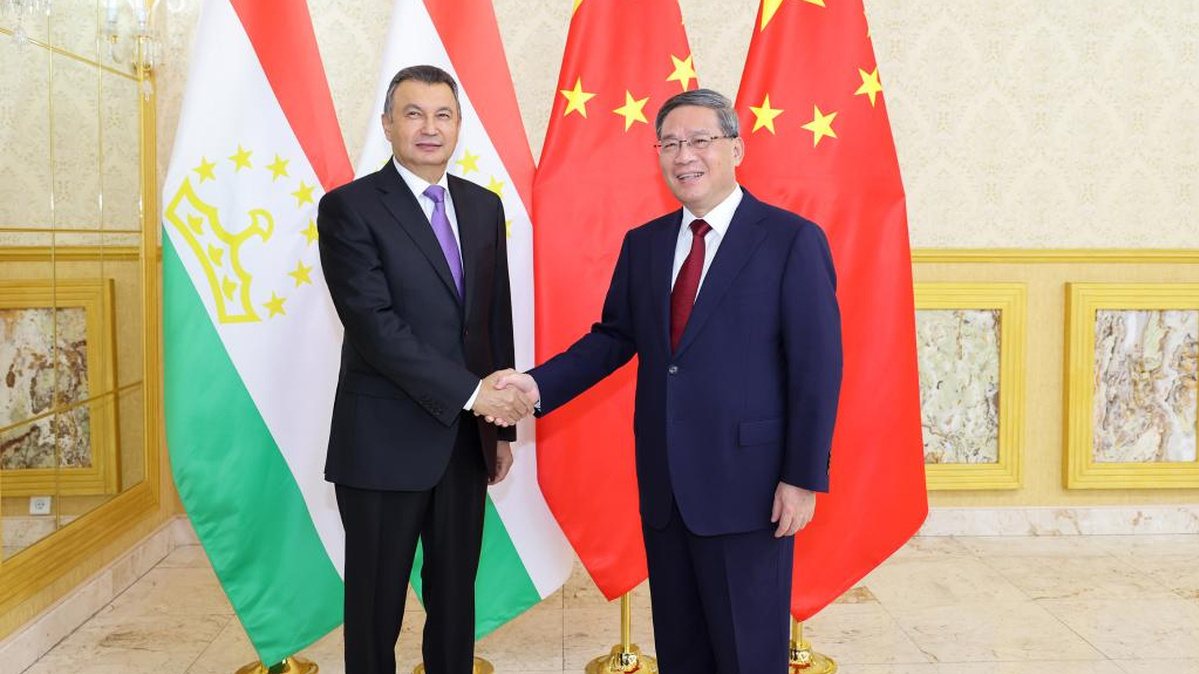
Li arrived in Dushanbe at the invitation of Tajik Prime Minister Kokhir Rasulzoda and was welcomed at the capital’s international airport by Rasulzoda and other senior officials, according to China’s State Council Information Office.
The visit follows Li’s trip to Uzbekistan and comes ahead of his scheduled visit to Russia, as Beijing steps up high-level diplomatic engagement across the region.
Regional security and cooperation in focus
Li is attending the 25th Meeting of the Council of Heads of Government of the Shanghai Cooperation Organisation (SCO), where leaders are discussing cooperation on trade, transport, energy and economic development.
Established in 2001, the SCO has expanded beyond its original focus on regional security to become a major platform for political and economic cooperation across Eurasia.
For China, which shares a border with Central Asia through its western Xinjiang region, the SCO is also a key forum for tackling cross-border security threats.
Tajikistan holds a strategic position along Central Asia’s mountainous southern frontier, bordering Afghanistan and sitting near potential trade routes connecting China with Central and South Asia.
Security remains a priority in Beijing’s relationship with Dushanbe. China has pushed for closer cooperation on counterterrorism, intelligence-sharing and law enforcement, amid concerns over instability along the Afghan border and previous attacks targeting Chinese nationals in Tajikistan.
On Monday, Li called for stronger security ties during talks with Tajik President Emomali Rahmon, according to Chinese state media.
China’s growing economic influence in Tajikistan
The visit also highlights the rapid expansion of economic ties between Beijing and Dushanbe.
China is Tajikistan’s largest investor and a major trading partner, backing projects in infrastructure, mining, manufacturing, agriculture and transport.
Chinese-funded highways, railway tunnels and industrial facilities have helped improve Tajikistan’s transport network and boost its industrial capacity.
Bilateral trade has surged over the past three decades, rising from less than $9 million in 1993 to approximately $1.96 billion in 2024, according to Tajikistan’s Foreign Ministry.
Chinese investment has become central to the country’s development ambitions, particularly in natural resources, industrialisation and regional transport corridors.
High-level visits strengthen bilateral ties
A series of diplomatic exchanges has further strengthened relations between the two countries.
During Chinese President Xi Jinping’s state visit to Tajikistan in July 2024, Beijing and Dushanbe upgraded their relationship to a comprehensive strategic cooperative partnership in the new era, paving the way for closer economic, political and security cooperation.
In May 2026, Rahmon visited China, where both countries signed further cooperation agreements and explored opportunities to expand investment and business ties.
The discussions highlighted Tajikistan’s efforts to attract foreign capital and develop transport and energy infrastructure, while opening up opportunities for Chinese companies in a country with significant hydropower potential and mineral resources.
For landlocked Tajikistan, closer economic ties with China offer opportunities to diversify trade routes, attract investment and gain better access to regional markets.
For Beijing, the partnership supports its broader ambition to expand economic links across Central Asia and develop transport corridors connecting western China with markets to the west and south.
SCO summit puts regional ambitions to the test
The SCO offers China and Tajikistan a wider platform to pursue these goals alongside other regional powers.
Member states have repeatedly called for greater economic integration, improved infrastructure and stronger cooperation on security, although differing national priorities and levels of development continue to present challenges.
Li’s visit runs until 20 October. After the Dushanbe meeting, he is scheduled to travel to Russia for the 31st regular meeting between Chinese and Russian heads of government.
The trip reflects Beijing’s efforts to deepen its influence across Central Asia while strengthening its wider diplomatic and economic partnerships across Eurasia.
As regional leaders meet in Dushanbe, a key question is whether the SCO can turn political commitments into tangible results on trade, infrastructure and security. For China and Tajikistan, the talks offer another opportunity to advance a partnership driven by shared security concerns and growing economic ties.










What is your opinion on this topic?
Leave the first comment