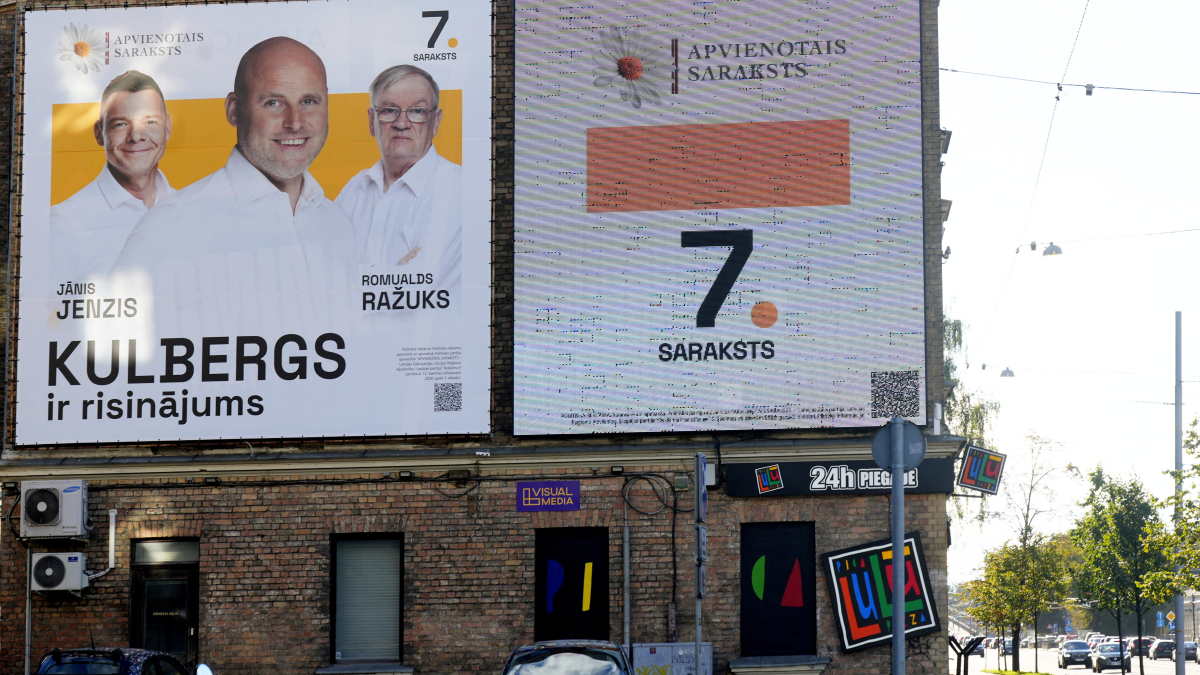
Latvian Prime Minister Andris Kulbergs’ centrist, pro-Ukraine United List party won Saturday’s parliamentary election by a wide margin, according to partial results, as security concerns linked to Russia’s war in Ukraine dominated the campaign.
With 88 per cent of ballots counted, United List had 36.6 per cent of the vote, well ahead of the populist Latvia First on 13.4 per cent. The pro-Russian Sovereign Power party was third on 11.6 per cent, followed by the nationalist National Alliance on 9.1 per cent.
Despite the strong result, Kulbergs will need coalition partners to form a government. He said he hoped to remain prime minister but did not want to govern with Latvia First.
Security dominates campaign
Security was a major concern for voters in the Baltic state, which borders Russia and Belarus and is a member of both NATO and the European Union.
Kulbergs, a 47-year-old businessman and amateur rally driver, became prime minister in May after the previous coalition collapsed over its handling of incidents involving military drones that entered Latvian airspace undetected. Officials have blamed Russia for causing Ukrainian drones to divert from their intended flight paths.
During his campaign, Kulbergs promised to strengthen Latvia’s anti-drone capabilities and maintain defence spending at 5 per cent of gross domestic product, among the highest levels in NATO.
Many voters also highlighted security as a priority. Megija Nordena, a 21-year-old student from Riga, said security came first, followed by support for students, the economy and pensioners.
Ukraine divides political debate
Kulbergs’ United List campaigned on continued support for Ukraine, while his pro-Kremlin rivals called for Latvia to stop providing aid and focus more heavily on domestic cost-of-living concerns.
Sovereign Power leader Julia Stepanenko said her voters wanted an end to the war and opposed financing Ukraine’s military effort, while also saying Ukraine should ultimately achieve victory through peace talks.
Latvia’s sizeable ethnic Russian minority is divided over the war and domestic policies concerning the Russian-speaking population. Some oppose Moscow’s invasion, while others say Latvia’s policies toward the Russian-speaking community are discriminatory.
The election comes as Baltic states continue to warn about what they describe as Russian sabotage, cyberattacks and other hybrid activities across Europe. Western officials have rejected concerns that Russia is preparing for a direct attack on NATO, while Moscow dismisses such warnings as anti-Russian hysteria.
With a population of around 1.9 million, Latvia lies between the Baltic Sea and Russia and Belarus, with fellow NATO and EU members Estonia and Lithuania on its northern and southern borders.
Read more:












What is your opinion on this topic?
Leave the first comment